Skip to content
Epomedicine

Mnemonics, Simplified Concepts & Thoughts

Epomedicine

Mnemonics, Simplified Concepts & Thoughts

gbs pathophysiology

Guillain Barre Syndrome (GBS) – Mnemonic

Epomedicine, Apr 16, 2017Apr 16, 2017

ASBURY CRITERIA FOR GUILLAIN BARRE SYNDROME (GBS)

Required Criteria

Mnemonic: AIDP

1. Areflexia

2. Include in differential and rule out other causes

3. Duration < 4 weeks

4. Progressive weakness of 2 or more limbs due to neuropathy

Supportive criteria

Mnemonic: AIDPS

1. Afebrile

2. Involvement:

  • Mild sensory involvement
  • Facial or other cranial nerve involvement

3. Demyelinating electrophysiologic evidence

4. Protein in CSF (100-1000 mg/dl) + Low WBC (Albumino-cytologic dissociation)

5. Symmetrical distribution relatively

Why protein is increased in CSF in GBS?

Intense inflammation at the junction of the dorsal and ventral roots leads to breakdown in the blood-brain barrier and the transudation of plasma proteins into the cerebrospinal fluid (CSF).

Management of GBS

Mnemonic: AIDP

1. Supportive:

  • Analgesia: e.g. NSAIDs
  • Airway: may need ventilation in ITU
  • Autonomic: may need a urinary catheter
  • Antithrombotic: TED stockings, LMWH

2. IVIG 0.4 g/kg/day for 5 days

3. Dexamethasone (corticosteroid): No significant role

4. Plasma exchange (Plasmapheresis): Alternative to IVIG; 5 times during 2 weeks

At about 6 weeks after treatment with IVIG, 5-10% deteriorate after initial stabilization or improvement due to wearing off of therapeutic effect of IVIG in patients in whom immune response is prolonged.

3% m
ay progress to CIDP.

Variants of GBS

AIDP (Acute inflammatory demyelinating polyradiculoneuropathy): commonest; antecedent viral or bacterial infection

AMAN (Acute motor axonal neuropathy): pure motor form; 60% are seropositive for campylobacter; pediatric

AMSAN (Acute motor sensory axonal neuropathy): adults

Miller Fisher syndrome: Ophthalmoplegia + Ataxia + Areflexia

Acute panautonomic neuropathy: rarest
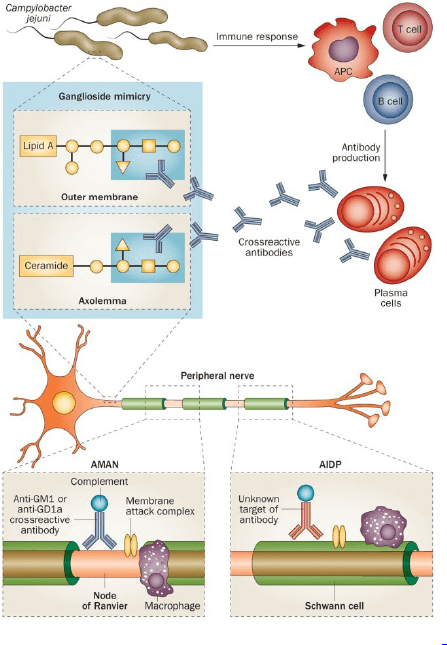
gbs pathophysiology

Pathogenesis of GBS

Molecular mimicry and cross-reactivity: Lipo-oligosaccharide (LOS) of C.jejuni mimic carbohydrate of ganglioside, i.e. anti-ganglioside antibodies.
7 shares
  • Facebook
  • Twitter
PGMEE, MRCS, USMLE, MBBS, MD/MS Internal medicineNervous systemPediatrics

Post navigation

Previous post
Next post

Related Posts

PGMEE, MRCS, USMLE, MBBS, MD/MS

Paget’s Disease of bone : Mnemonic

Jul 20, 2022Jul 20, 2022

Synonyms: Osteitis deformans Collage of matrix madness Mnemonic: Sixteen “P”s 1. Paramyxovirus infection and inclusions in osteocalsts 2. Pain (most common symptom – localized fractures or nerve compressions) 3. Pelvis (most common site) 4. Polyostotic (more common; 85%) 5. Phases: Active (lytic, mixed, sclerotic) and Inactive 6. Plasma volume expansion…

Read More
PGMEE, MRCS, USMLE, MBBS, MD/MS Febrile seizure anticonvulsants

Febrile Seizure : Clinical approach

Sep 11, 2015Sep 11, 2015

A) General consideration: Febrile seizures are seizures during fever occuring between 6 months and 5 years of age in absence of: CNS infections Abnormal neurologic findings Types of febrile seizure: Simple febrile seizure: Solitary Brief (< 15 minutes) Within 24 hours of onset of fever Generalized Tonic Clonic Seizure (GTCS)…

Read More
PGMEE, MRCS, USMLE, MBBS, MD/MS fetal skull transverse

Fetal Skull Dimensions : Mnemonic

Jul 27, 2018

Anteroposterior Diameters Mnemonic: Larger the alphabets, larger the diameter (V>F>B) Diameters with “sub” prefix are smaller than counterpart without it. mento-Vertical: 14 cm SUB-mento-Vertical: 11.5 cm occipito-Frontal: 11.5 cm SUB-occipito-Frontal: 10.5 cm sub-occipito-Bregmatic: 9.5 cm sub-mento-Bregmatic: 9.5 cm Transverse Diameters Mnemonic: MTP (Medical Termination of Pregnancy) in increasing order. bi-Mastoid:…

Read More

Comments (2)

  1. Dr. Raghavender says:
    Jul 21, 2017 at 6:07 am

    Very nice

    Reply
  2. Susmin Karki says:
    May 30, 2022 at 4:33 pm

    Difference between asbury and brighton criteria?

    Reply

Leave a Reply Cancel reply

Your email address will not be published. Required fields are marked *

This site uses Akismet to reduce spam. Learn how your comment data is processed.

Pre-clinical (Basic Sciences)

Anatomy

Biochemistry

Community medicine (PSM)

Embryology

Microbiology

Pathology

Pharmacology

Physiology

Clinical Sciences

Anesthesia

Dermatology

Emergency medicine

Forensic

Internal medicine

Gynecology & Obstetrics

Oncology

Ophthalmology

Orthopedics

Otorhinolaryngology (ENT)

Pediatrics

Psychiatry

Radiology

Surgery

RSS Ask Epomedicine

  • What to study for Clinical examination in Orthopedics?
  • What is the mechanism of AVNRT?

Epomedicine weekly

  • About Epomedicine
  • Contact Us
  • Author Guidelines
  • Submit Article
  • Editorial Board
  • USMLE
  • MRCS
  • Thesis
©2026 Epomedicine | WordPress Theme by SuperbThemes