Skip to content
Epomedicine

Mnemonics, Simplified Concepts & Thoughts

Epomedicine

Mnemonics, Simplified Concepts & Thoughts

severe malaria

Severe Malaria : Quick revision

Epomedicine, Apr 15, 2017

Criteria for Severe and Complicated Malaria

Positive peripheral blood smear for P.falciparum + ≥1 of the CHAPLINS (Mnemonic)

  1. Convulsions: >2 in 24 hour
  2. Cerebral edema (Consciousness impaired)
  3. Hypoglycemia (glucose <40 mg/dl)
  4. Hemorrhage (DIC)
  5. Hemoglobinuria (Black water fever)
  6. Anemia (hemoglobin <5 gm/dl or PCV <15% in children; hemoglobin <7 gm/dl or PCV <20% in adults)
  7. Pulmonary edema or ARDS
  8. Lactic acidosis (pH <7.25, lactate >5 mmol/l, bicarbonate <15 mmol/l)
  9. Infection (>5% erythrocytes infested)
  10. Icterus (Bilirubin >3 gm/dl)
  11. Necrosis i.e. ATN (Serum creatinine >3 mg/dl, oliguria)
  12. Shock (SBP <80 mmHg in adults; SBP <50 mmHg in children)
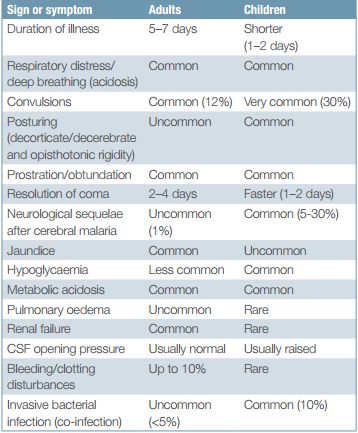
severe malaria

Where microscopy is unavailable or not feasible, Rapid Diagnostic Test (RDT) using HRP-2 must be used. Frequent monitoring of parasitemia (e.g. every 12 hour) is important during the first 2-3 days of treatment in order to monitor the parasite response during the treatment. RDTs for detecting HRP-2 cannot be used for this purpose because it can remain positive for upto 4 weeks after clearance of parasitemia.

Antimalaria Drugs for Severe Malaria

Antimalaria drugs should be given:

  1. Parenterally for minimum 24 hours (intramuscular injections must not be given in buttocks due to risk of sciatic nerve injury)
  2. Then, replaced by oral medications as soon as it is tolerable
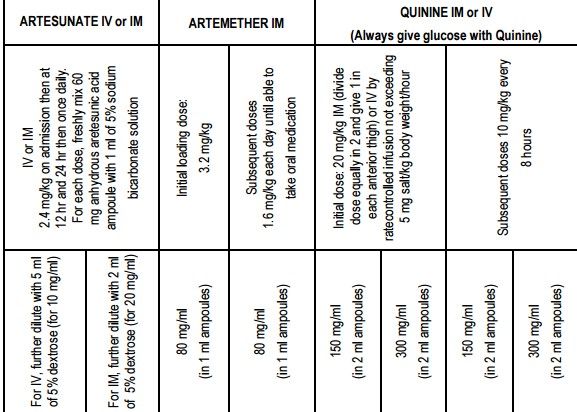
severe malaria treatment

Drug of choice: Artesunate IV or IM

Alternatives: Arthemeter IM, Quinine IV or IM

Besides, antimalarial drugs – patient must be treated side by side for seizure, hypoglycemia, hyperpyrexia, DIC, renal failure, acute pulmonary edema, etc.

Start broad-spectrum antibiotics along with antimalarials in following conditions:

  1. Meningitis cannot be ruled out in case of altered sensorium.
  2. Suspected bacterial co-infection: hypotension, pneumonia.

Reference: Management of Severe Malaria – A practical Handbook 3rd edition byWHO

27 shares
  • Facebook26
  • Twitter
Emergency Medicine Emergency medicineInternal medicinePediatrics

Post navigation

Previous post
Next post

Related Posts

Emergency Medicine septic shock hemodynamic changes

Septic Shock Fluid Resuscitation

Jun 16, 2016

Endpoints of resuscitation MAP: > or = 65 mmHg Urine output: > 0.5 ml/kg/hr; despite ↓RBF (Renal Blood Flow) it can be normal due to – Atrial natriuretic factor are elevated in sepsis Hypoproteinemia in sepsis – low plasma colloid osmotic pressure is less able to facilitate oncotic reabsorption. CVP:…

Read More
Emergency Medicine

Acetaminophen (Paracetamol) Poisoning: Mnemonic Approach

Aug 24, 2019Aug 24, 2019

Rule of 150 and 4 a. Begin treatment if: Paracetamol is ingested at a dose >150 mg/kg Threshold to begin treatment is half the dose (75 mg/kg) in high risk cases: 1. Regular ethanol consumption: >21 Units/week in male and >14 Units/week in female 2. Regular use of enzyme inducing…

Read More
Emergency Medicine sepsis-3 definitions

Understanding New Definition of Sepsis (Sepsis-3)

Jun 15, 2016

The Sepsis-2 definition used SIRS criteria and the term “Severe sepsis” which has been recently eliminated by the Sepsis-3. The new sepsis definitions recommend using a change in baseline of the total SOFA score of two or more points to represent organ dysfunction. New Definition of Sepsis and Septic Shock…

Read More

Leave a Reply Cancel reply

Your email address will not be published. Required fields are marked *

This site uses Akismet to reduce spam. Learn how your comment data is processed.

Pre-clinical (Basic Sciences)

Anatomy

Biochemistry

Community medicine (PSM)

Embryology

Microbiology

Pathology

Pharmacology

Physiology

Clinical Sciences

Anesthesia

Dermatology

Emergency medicine

Forensic

Internal medicine

Gynecology & Obstetrics

Oncology

Ophthalmology

Orthopedics

Otorhinolaryngology (ENT)

Pediatrics

Psychiatry

Radiology

Surgery

RSS Ask Epomedicine

  • What to study for Clinical examination in Orthopedics?
  • What is the mechanism of AVNRT?

Epomedicine weekly

  • About Epomedicine
  • Contact Us
  • Author Guidelines
  • Submit Article
  • Editorial Board
  • USMLE
  • MRCS
  • Thesis
©2026 Epomedicine | WordPress Theme by SuperbThemes