Modified Glasgow-Imrie Score
Severe pancreatitis likely: 3 or more of the following within 48 hours of symptom onset
Mnemonic: PANCREAS
| Mnemonic | Criteria | Positive when |
| P | PaO2 | <60 mmHg |
| A | Age | >55 years |
| N | Neutrophils (WBC) | >15,000/cu.mm |
| C | Calcium | <2 mmol/l |
| R | RFT (Urea) | >16 mmol/l |
| E | Enzyme (LDH/AST) | LDH >600 units/l AST >200 units/l |
| A | Albumin | <32 gm/l |
| S | Sugar (Glucose) | >10 mmol/l |
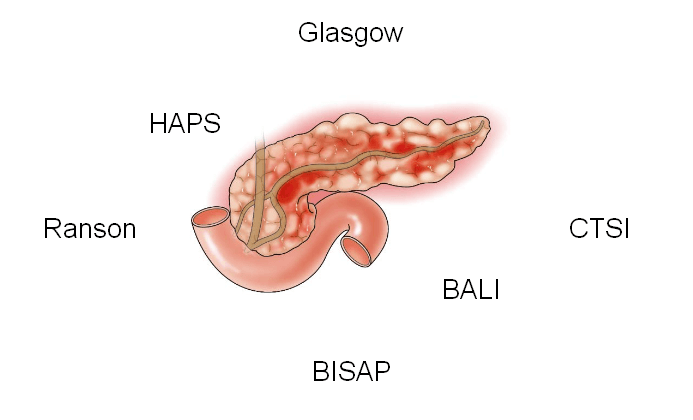
Ranson’s criteria
Severe pancreatitis likely: 3 or more
1. At Presentation:
Mnemonic: A Good LAW
| Mnemonic | Criteria | Non gallstone | + for gall stone | Gall stone |
| A | Age | >55 yrs | 15 | >70 yrs |
| Good | Glucose | >200 mg/dl | 20 | >220 mg/dl |
| L | LDH | >350 U/l | 50 | >400 U/l |
| A | AST | >250 U/l | 0 | >250 U/l |
| W | WBC | >16000/cu.mm | 2000 | >18000/cu.mm |
After 48 hours:
Mnemonic: ABCDeFgH
| Mnemonic | Criteria | Non gallstone | Add or Subtract | Gallstone |
| A | Arterial pO2 | <60 mmHg | 0 | <60 mmHg |
| B | BUN increase | >5 mg/dl | -3 | >2 mg/dl |
| C | Calcium | <8 mg/dl | 0 | <8 mg/dl |
| De | Deficit base | >4 mEq/l | +1 | >5 mEq/l |
| Fg | Fluid requirement | >6 L | -2 | >4 L |
| H | HCt drop | >10% | 0 | >10% |
BISAP (Bedside Index for Severity in Acute Pancreatitis) score
Severe pancreatitis likely: 3 or more at the time of admission
Mnemonic: BISAP
| Mnemonic | Criteria | Positive when |
| B | BUN | >25 mg/dl |
| I | Impaired mental status | Present |
| S | SIRS | Present |
| A | Age | >60 years |
| P | Pleural effusion | Present |
HAPS (Harmless Acute Pancreatitis Score)
Severe pancreatitis likely: 1 or more
Mnemonic: HAPS
| Mnemonic | Criteria | Positive when |
| H | HCt | Abnormal |
| AP | Abdominal Peritonism (Rebound tenderness) | Present |
| S | Serum creatinine | ≥2 mg/dL |
BALI score
Severe pancreatitis likely: 3 or more
| Mnemonic | Criteria | Positive when |
| B | BUN | ≥25 mg/dl |
| A | Age | ≥65 years |
| L | LDH | ≥300 U/l |
| I | IL-6 | ≥300 pg/ml |
CT Severity Index (CTSI)
CTSI = Balthazar grade + Necrosis score
Severe pancreatitis likely: 7 or more
| Balthazar grade | CT appearance | Points |
| A | All normal | 0 |
| B | Bulky (edematous) pancreas | 1 |
| C | Changes (inflammatory – pancreatic +/- peripancreatic) | 2 |
| D | Definitely one fluid collection | 3 |
| E | Extensive extrapancreatic fluid (more than 1) or gas collection | 4 |
| Necrosis percentage | Points |
| 0 | 0 |
| 0-30% | 2 |
| 30-50% | 4 |
| >50% | 6 |