Skip to content
Epomedicine

Mnemonics, Simplified Concepts & Thoughts

Epomedicine

Mnemonics, Simplified Concepts & Thoughts

Glasgow Coma Scale

Epomedicine, Aug 23, 2023Oct 26, 2024

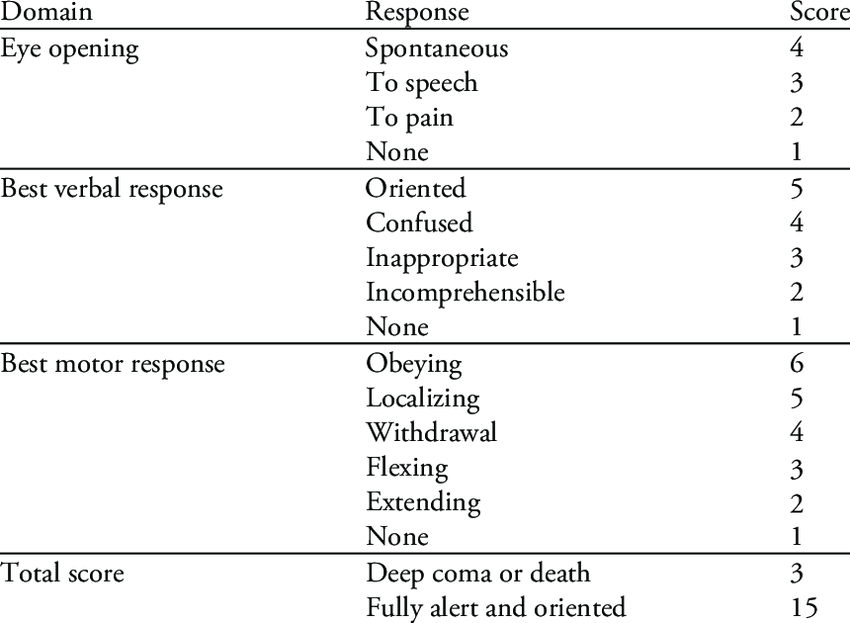
Best eye opening

Mnemonic: ESPN

  • 4 – Eye(s) open spontaneously
  • 3 – to Sounds
  • 2 – to Pain
  • 1 – No opening

Best verbal response

Mnemonic: ASWGN

  • 5 – Appropriate
  • 4 – Sentences (confused)
  • 3 – Words (inappropriate)
  • 2 – Groans and grunts (incomprehensible)
  • 1 – No sound

Best motor response

Mnemonic: OLD BEN

  • 6 – Obeys
  • 5 – Localizes pain
  • 4 – Draws away from pain (withdrawal)
  • 3 – Bends to pain, i.e., decorticate
  • 2 – Extends to pain, i.e., decerebrate (extends elbow to nailbed pressure)
  • 1 – No response
glasgow coma scale

Important points

  1. Minimum score = 3
  2. Maximum score = 15 or 11T (if intubated)
  3. Record best response in each category and sum of all 3. e.g., E3 V3 M4 (10)
  4. “1T” is designated in verbal response for intubated patients. e.g., E3 V1T M4 (8T)
  5. GCS ≤ 8 = Coma
  6. GCS < 8 = Intubate (If less than eight, intubate)
  7. Head injury classification:
    • Mild: GCS 13-15
    • Moderate: GCS 9-12
    • Severe: GCS 3-8
  8. ICP monitoring indications:
    • GCS ≤ 8 after resuscitation + abnormal head CT scan
    • GCS ≤ 8 + normal head CT scan + ≥2 risk factors for intracranial hypertension (including age >40 years, SBP < 90 mmHg, and motor posturing)
  9. CT head indications:
    • GCS <15 at 2 hours following injury
    • GCS <13 at any stage

Question and Example

A 20 year old man is hit over the head with a mallet. On arrival in the accident and emergency department he opens his eyes to pain and groans or grunts. On application of a painful stimulus to his hands, he extends his arm at the elbow. What is his Glasgow coma score?

  • E = Pain (2)
  • V = Groans/grunts (2)
  • M = Extends to pain (2)

So, his GCS is E2 V2 M2 (6).

25 shares
  • Facebook25
  • Twitter
Clinical Skills and Approaches Emergency Medicine Clinical examinationEmergency medicineNervous system

Post navigation

Previous post
Next post

Related Posts

Emergency Medicine

Handtevy Method : Emergency Drug Dose by Age

Sep 11, 2021Sep 11, 2021

To obtain the correct weight for each age, assign each finger a chronological odd number starting with 1, representing the age in years. Now, using the same fingers, count in the multiples of 5, starting with 10 to obtain the corresponding ideal body weight in kilograms. For the even ages,…

Read More
Clinical Skills and Approaches ascitic paracentesis site

Ascitic Paracentesis : Practical Essentials

Jan 16, 2017

Absolute contraindications to Ascitic Tapping (Paracentesis) While some authors have claimed ascitic paracentesis to be free from absolute contraindications, others have listed following as absolute contraindications: Clinically evident fibrinolysis Disseminated Intravascular Coagulation (DIC) Clinically apparent oozing from needle sticks Acute abdomen requiring surgery Relative contraindications to Blind Paracentesis Ultrasound guided…

Read More
Emergency Medicine

Circumferential Periosteal Block (CPB)

May 28, 2023May 28, 2023

Use: Alternative to hematoma block in reduction of distal radius and ulna fractures Advantage: Providing distance from the fracture hematoma (no theoretical risk of converting closed fracture into open fracture) Disadvantage: Risk of neurovascular injury on volar surface of forearm Local anesthetic and volume: 10–15 ml of 1 % plain lidocaine…

Read More

Leave a Reply Cancel reply

Your email address will not be published. Required fields are marked *

This site uses Akismet to reduce spam. Learn how your comment data is processed.

Epomedicine. Glasgow Coma Scale [Internet]. Epomedicine; 2023 Aug 23 [cited 2026 Jan 21]. Available from: https://epomedicine.com/clinical-medicine/glasgow-coma-scale/.

Pre-clinical (Basic Sciences)

Anatomy

Biochemistry

Community medicine (PSM)

Embryology

Microbiology

Pathology

Pharmacology

Physiology

Clinical Sciences

Anesthesia

Dermatology

Emergency medicine

Forensic

Internal medicine

Gynecology & Obstetrics

Oncology

Ophthalmology

Orthopedics

Otorhinolaryngology (ENT)

Pediatrics

Psychiatry

Radiology

Surgery

RSS Ask Epomedicine

  • What to study for Clinical examination in Orthopedics?
  • What is the mechanism of AVNRT?

Epomedicine weekly

  • About Epomedicine
  • Contact Us
  • Author Guidelines
  • Submit Article
  • Editorial Board
  • USMLE
  • MRCS
  • Thesis
©2026 Epomedicine . All rights reserved.