Skip to content
Epomedicine

Mnemonics, Simplified Concepts & Thoughts

Epomedicine

Mnemonics, Simplified Concepts & Thoughts

gbs pathophysiology

Guillain Barre Syndrome (GBS) – Mnemonic

Epomedicine, Apr 16, 2017Apr 16, 2017

ASBURY CRITERIA FOR GUILLAIN BARRE SYNDROME (GBS)

Required Criteria

Mnemonic: AIDP

1. Areflexia

2. Include in differential and rule out other causes

3. Duration < 4 weeks

4. Progressive weakness of 2 or more limbs due to neuropathy

Supportive criteria

Mnemonic: AIDPS

1. Afebrile

2. Involvement:

  • Mild sensory involvement
  • Facial or other cranial nerve involvement

3. Demyelinating electrophysiologic evidence

4. Protein in CSF (100-1000 mg/dl) + Low WBC (Albumino-cytologic dissociation)

5. Symmetrical distribution relatively

Why protein is increased in CSF in GBS?

Intense inflammation at the junction of the dorsal and ventral roots leads to breakdown in the blood-brain barrier and the transudation of plasma proteins into the cerebrospinal fluid (CSF).

Management of GBS

Mnemonic: AIDP

1. Supportive:

  • Analgesia: e.g. NSAIDs
  • Airway: may need ventilation in ITU
  • Autonomic: may need a urinary catheter
  • Antithrombotic: TED stockings, LMWH

2. IVIG 0.4 g/kg/day for 5 days

3. Dexamethasone (corticosteroid): No significant role

4. Plasma exchange (Plasmapheresis): Alternative to IVIG; 5 times during 2 weeks

At about 6 weeks after treatment with IVIG, 5-10% deteriorate after initial stabilization or improvement due to wearing off of therapeutic effect of IVIG in patients in whom immune response is prolonged.

3% m
ay progress to CIDP.

Variants of GBS

AIDP (Acute inflammatory demyelinating polyradiculoneuropathy): commonest; antecedent viral or bacterial infection

AMAN (Acute motor axonal neuropathy): pure motor form; 60% are seropositive for campylobacter; pediatric

AMSAN (Acute motor sensory axonal neuropathy): adults

Miller Fisher syndrome: Ophthalmoplegia + Ataxia + Areflexia

Acute panautonomic neuropathy: rarest
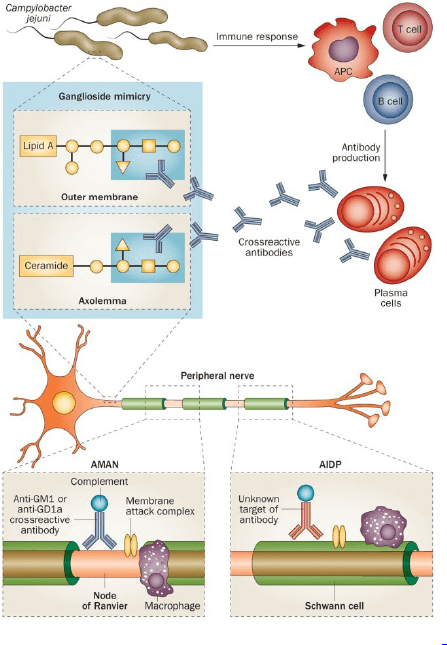
gbs pathophysiology

Pathogenesis of GBS

Molecular mimicry and cross-reactivity: Lipo-oligosaccharide (LOS) of C.jejuni mimic carbohydrate of ganglioside, i.e. anti-ganglioside antibodies.
7 shares
  • Facebook
  • Twitter
PGMEE, MRCS, USMLE, MBBS, MD/MS Internal medicineNervous systemPediatrics

Post navigation

Previous post
Next post

Related Posts

PGMEE, MRCS, USMLE, MBBS, MD/MS

Osteoid Osteoma : Mnemonic

May 13, 2022May 13, 2022

Epidemiology and Clinical features Mnemonic: LMNOP Lower extremity predilection (proximal femur > tibial diaphysis) Male predilection (2:1 to 3:1) Night pain relieved by NSAIDs (absent in osteoblastoma) Osteogenic benign tumor Prostaglandins (PGE2) and Cyclooxygenase (COX1 and 2) release by nidus (explains night pain and response to NSAIDs) 3 Concentric layers…

Read More
PGMEE, MRCS, USMLE, MBBS, MD/MS tumor suppressor

Tumor Suppressor Genes – Mnemonics

May 19, 2019May 19, 2019

Today, we are going to talk only about the commonly mentioned tumor suppressor genes in the textbooks. This somewhat a “forced mnemonic” and may not be as effective and tedious to learn itself. If it works for you it’s well and good, if not find some other ways. General Rules…

Read More
PGMEE, MRCS, USMLE, MBBS, MD/MS ovulatin

Embryology Week 0: Gametogenesis, Ovulation and Fertilization

Aug 2, 2016Aug 2, 2016

Gametogenesis – formation of gametes from primitive germ cells Spermatogenesis, begins at puberty and occurs in seminiferous tubules (spermiogenesis occurs in sertoli cells). One spermatogenesis takes an average of 74 days to complete. Oogenesis Stages Spermatogenesis Migrate at 6th week of development 1. Primordial Germ Cells / PGCs (46, 2n) – epiblast…

Read More

Comments (2)

  1. Dr. Raghavender says:
    Jul 21, 2017 at 6:07 am

    Very nice

    Reply
  2. Susmin Karki says:
    May 30, 2022 at 4:33 pm

    Difference between asbury and brighton criteria?

    Reply

Leave a Reply to Susmin Karki Cancel reply

Your email address will not be published. Required fields are marked *

This site uses Akismet to reduce spam. Learn how your comment data is processed.

Pre-clinical (Basic Sciences)

Anatomy

Biochemistry

Community medicine (PSM)

Embryology

Microbiology

Pathology

Pharmacology

Physiology

Clinical Sciences

Anesthesia

Dermatology

Emergency medicine

Forensic

Internal medicine

Gynecology & Obstetrics

Oncology

Ophthalmology

Orthopedics

Otorhinolaryngology (ENT)

Pediatrics

Psychiatry

Radiology

Surgery

RSS Ask Epomedicine

  • What to study for Clinical examination in Orthopedics?
  • What is the mechanism of AVNRT?

Epomedicine weekly

  • About Epomedicine
  • Contact Us
  • Author Guidelines
  • Submit Article
  • Editorial Board
  • USMLE
  • MRCS
  • Thesis
©2026 Epomedicine | WordPress Theme by SuperbThemes