Skip to content
Epomedicine

Mnemonics, Simplified Concepts & Thoughts

Epomedicine

Mnemonics, Simplified Concepts & Thoughts

Popliteal Fossa : Mnemonics

Epomedicine, May 13, 2023Aug 9, 2023

Mnemonic: Serve And Volley Next Ball

  1. Semimembranosus/Semitendinosus
  2. Artery – Popliteal artery
  3. Vein – Popliteal vein
  4. Nerve – Tibial nerve and Common peroneal nerve
  5. Biceps femoris

Think of popliteal fossa as a diamond-shaped space. The floor is formed by Popliteus muscle.
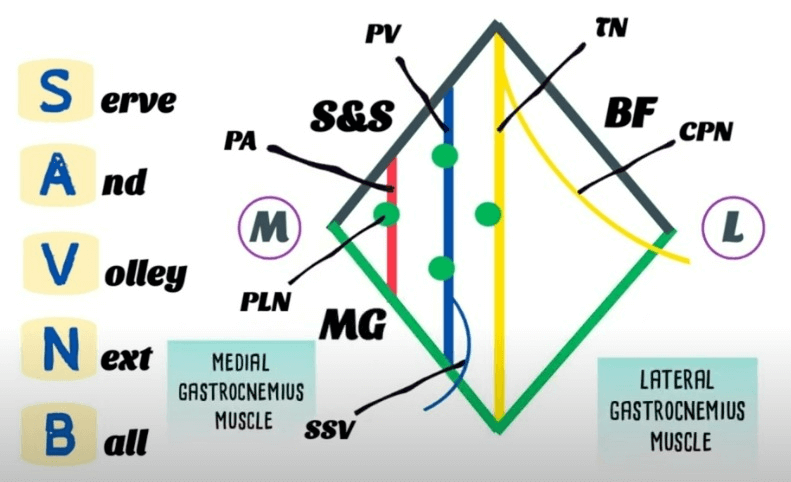
popliteal fossa schematic

Membranosus = Medial (The 2 “Semis” go together – hence medial border is formed by semimembranosus, semitendinosus and medial head of gastrocnemius)

Therefore, biceps femoris and lateral head of gastrocnemius has to be lateral.

The tibial nerve lies superior to the vessels in the inferior aspect of the popliteal fossa. In the upper part of the fossa, the tibial nerve lies lateral to the vessels, it then passes superficial to them to lie medially. The popliteal artery is the deepest structure in the popliteal fossa.

Causes of lump/swelling in popliteal fossa

Mnemonic: ABCD

  1. Aneurysm
  2. Benign and malignant neoplasms:
    • Rhabdomyosarcoma
    • Pigmented villonodular synovitis (PVNS)
    • Synovial hemangioma
  3. Cysts:
    • Baker’s cyst (Synovial cyst)
    • Ganglionic cyst
    • Meniscal cyst
  4. DVT
  • Facebook
  • Twitter
PGMEE, MRCS, USMLE, MBBS, MD/MS Anatomy

Post navigation

Previous post
Next post

Related Posts

PGMEE, MRCS, USMLE, MBBS, MD/MS

Oestern and Tscherne Classification for Closed fractures

Sep 6, 2020Sep 6, 2020

The classification system for closed fractures is based on the physiologic concept that the energy imparted to the bone (and the resultant fracture pattern) directly correlates with the energy transferred to the surrounding soft tissues. Grade Soft tissue injury Fracture Compartment C0 Absent or Negligible Simple (Spiral) Soft and/or Normal…

Read More
PGMEE, MRCS, USMLE, MBBS, MD/MS

ECG Axis Determination : Mnemonic

Aug 11, 2019Aug 11, 2019

Lead I = left (0 degrees)Lead aVF = floor (90 degrees) Lead I +ve and Lead aVF +ve = Between 0-90 degrees (Normal axis) Lead I -ve and Lead aVF +ve = Between 90-180 degrees (Right axis deviation) Lead I +ve and Lead aVF -ve = Between 0 to -90…

Read More
PGMEE, MRCS, USMLE, MBBS, MD/MS tympanogram interpretation

Understanding and Interpreting a Tympanogram

Aug 3, 2015

Relevant terms and definitions: 1. Tympanogram: plots compliance changes of the Tympanic Membrane (TM) versus air pressure in the EAC Y-axis shows pressure gradient and X-axis shows compliance change 2. Peak: point on the tympanogram that represents the point of maximum compliance, in which pressure of the external ear canal equals the pressure of the…

Read More

Leave a Reply Cancel reply

Your email address will not be published. Required fields are marked *

This site uses Akismet to reduce spam. Learn how your comment data is processed.

Pre-clinical (Basic Sciences)

Anatomy

Biochemistry

Community medicine (PSM)

Embryology

Microbiology

Pathology

Pharmacology

Physiology

Clinical Sciences

Anesthesia

Dermatology

Emergency medicine

Forensic

Internal medicine

Gynecology & Obstetrics

Oncology

Ophthalmology

Orthopedics

Otorhinolaryngology (ENT)

Pediatrics

Psychiatry

Radiology

Surgery

RSS Ask Epomedicine

  • What to study for Clinical examination in Orthopedics?
  • What is the mechanism of AVNRT?

Epomedicine weekly

  • About Epomedicine
  • Contact Us
  • Author Guidelines
  • Submit Article
  • Editorial Board
  • USMLE
  • MRCS
  • Thesis
©2026 Epomedicine | WordPress Theme by SuperbThemes