Skip to content
Epomedicine

Mnemonics, Simplified Concepts & Thoughts

Epomedicine

Mnemonics, Simplified Concepts & Thoughts

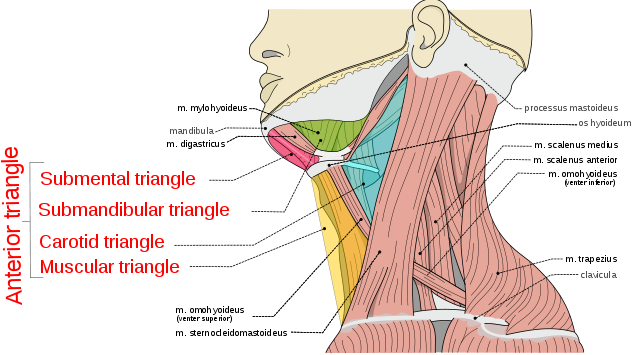
Triangles of Neck

Epomedicine, Jul 16, 2024Jul 16, 2024
neck triangles
Olek Remesz (wiki-pl: Orem, commons: Orem) Modified by user:madhero88, CC BY 3.0, via Wikimedia Commons
TrianglesSubdivisionsBoundariesFloorContentsClinical relevance
Anterior
Digastric (submandibular) – further subdivided into 3 small triangles:
a. Lesser’s
b. Pirogov’s
c. Beclard’s
2 digastric bellies
Mandible
MylohyoidSubmandibular gland
Submandibular nodes
Facial nerve – Marginal mandibular branch (MMB)
Facial vessels
Lingual vessels
Hypoglossal nerve
Nerve to mylohyoid
Incision 2 finger breadth below inferior border of mandible avoids MMB of CN VII
Submental2 digastric bellies
Hyoid
MylohyoidSubmental nodes
Anterior jugular vein
Safe incision – no arteries
CarotidSCM
Superior belly of Omohyoid
Posterior belly of Digastric
Hyoglossus
Thyrohyoid
Middle/Inferior constrictors of
pharynx
Common carotid and bifurcation
IJV
CN X (and superior laryngeal nerve), XI, XII
Ansa cervicalis
Contains Farabeuf’s triangle (landmark for identifying IJV): IJV, Common facial vein, CN XII
MuscularSuperior belly of omohyoid
SCM
Anterior neck midline
Strap muscles (TOSS)
Thyroid gland (along with superior thyroid artery, anterior jugular and inferior thyroid veins)
Parathyroid gland
Cervical part of trachea and esophagus
Tracheostomy and thyroidectomy

Injury of superior thyroid artery – bleeding
Posterior
OccipitalSCM
Trapezius
Inferior belly of omohyoid
Levator scapulae
Splenius capitis
Middle/Posterior scalene
Accessory nerve (CN XI)
Artery – Occipital, Transverse cervical
Brachial plexus – parts
Cervical plexus (GLaST) – Greater auricular nerve, Lesser occipital nerve, Supraclavicular nerve, Transverse cervical nerve
Deep cervical lymph nodes
Supraclavicular or Subclavian or OmoclavicularSCM
Inferior belly of omohyoid
Clavicle
Subclavian artery (3rd part)
Subclavian vein (and EJV termination)
Brachial plexus – trunks
Supraclavicular vessels
Dorsal scapular artery
Phrenic nerve
Deep cervical nodes
Virchow/Troisier’s node
Mnemonic: TOSS muscles (Thyrohyoid, Omohyoid, Sternohyoid, Sternothyroid)

Further reading: Triangles of the neck: a review with clinical/surgical applications – PMC (nih.gov)
  • Facebook
  • Twitter
PGMEE, MRCS, USMLE, MBBS, MD/MS AnatomyOtorhinolaryngology

Post navigation

Previous post
Next post

Related Posts

PGMEE, MRCS, USMLE, MBBS, MD/MS

Kocher Criteria for Septic Arthritis : Mnemonic

Apr 25, 2020Apr 25, 2020

Kocher criteria can help to differentiate between spetic arthritis and transient synovitis in a case of non-traumatic painful hip in a child. A restrospective study in 104 pediatric patients has depicted that meeting 3 out of 4 crtieria would miss 52% cases and is of limited usefulness in detecting septic…

Read More
PGMEE, MRCS, USMLE, MBBS, MD/MS pediatrician-patient

Pediatric History Taking – Structured format and Guide

May 19, 2019Oct 27, 2020

Identification (ID): Name Age/Date of Birth Sex Informant ( Reliability) Parent’s name, age, address, education, religion Chief Complaints (CC): Symptoms X Duration in Chronological order History of Presenting Illness (HPI): Symptoms: Location, quality, quantity, aggravating and alleviating factors Time course: Onset, duration, frequency, change over time Rx/Intervention: Medications, medical help…

Read More
PGMEE, MRCS, USMLE, MBBS, MD/MS cardiac impulse spread

Physiology of Conducting System of Heart

Jul 12, 2018Aug 10, 2023

Origin and Spread of Cardiac Impulse Mnemonic: SAIL MRS. SAVE APPS 1. SA node (generates impulse at highest rate, i.e. 70-80/min) 3 Internodal pathways: 2. AV node Bundle of His 3. Interventricular septum – Left 4. Midportion Right Septal activation Purkinje System 5. Septum (upper to lower) – purkinje system…

Read More

Leave a Reply Cancel reply

Your email address will not be published. Required fields are marked *

This site uses Akismet to reduce spam. Learn how your comment data is processed.

Pre-clinical (Basic Sciences)

Anatomy

Biochemistry

Community medicine (PSM)

Embryology

Microbiology

Pathology

Pharmacology

Physiology

Clinical Sciences

Anesthesia

Dermatology

Emergency medicine

Forensic

Internal medicine

Gynecology & Obstetrics

Oncology

Ophthalmology

Orthopedics

Otorhinolaryngology (ENT)

Pediatrics

Psychiatry

Radiology

Surgery

RSS Ask Epomedicine

  • What to study for Clinical examination in Orthopedics?
  • What is the mechanism of AVNRT?

Epomedicine weekly

  • About Epomedicine
  • Contact Us
  • Author Guidelines
  • Submit Article
  • Editorial Board
  • USMLE
  • MRCS
  • Thesis
©2026 Epomedicine | WordPress Theme by SuperbThemes