Skip to content
Epomedicine

Mnemonics, Simplified Concepts & Thoughts

Epomedicine

Mnemonics, Simplified Concepts & Thoughts

renal angle tenderness

Costovertebral or Renal angle tenderness

Epomedicine, Jul 26, 2019Jul 26, 2019

Synonyms: Murphy’s kidney punch, CVA tenderness (CVAT)

Anatomy of Costovertebral angle or Renal angle:

Costovertebral angle is formed by the junction of the 12th, or lowermost, rib with the paravertebral muscles, which run parallel to and on both sides of the vertebral column.

Eliciting costovertebral angle tenderness:
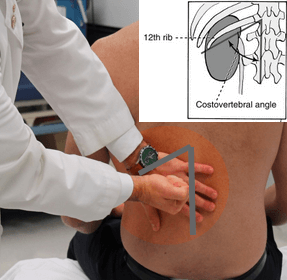
costovertebral angle tenderness

Position of patient: Sitting or Prone

It is performed by striking the fist of one hand against the dorsal surface of the other hand, which is placed flat along the posterior CVA margin. Normally, percussion in CVA should not elicit tenderness.

Causes of costovertebral angle tenderness:

  1. Acute pyelonephritis
  2. Calculi
  3. Renal artery occlusion
  4. Perinephric abscess

References:

  1. Nursing Know-how: Evaluating signs & symptoms – Lippincott Williams & Wilkins
  2. Varney’s Midwifery – By Helen Varney, Helen Varney Burst, Jan M. Kriebs, Carolyn L. Gegor
  3. Emergency and Trauma Care for Nurses and Paramedics – By Kate Curtis, Clair Ramsden
  • Facebook
  • Twitter
Clinical Skills and Approaches Clinical examinationGeneral SurgeryInternal medicinePediatricsRenal and Electroloyte

Post navigation

Previous post
Next post

Related Posts

Clinical Skills and Approaches

Finger test for Necrotizing Fascitis

Feb 22, 2020Feb 22, 2020

Synonyms: Finger sweep test Finger test can be performed under Local anesthesia or General anesthesia in: Emergency department Bedside in wards Operation theaters Procedure: Area is infiltrated with local anesthetic A 2 cm test incision down to fascia is made in the suspected area The tissues are visually examined for:…

Read More
Clinical Skills and Approaches

Management of Diabetes – GLUCOSE BAD mnemonic

Jul 25, 2020Jul 25, 2020

Glycemic control HbA1c 3 monthly or Bianually (if treatment goal acheived and glycemic control considered stable) – Target: Non-pregnant adult patients: <7% Minor cardiovascular disease, minor hypoglycemic episodes, short diagnosis time with diabetes, and long life expectancy: <6.5% Significant co-morbidities, progressive micro- and macrovascular complications, or short life expectancy: <8%…

Read More
Clinical Skills and Approaches facial nerve examination

Examination of Facial Nerve (7th Cranial Nerve)

May 25, 2014Jul 7, 2016

The anatomy of facial nerve has already been discussed in detail earlier. It is essential to have proper knowledge of anatomy to understand this section of clinical examination of facial nerve. A) Inspection: Observe: Face at rest for any facial asymmetry Any facial tics, symmetry of eye blinking or eye…

Read More

Leave a Reply Cancel reply

Your email address will not be published. Required fields are marked *

This site uses Akismet to reduce spam. Learn how your comment data is processed.

Pre-clinical (Basic Sciences)

Anatomy

Biochemistry

Community medicine (PSM)

Embryology

Microbiology

Pathology

Pharmacology

Physiology

Clinical Sciences

Anesthesia

Dermatology

Emergency medicine

Forensic

Internal medicine

Gynecology & Obstetrics

Oncology

Ophthalmology

Orthopedics

Otorhinolaryngology (ENT)

Pediatrics

Psychiatry

Radiology

Surgery

RSS Ask Epomedicine

  • What to study for Clinical examination in Orthopedics?
  • What is the mechanism of AVNRT?

Epomedicine weekly

  • About Epomedicine
  • Contact Us
  • Author Guidelines
  • Submit Article
  • Editorial Board
  • USMLE
  • MRCS
  • Thesis
©2026 Epomedicine | WordPress Theme by SuperbThemes