Skip to content
Epomedicine

Mnemonics, Simplified Concepts & Thoughts

Epomedicine

Mnemonics, Simplified Concepts & Thoughts

JVP Mnemonics

Dr. Sulabh Kumar Shrestha, MS Orthopedics, Aug 4, 2019Aug 4, 2019

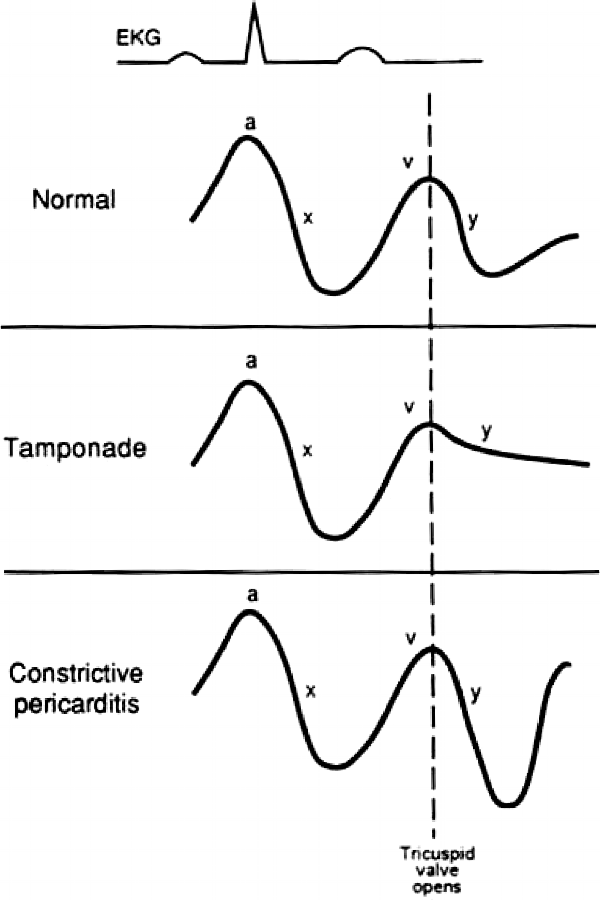
Jugular venous pulse (JVP) waveforms

  1. a – Atrial contraction (RA)
  2. c – Closure and Curving of tricuspid valve into RA
  3. x – atrial relaXation
  4. v – Venous filling of right atrium (RA)
  5. y – atrial emptYing
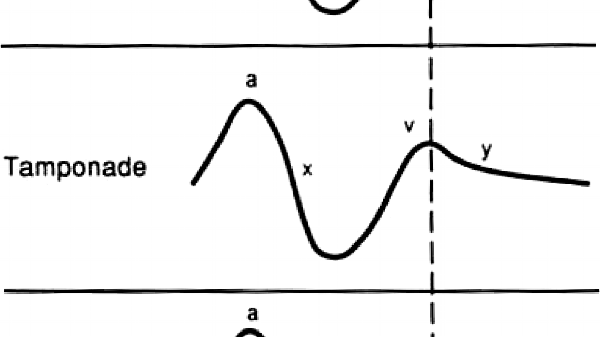
jvp pericarditis tamponade

Distinguishing JVP from Internal carotid pulsation

Mnemonic: POLICE

  1. Palpation: Non-palpable
  2. Occlussion: Readily occludable
  3. Location: Between 2 heads of sternocleidomastoid, lateral to carotid
  4. Inspiration: Drops with inspiration
  5. Contour: Biphasic waveform
  6. Erect position: Drops when sitting erect

Abnormal JVP waveforms

Prominent “a” wave: Pressure of atria peaked

  1. Tricuspid stenosis
  2. Pulmonary hypertension

Cannon “a” wave: Contraction of atria against closed tricuspid valve

  1. Complete heart block
  2. Junctional rhythm

“a” wave fallen (absent): Atrial fibrillation

Large “v” wave: Vomit (backflow) of blood in right atrium

  1. Tricuspid regurgitation

PaY TaX:

  1. Sharp “y” descent: Constrictive pericarditis (Frierdrich’s sign)
  2. Sharp “x” descent: Tamponade and Constrictive pericarditis

Slow “y” descent”: Slow emptYing of RA

  1. Tricuspid stenosis
dr. sulabh kumar shrestha
Dr. Sulabh Kumar Shrestha, MS Orthopedics

He is the section editor of Orthopedics in Epomedicine. He searches for and share simpler ways to make complicated medical topics simple. He also loves writing poetry, listening and playing music. He is currently pursuing Fellowship in Hip, Pelvi-acetabulum and Arthroplasty at B&B Hospital.
29 shares
  • Facebook9
  • Twitter
PGMEE, MRCS, USMLE, MBBS, MD/MS Cardiovascular systemClinical examination

Post navigation

Previous post
Next post

Related Posts

PGMEE, MRCS, USMLE, MBBS, MD/MS

Inferior Venacava (IVC) Tributaries and Abdominal Aorta Branches : Mnemonic

May 11, 2024May 11, 2024

Inferior Venacava (IVC) Tributaries Mnemonic: I Like To Rise So Incredibly High 1. common Iliac veins (L5) – Origin or Formation 2. Lumbar veins (L1-L5) 3. Testicular/gonadal veins – right (L2) 4. Renal veins (L1) 5. Suprarenal veins – right (L1) 6. Inferior phrenic veins (T8) 7. Hepatic veins (T8)…

Read More
PGMEE, MRCS, USMLE, MBBS, MD/MS

Classifications of Sequelae of Septic Arthritis of Hip in Children

Nov 20, 2025

Several radiological classifications have been developed to describe the long-term changes in the hip following septic arthritis and to help guide management. Hunka classification Choi classification Forlin and Milani classification Grade 1: Hips with the head or the femoral neck within the acetabulum Grade 2: Hips are dislocated Johari classification…

Read More
PGMEE, MRCS, USMLE, MBBS, MD/MS steroid leukocytosis mechanism

Steroid Induced Leukocytosis

Dec 23, 2016Dec 23, 2016

Mechanism of Steroid Induced Leukocytosis There are 3 major mechanisms responsible for corticosteroid induced granulocytosis: 1. Demargination of neutrophils from endothelial cells (60% of the rise): Recall the leukocyte adhesion cascade in the chapter of inflammation. L-selectins are present in leukocytes that mediates their rolling on the endothelial lining of…

Read More

Leave a Reply Cancel reply

Your email address will not be published. Required fields are marked *

This site uses Akismet to reduce spam. Learn how your comment data is processed.

Shrestha SK. JVP Mnemonics [Internet]. Epomedicine; 2019 Aug 4 [cited 2025 Dec 15]. Available from: https://epomedicine.com/medical-students/jvp-mnemonics/.

Pre-clinical (Basic Sciences)

Anatomy

Biochemistry

Community medicine (PSM)

Embryology

Microbiology

Pathology

Pharmacology

Physiology

Clinical Sciences

Anesthesia

Dermatology

Emergency medicine

Forensic

Internal medicine

Gynecology & Obstetrics

Oncology

Ophthalmology

Orthopedics

Otorhinolaryngology (ENT)

Pediatrics

Psychiatry

Radiology

Surgery

RSS Ask Epomedicine

  • What to study for Clinical examination in Orthopedics?
  • What is the mechanism of AVNRT?

Epomedicine weekly

  • About Epomedicine
  • Contact Us
  • Author Guidelines
  • Submit Article
  • Editorial Board
  • USMLE
  • MRCS
  • Thesis
©2025 Epomedicine . All rights reserved.