Skip to content
Epomedicine

Mnemonics, Simplified Concepts & Thoughts

Epomedicine

Mnemonics, Simplified Concepts & Thoughts

Inguinal Canal : Mnemonics

Epomedicine, Jul 1, 2024Jul 1, 2024

Walls of Inguinal Canal

Mnemonic: SALP 2 X MALT

Starting from superior, moving counterclockwise in order to posterior:

1. Superior (Roof): 2 Muscles (Internal oblique, Transverse abdominus)

2. Anterior: 2 Aponeuroses (External abdominal oblique, Internal abdominal oblique)

3. Lower (Floor): 2 Ligaments (Lacunar and Inguinal)

4. Posterior: 2 T‘s (conjoint Tendon and Transversalis fascia)

Deep inguinal ring is defect in posterior wall (Transversalis fascia).

Superficial inguinal ring is defect in anterior wall (External abdominal oblique aponeurosis).
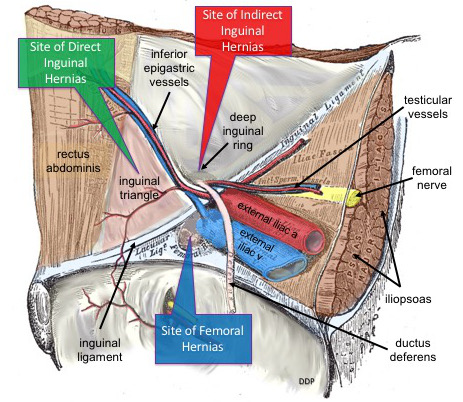
inguinal hernias
Dennis M. DePace, PhD, CC BY-SA 4.0, via Wikimedia Commons

Inguinal triangle or Hesselbach’s triangle

Mnemonic: RIP

The triangle is defined by following structures:

  1. Medial border: Rectus sheath (lateral margin)
  2. Superolateral border: Inferior epigastric vessels
  3. Inferior border: Poupart’s (inguinal) ligament

Inguinal Hernia

Mnemonic: MDs don’t LIe

  1. Medial to inferior epigastric vessels: Direct hernia
  2. Lateral to inferior epigastric vessels: Indirect hernia
  • Facebook
  • Twitter
PGMEE, MRCS, USMLE, MBBS, MD/MS Gastrointestinal systemGeneral Surgery

Post navigation

Previous post
Next post

Related Posts

PGMEE, MRCS, USMLE, MBBS, MD/MS

Perkin’s Timetable for Fracture Healing

Oct 19, 2022

One needs to understand the difference between bone union and consolidation first Union Consolidation Definition Partial/Incomplete repair Full/Complete repair Callus Calcified Ossified Attempted angulation Painful Painless Fracture line in X-ray Still visible Obliterated and crossed by bony trabeculae Full weight bearing Cannot be undertaken Can be undertaken Reference: Physiotherapy in…

Read More
PGMEE, MRCS, USMLE, MBBS, MD/MS

Appearance and Fusion of Ossification Centers

Oct 30, 2019Oct 30, 2019

Upper end of humerus Mnemonic: HGL – 1,3,5 a. Head – by 1 year b. Greater tuberosity – by 3 years c. Lesser tuberosity – by 5 years All 3 centers fuse together by 6 years (1 year after the last center appears) Upper end of femur Mnemonic: HGL –…

Read More
PGMEE, MRCS, USMLE, MBBS, MD/MS

Nipah virus

Nov 16, 2020Nov 16, 2020

Nipah virus is closely related to, but distinct from Hendra virus. Family: Paramyxoviridae Genus: Henipavirus History: A Nipah epidemic of viral encephalitis, complicated by respiratory failure, occurred in Malaysia in 1998 and 1999, causing 265 infections and 105 fatalities (93% had occupational exposure to pigs). An associated outbreak among abbatoir…

Read More

Leave a Reply Cancel reply

Your email address will not be published. Required fields are marked *

This site uses Akismet to reduce spam. Learn how your comment data is processed.

Pre-clinical (Basic Sciences)

Anatomy

Biochemistry

Community medicine (PSM)

Embryology

Microbiology

Pathology

Pharmacology

Physiology

Clinical Sciences

Anesthesia

Dermatology

Emergency medicine

Forensic

Internal medicine

Gynecology & Obstetrics

Oncology

Ophthalmology

Orthopedics

Otorhinolaryngology (ENT)

Pediatrics

Psychiatry

Radiology

Surgery

RSS Ask Epomedicine

  • What to study for Clinical examination in Orthopedics?
  • What is the mechanism of AVNRT?

Epomedicine weekly

  • About Epomedicine
  • Contact Us
  • Author Guidelines
  • Submit Article
  • Editorial Board
  • USMLE
  • MRCS
  • Thesis
©2026 Epomedicine | WordPress Theme by SuperbThemes