Skip to content
Epomedicine

Mnemonics, Simplified Concepts & Thoughts

Epomedicine

Mnemonics, Simplified Concepts & Thoughts

Paranasal sinus drainage in Nasal cavity : Mnemonic

Epomedicine, Aug 4, 2023Aug 4, 2023

Lateral wall of nasal cavity has:

  1. Conchae or turbinates: shelf like projections
  2. Meatus: air space inferior to each concha
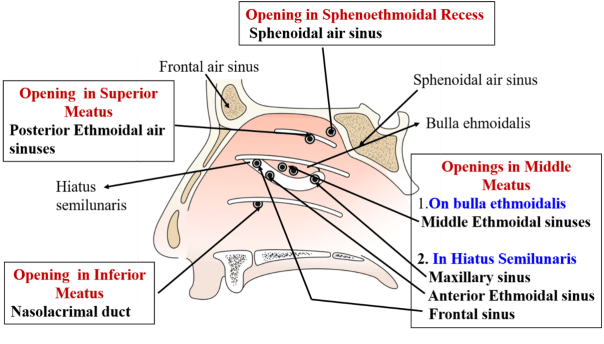
paranasal sinus drainage

Mnemonic: SPIN

1. Superior meatus: Posterior ethmoidal sinus

2. Inferior meatus: Nasolacrimal duct

The sphenoidal sinus drains into spheno-ethmoidal recess (superior to superior concha).

All others drain into middle meatus:

Mnemonic: AM/FM

  1. Anterior ethmoidal sinus
  2. Middle ethmoidal sinus
  3. Frontal sinus
  4. Maxillary sinus
  • Facebook
  • Twitter
PGMEE, MRCS, USMLE, MBBS, MD/MS AnatomyOtorhinolaryngology

Post navigation

Previous post
Next post

Related Posts

PGMEE, MRCS, USMLE, MBBS, MD/MS dna replication

DNA Replication Explained With Zipper Model

Jan 25, 2017Jan 26, 2017

Imagine DNA as a zipper Prokaryotic DNA as a zipper with single slider (single origin of replication) and Eukaryotic DNA as a zipper with two sliders (multiple origin of replication). Zipper teeth: Purines and pyrimidine bases Complementary teeth pair: Complementary base pairs attached by hydrogen bonds Top stops: Origin of…

Read More
PGMEE, MRCS, USMLE, MBBS, MD/MS

Fascia Lata and Tensor Fascia Lata

Jun 16, 2020Jun 16, 2020

Fascia lata and Tensor fascia lata althought different structures is often mistaken as the same by the students. Fascia Lata It is the fascial ‘stocking’ deep to the skin and superficial fascial and encloses the muscle of thigh. Proximally, its attachment can be traced around the pelvis and distally, it…

Read More
PGMEE, MRCS, USMLE, MBBS, MD/MS elbow joint anatomy

Pediatric Lateral Condyle Humerus Fracture : Review

Nov 19, 2015May 25, 2023

A) Epidemiology: B) Mechanism of Injury: C) Classifications: a. Milch: Fracture line based – b. Jakob and Weiss: Displacement and articular congruency based – Modified Weiss classification: No need for arthrogram1. Type I: <2 mm displacement2. Type II: 2-4 mm displacement 3. Type III: >4 mm displacement (displacement of >4…

Read More

Leave a Reply Cancel reply

Your email address will not be published. Required fields are marked *

This site uses Akismet to reduce spam. Learn how your comment data is processed.

Pre-clinical (Basic Sciences)

Anatomy

Biochemistry

Community medicine (PSM)

Embryology

Microbiology

Pathology

Pharmacology

Physiology

Clinical Sciences

Anesthesia

Dermatology

Emergency medicine

Forensic

Internal medicine

Gynecology & Obstetrics

Oncology

Ophthalmology

Orthopedics

Otorhinolaryngology (ENT)

Pediatrics

Psychiatry

Radiology

Surgery

RSS Ask Epomedicine

  • What to study for Clinical examination in Orthopedics?
  • What is the mechanism of AVNRT?

Epomedicine weekly

  • About Epomedicine
  • Contact Us
  • Author Guidelines
  • Submit Article
  • Editorial Board
  • USMLE
  • MRCS
  • Thesis
©2026 Epomedicine | WordPress Theme by SuperbThemes