Skip to content
Epomedicine

Mnemonics, Simplified Concepts & Thoughts

Epomedicine

Mnemonics, Simplified Concepts & Thoughts

Ankle block : Nerves and Landmarks

Epomedicine, Jun 5, 2020Jun 5, 2020
foot nerve supply

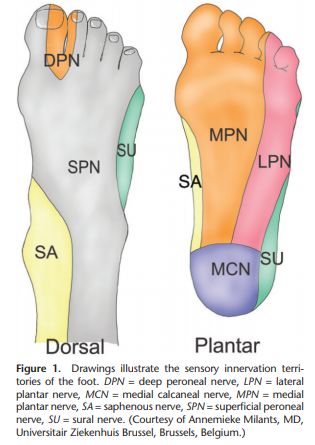
Mnemonic: The 3 nerves starting with letter “S” are sensory only and supply superior and side aspect of foot (dorsum).

1. Superficial peroneal nerve (L4-S1): located lateral to Extensor Digitorum Longus (EDL)

  • Supplies: dorsum of foot and toes except between the great and 2nd toe

2. Sural nerve (S1-S2): It is formed from the medial sural nerve (branch of the tibial nerve) and the lateral sural nerve (branch of the common peroneal nerve)

  • Location: superficially between lateral malleolus and achilles tendon
  • Supplies: posterolateral leg, lateral foot, 5th toe

3. Saphenous nerve (L3-L4): It is a branch of femoral nerve.

  • Location: just anterior to the medial malleolus
  • Supplies: anteromedial side of leg, medial side of foot

Other nerves (Motor + Sensory):

4. Deep peroneal nerve (L4-L5): located lateral to Extensor Hallucis Longus (EHL)

  • Sensory: between the great and second toes
  • Motor: extends the toes

5. Tibial nerve: It divides into lateral and medial plantar nerves just inferior to the medial malleolus.

  • Location: posterior to medial malleolus
  • Sensory: plantar surface of the foot
  • Motor: flexes the toes

Landmarks for Ankle block

  • Deep peroneal: Lateral to Extensor hallucis longus tendon
  • Posterior tibial: Posterior to posterior tibial artery
  • Sural: Posterior to lateral malleolus
  • Superficial peroneal: Lateral to ext. digitorum longus
  • Saphenous: Anterior to medial malleolus

  • Facebook
  • Twitter
PGMEE, MRCS, USMLE, MBBS, MD/MS Anesthesia

Post navigation

Previous post
Next post

Related Posts

PGMEE, MRCS, USMLE, MBBS, MD/MS

Patient Decision Making Capacities – CURVES mnemonic

Jun 27, 2020May 24, 2024

a. Choose and communicate Can the patient make a choice and communicate that choice? b. Understand Does the patient understand the risks, benefits, alternatives and consequences of the decision? c. Reason Can the patient provide logic or reason behind his/her decision? d. Value Is the choice the patient makes consistent…

Read More
PGMEE, MRCS, USMLE, MBBS, MD/MS retroperitoneal-structures

Retroperitoneal Organs : Mnemonic

Jun 27, 2018May 13, 2024

Retroperitoneal organs are partly covered on one side with parietal peritoneum. They are immobile or fixed. The classification of retroperitoneal organs divides primary and secondary retroperitoneal organs due to the embryonic development – Retroperitoneal structures Mnemonic: SAD PUCKER Primary retroperitoneal structures Mnemonic: SAUKER Secondary retroperitoneal structures Clinical significance Kocher maneuver…

Read More
PGMEE, MRCS, USMLE, MBBS, MD/MS

Popliteal Fossa : Mnemonics

May 13, 2023Aug 9, 2023

Mnemonic: Serve And Volley Next Ball Think of popliteal fossa as a diamond-shaped space. The floor is formed by Popliteus muscle. Membranosus = Medial (The 2 “Semis” go together – hence medial border is formed by semimembranosus, semitendinosus and medial head of gastrocnemius) Therefore, biceps femoris and lateral head of…

Read More

Leave a Reply Cancel reply

Your email address will not be published. Required fields are marked *

This site uses Akismet to reduce spam. Learn how your comment data is processed.

Pre-clinical (Basic Sciences)

Anatomy

Biochemistry

Community medicine (PSM)

Embryology

Microbiology

Pathology

Pharmacology

Physiology

Clinical Sciences

Anesthesia

Dermatology

Emergency medicine

Forensic

Internal medicine

Gynecology & Obstetrics

Oncology

Ophthalmology

Orthopedics

Otorhinolaryngology (ENT)

Pediatrics

Psychiatry

Radiology

Surgery

RSS Ask Epomedicine

  • What to study for Clinical examination in Orthopedics?
  • What is the mechanism of AVNRT?

Epomedicine weekly

  • About Epomedicine
  • Contact Us
  • Author Guidelines
  • Submit Article
  • Editorial Board
  • USMLE
  • MRCS
  • Thesis
©2026 Epomedicine | WordPress Theme by SuperbThemes