Skip to content
Epomedicine

Mnemonics, Simplified Concepts & Thoughts

Epomedicine

Mnemonics, Simplified Concepts & Thoughts

koilonychia

Koilonychia

Epomedicine, May 21, 2018

Synonyms: Spoon-shaped nails, Concave nails

Definition of koilonychia: Loss of longitudinal and lateral convexity of the nail, with thinning and fraying of the distal portions.
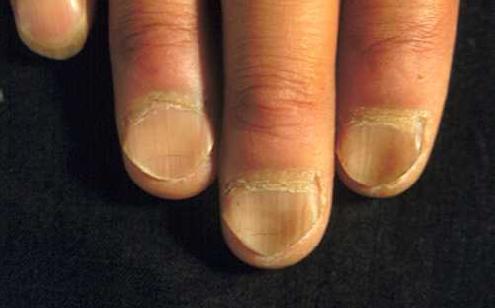
koilonychia

Conditions associated with koilonychia:

  1. Normal variant
  2. Soft nails with occupational damage
  3. Iron deficiency anemia
  4. Hemochromatosis
  5. Raynaud’s syndrome
  6. Psoriasis (Koilonychia with subungual keratosis)

Mechanism of koilonychia in Iron Deficiency Anemia:

Koilonychia occurs in 5.4% of the patients with iron deficiency. It is thought to occur due to the upward deformation of lateral and distal portions of pliable iron deficient nail plates under mechanical pressure. Nail matrix changes due to blood flow abnormalities was also proposed as a pathomechanism. It is reversible with replenishment of iron stores.

Clinical test to detect koilonychia:

In mild cases, the water test may enable a drop of water to be retained on the nail plate.

References:

  1. M Razmi T, R V Nampoothiri, S Dogra; Koilonychia in iron deficiency, QJM: An International Journal of Medicine, Volume 111, Issue 4, 1 April 2018, Pages 271–272
  2. A Text Atlas of Nail Disorders: Techniques in Investigation and Diagnosis edited by Robert Baran, Ivan Bristow, Rodney P. R. Dawber, Ekart Haneke, Antonella Tosti
15 shares
  • Facebook15
  • Twitter
Clinical Skills and Approaches DermatologyInternal medicine

Post navigation

Previous post
Next post

Related Posts

Clinical Skills and Approaches

Deep tendon reflexes

Sep 3, 2022Sep 3, 2022

Deep tendon reflexes are monosynaptic reflexes integrated at lamina IX of the spinal cord. Deep tendon reflexes may be interpreted as: Normal Diminished or absent (hyporeflexia): Lower motor neuron lesions Exaggerated or clonus (hyper-reflexia): Upper motor neuron lesions Inverted or paradoxical: Damaged afferent pathway Name Spinal level Peripheral nerve Location…

Read More
Clinical Skills and Approaches Superficial-pathological-reflexes

Pathological reflexes – Variations of Babinski

Jun 18, 2015Dec 7, 2022

Normally, the pathological reflexes are not evident because they are suppressed by cerebrum at brainstem or spinal cord level by 6 months of age. Importance: Up-going (dorsiflexion) toe can be elicited at various sites and all indicated Upper Motor Neuron (UMN) lesion. Use a blunt-pointed object like fingernail or tip…

Read More
Clinical Skills and Approaches gowers sign

Gower’s sign

Nov 6, 2016Jun 20, 2024

Synonyms: Gower’s maneuver, Myopathic walking, Butt-first maneuver Identifying Gower’s sign To check for Gower’s sign, place the patient in the supine position and ask him to rise. A positive Gower’s sign – an inability to lift the trunk without using the hands and arms to brace and push – indicates…

Read More

Comment

  1. Larry Hubbard says:
    Jan 17, 2021 at 8:23 pm

    Yes my name is Larry and I have this and my nails are also a brownish color and really would like help for it what can I do

    Reply

Leave a Reply Cancel reply

Your email address will not be published. Required fields are marked *

This site uses Akismet to reduce spam. Learn how your comment data is processed.

Epomedicine. Koilonychia [Internet]. Epomedicine; 2018 May 21 [cited 2026 Jul 6]. Available from: https://epomedicine.com/clinical-medicine/koilonychia/.

Pre-clinical (Basic Sciences)

Anatomy

Biochemistry

Community medicine (PSM)

Embryology

Microbiology

Pathology

Pharmacology

Physiology

Clinical Sciences

Anesthesia

Dermatology

Emergency medicine

Forensic

Internal medicine

Gynecology & Obstetrics

Oncology

Ophthalmology

Orthopedics

Otorhinolaryngology (ENT)

Pediatrics

Psychiatry

Radiology

Surgery

RSS Ask Epomedicine

  • What to study for Clinical examination in Orthopedics?
  • What is the mechanism of AVNRT?

Epomedicine weekly

  • About Epomedicine
  • Contact Us
  • Author Guidelines
  • Submit Article
  • Editorial Board
  • USMLE
  • MRCS
  • Thesis
©2026 Epomedicine | WordPress Theme by SuperbThemes