Skip to content
Epomedicine

Mnemonics, Simplified Concepts & Thoughts

Epomedicine

Mnemonics, Simplified Concepts & Thoughts

surgical blade mnemonic

Surgical blade size : Tricks to remember

Epomedicine, Apr 17, 2020Apr 17, 2020

Surgical blade anatomy

  1. Sharp edge: Belly
  2. Tip
  3. Unsharpened ridge opposite to the edge: Spine
  4. Slot for scalpel

Surgical blade numbers

Here is a trick to know the surgical blades by numbers – a simple image mnemonic which will require your imagination. We will only discuss blades commonly used in our practice.
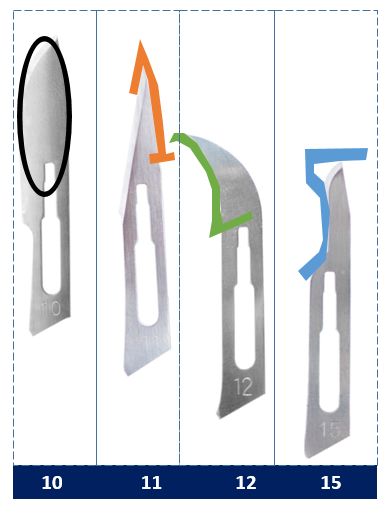
surgical blade mnemonic

Blade #11 – Straignt and Pointed like number “1”

  • Used for stab incisions (like in abscess drainage) because of it’s pointed tip.

Blade #12 – Edge is curved like number “2”

  • Enables surgeon to make incision in inaccessible areas.

Blade #15 – Edge is curved like alphabet “S” or number “5”

  • Used for making short, precise (finer) incision.

Blade #10 – The edge or belly is round like number “0”

  • Used for cutting tissues.

Blade #20, 21 – This is like Blade #10 but larger in size

  • Used for cutting soft tissues and covering large distance during intial skin incision.
544 shares
  • Facebook
  • Twitter
Surgical Skills General Surgery

Post navigation

Previous post
Next post

Related Posts

Surgical Skills

Corner Stitch

Oct 5, 2020Oct 5, 2020

Synonym: Half-buried horizontal mattress suture Indications: V, Y or X-pattern laceration repair Risk: Dermal stitch may be placed too close to the tip of the flap and compromise the tenuous blood supply Suture: Non-absorbable Principle: When repairing, this stitch must be placed first Landmark sites (2 on each site of…

Read More
Emergency Medicine

Bier Block

Jan 11, 2022Jan 11, 2022

Named after: German Surgeon August Bier (first introduced the block in 1908) Definition: It is a peripheral intravenous local anesthetic block (IVRA; Intravenous Regional Anesthesia) of the upper limb using a pneumatic cuff technique Mechanism of action: Local anesthesia diffuses into the small veins surrounding the nerves and then into…

Read More
Surgical Skills

Surgical Sutures – Basics

Sep 17, 2020Mar 5, 2024

Monofilament Polyfilament Absorbable Caprosyn (Polyglytone 621)Monocryl (Polyglecaprone 25)Biosyn (Polyglecaprone CV-23)Maxon (Polytrimethylate carbon)PDS (Polydiaxonone) CatgutVicryl rapide (Polyglactin 910 rapide)Vicryl (Polyglactin 910)Dexon (Polyglycolic acid) Non-absorbable NylonEthilon (Monofilament polyamide)Prolene (Polypropylene) SilkDacronEthibond (Polyester)Braided nylon (Surgilon, Nurolon)Supramid Monofilament sutures: Polyfilament/Multifilament sutures: Natural sutures: Synthetic sutures: Absorbability: There are 2 principal methods, by which the sutures…

Read More

Leave a Reply Cancel reply

Your email address will not be published. Required fields are marked *

This site uses Akismet to reduce spam. Learn how your comment data is processed.

Pre-clinical (Basic Sciences)

Anatomy

Biochemistry

Community medicine (PSM)

Embryology

Microbiology

Pathology

Pharmacology

Physiology

Clinical Sciences

Anesthesia

Dermatology

Emergency medicine

Forensic

Internal medicine

Gynecology & Obstetrics

Oncology

Ophthalmology

Orthopedics

Otorhinolaryngology (ENT)

Pediatrics

Psychiatry

Radiology

Surgery

RSS Ask Epomedicine

  • What to study for Clinical examination in Orthopedics?
  • What is the mechanism of AVNRT?

Epomedicine weekly

  • About Epomedicine
  • Contact Us
  • Author Guidelines
  • Submit Article
  • Editorial Board
  • USMLE
  • MRCS
  • Thesis
©2026 Epomedicine | WordPress Theme by SuperbThemes