Skip to content
Epomedicine

Mnemonics, Simplified Concepts & Thoughts

Epomedicine

Mnemonics, Simplified Concepts & Thoughts

ALI and ARDS : Mnemonics

Epomedicine, May 20, 2024May 20, 2024

Diagnosis (Berlin Criteria)

MnemonicARDS
Acute Lung Injury (ALI)Acute onset (<7 days)Ratio PaO2/FiO2 ≤300 mmHg or 40 kPaDiffuse bilateral pulmonary infiltrates on CXRSwan-Ganz pulmonary wedge pressure ≤18 mmHg or No evidence of Left atrial hypertension
Acute Respiratory Distress Syndrome (ARDS)Acute onset (<7 days)Ratio PaO2/FiO2 ≤200 mmHg or 26.6 kPaDiffuse bilateral pulmonary infiltrates on CXRSwan-Ganz pulmonary wedge pressure ≤18 mmHg or No evidence of Left atrial hypertension

Causes of ALI and ARDS

Mnemonic: ARDS

  1. A
    • Aspiration pneumonia
    • Air embolism
    • Amniotic fluid embolism
  2. R
    • Radiation-Trauma-Burns
  3. D
    • DIC
    • Drugs (chemotherapy, heroin)
    • near Drowning
    • Dialysis
    • Dysregulation of metabolic pathways (pancreatitis, uremia, ingestion of paraquat)
  4. S
    • Shock
    • Sepsis
    • Smoke inhalation

Phases of ALI and ARDS
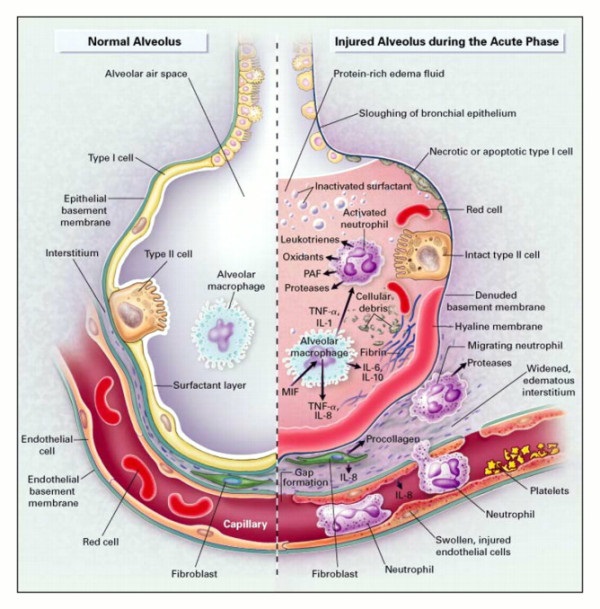
ARDS stages
Bakowitz, Magdalena & Bruns, Brandon & McCunn, Maureen. (2012). Acute lung injury and the acute respiratory distress syndrome in the injured patient. Scandinavian journal of trauma, resuscitation and emergency medicine. 20. 54. 10.1186/1757-7241-20-54. [CC BY-SA 4.0.]
Phase (Mnemonic: EPF)OnsetEventPathologyTreatment principles
1. Exudative<1 weekIL-1 & other inflammatory mediatorsInterstitial alveolar edema
Hyaline membrane
1. Primarily supportive
2. Treatment of cause
3. PEEP ventilation
4. Inverse ventilation (Inspiration : Expiration ratio = 2:1)
5. Prone ventilation
2. Proliferative1-3 weeksType II pneumocyte + myofibroblast proliferationAlveolar exudate resolves or organizesInhaled NO (Vasodilation may improve V/Q at ventilated areas)
3. Fibrotic>3 weeksCollagen III to I conversionAlveolar ducts & spaces undergo fibrosisSteroids
  • Facebook
  • Twitter
PGMEE, MRCS, USMLE, MBBS, MD/MS PathologyRespiratory system

Post navigation

Previous post
Next post

Related Posts

PGMEE, MRCS, USMLE, MBBS, MD/MS

Surgical Anatomy of Diaphragm

Jan 20, 2024Jan 20, 2024

Diaphragm is a thoracoabdominal organ which is musculotendinous. It is the primary muscle of respiration.  Extension: There are 2 crura of diaphragm: 3 ligaments: Quadratus lumborum muscle is related to lateral arcuate whereas psoas muscle is related to medial arcuate ligament. The foramen of Morgagni shown in the above picture…

Read More
PGMEE, MRCS, USMLE, MBBS, MD/MS salter harris classification

Salter Harris Classification for Physeal Fracture: Mnemonic

Oct 29, 2017Jun 20, 2024

In children, the growth plate (physis) is a zone of cartilate situated between the epiphysis and the metaphysis of long bones. Cartilage is weaker than bone and thus is a common site of fracture. The Salter-Harris classification consists of 5 different types of growth plate fractures based on the location…

Read More
PGMEE, MRCS, USMLE, MBBS, MD/MS Pancreas anatomy

Courvoisier’s law of Obstructive Jaundice

Aug 10, 2014Jun 12, 2023

Synonyms: Courvoisier’s sign, Courvoisier syndrome, Courvoisier-Terrier sign, Bard-Pic disease Over years, the use of the term Courvoisier’s sign or gallbladder has been suggested instead of law, because of rising number of exceptions. Eponymous to: Ludwig Courvoisier (1843-1918) Definition of Courvoisier’s law Courvoisier’s (koor-vwah-zee-ayz) law states that ‘a palpable non-tender gallbladder…

Read More

Leave a Reply Cancel reply

Your email address will not be published. Required fields are marked *

This site uses Akismet to reduce spam. Learn how your comment data is processed.

Epomedicine. ALI and ARDS : Mnemonics [Internet]. Epomedicine; 2024 May 20 [cited 2026 May 20]. Available from: https://epomedicine.com/medical-students/ali-and-ards-mnemonics/.

Pre-clinical (Basic Sciences)

Anatomy

Biochemistry

Community medicine (PSM)

Embryology

Microbiology

Pathology

Pharmacology

Physiology

Clinical Sciences

Anesthesia

Dermatology

Emergency medicine

Forensic

Internal medicine

Gynecology & Obstetrics

Oncology

Ophthalmology

Orthopedics

Otorhinolaryngology (ENT)

Pediatrics

Psychiatry

Radiology

Surgery

RSS Ask Epomedicine

  • What to study for Clinical examination in Orthopedics?
  • What is the mechanism of AVNRT?

Epomedicine weekly

  • About Epomedicine
  • Contact Us
  • Author Guidelines
  • Submit Article
  • Editorial Board
  • USMLE
  • MRCS
  • Thesis
©2026 Epomedicine | WordPress Theme by SuperbThemes