Skip to content
Epomedicine

Mnemonics, Simplified Concepts & Thoughts

Epomedicine

Mnemonics, Simplified Concepts & Thoughts

osteochondritis

List of Osteochondritis of Different Bones

Epomedicine, Jun 8, 2019Jun 8, 2019
  1. Osteochondritis of the capitulum of humerus (elbow): panner’s disease
  2. Osteochondritis of the lunate bone: keinbock’s disease
  3. Osteochondritis of the femoral head: perthe’s disease
  4. Osteochondritis of lateral part of medial femoral condyle: osteochondritis dissecans
  5. Osteochondritis of the tibial tubercle: osgood schlatter’s disease
  6. Osteochondritis of lower part of patella: sinding larsen johansson disease
  7. Osteochondritis of the calcaneal tuberosity: sever’s disease
  8. Osteochondritis of the navicular bone: kohler’s disease
  9. Osteochondritis of 2nd metatarsal head: freiberg’s disease
  10. Osteochondritis of 5th metatasal base: islene disease
  11. Osteochondritis of the ring epiphysis of the vertebrae: scheurmann’ s disease
  12. Osteochondritis of the central bony nucleus of vertebral body: calve’s disease
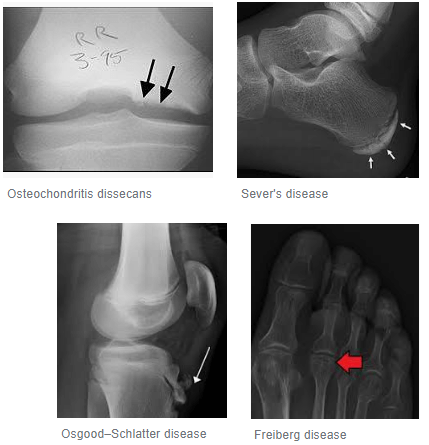
osteochondritis

Mnemonic: This mnemonic will only make sense to those who will understand hindi language.

Calcutta Vali / Sunder Radiologist / Fatima Malik / O.T. / Se Chal / Kar Nikli / Pahunchi Fir / Panna College / Ki Library.

1. Calve’s – Vertebral body (central nucleus)
2. Scheuermann’s – Ring epiphysis of vertebra
3. Freiberg’s – Metatarsal head
4. Osgood Schlatter’s – Tibial tuberosity
5. Sever’s – Calcaneal tuberosity
6. Kohler’s – Navicular bone
7. Perthe’s – Femoral head
8. Panner’s – Capitulum
9. Kienboch’s – Lunate

Common sites affected by osteochondritis:

  • Commonest: Lateral part of medial femoral condyle
  • 2nd most common: Capitulum of humerus
  • Facebook
  • Twitter
PGMEE, MRCS, USMLE, MBBS, MD/MS Musculoskeletal systemOrthopedics

Post navigation

Previous post
Next post

Related Posts

PGMEE, MRCS, USMLE, MBBS, MD/MS chemotherapy action

Principles of Chemotherapy

Dec 26, 2015Jul 2, 2016

Master the knowledge of clinically relevant cell cycle to understand the principles of chemotherapy. Tumors that are highly responsive to chemotherapeutic agents (e.g., testicular cancer, lymphomas) tend to have a very rapid doubling time compared to tumors that are less responsive to chemotherapy (e.g., pancreatic and prostate cancers). The tumor doubling time of metastases…

Read More
PGMEE, MRCS, USMLE, MBBS, MD/MS

Organ Transplant Complications and Rejection

Aug 20, 2023Aug 20, 2023

Types of Transplant Rejection Type Time Mechanism Pathology Hypersensitivity Management Host against Graft (Host vs Graft) Mnemonic: TIA Hyperacute Immediate (<5 days) Anti-donor antibodies in recipient Thrombosis and Obliteration of blood supply Type II UntreatablePrevent by cross-matchingRemove graft Acute (most common) < 6 months (most common in 1st month) Anti-donor…

Read More
PGMEE, MRCS, USMLE, MBBS, MD/MS

Dog bite wounds : Primary closure or Delayed closure?

Sep 7, 2020Sep 13, 2020

A study of 50 dog bite wounds revealed that the commonest colonizing: Aerobic micro-organisms are: Pasteurella (50%), Streptococcus (46%), Staphylococcus (46%), Neisseria (32%), and Corynebacterium (12%), Eikenella corrodens (2%) Anaerobic micro-organisms are: Fusobacterium nucleatum (16%), Bacteroides tectus (14%), Prevotella heparinolytica (14%), Propionibacterium acnes (14%), Prevotella intermedia (8%), Peptostreptococcus anaerobius (8%),…

Read More

Leave a Reply Cancel reply

Your email address will not be published. Required fields are marked *

This site uses Akismet to reduce spam. Learn how your comment data is processed.

Pre-clinical (Basic Sciences)

Anatomy

Biochemistry

Community medicine (PSM)

Embryology

Microbiology

Pathology

Pharmacology

Physiology

Clinical Sciences

Anesthesia

Dermatology

Emergency medicine

Forensic

Internal medicine

Gynecology & Obstetrics

Oncology

Ophthalmology

Orthopedics

Otorhinolaryngology (ENT)

Pediatrics

Psychiatry

Radiology

Surgery

RSS Ask Epomedicine

  • What to study for Clinical examination in Orthopedics?
  • What is the mechanism of AVNRT?

Epomedicine weekly

  • About Epomedicine
  • Contact Us
  • Author Guidelines
  • Submit Article
  • Editorial Board
  • USMLE
  • MRCS
  • Thesis
©2026 Epomedicine | WordPress Theme by SuperbThemes