Skip to content
Epomedicine

Mnemonics, Simplified Concepts & Thoughts

Epomedicine

Mnemonics, Simplified Concepts & Thoughts

hip deformity

Hip and Shoulder Deformities

Epomedicine, Jun 7, 2019Jun 7, 2019

HIP

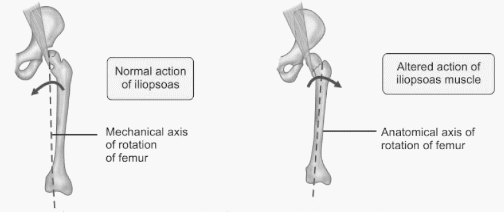
Flexion, Abduction, External rotation (FABER) + apparent lengthening: Synovitis

Flexion, Abduction, External rotation (FABER) + true lengthening: Anterior dislocation of hip (Obturator)

Extension+ Abduction + External rotation (EABER): Anterior dislocation of hip (Superior or Pubic)

Flexion, Adduction, Internal rotation (FADIR) + true shortening: Arthritis, Posterior dislocation of hip

Flexion, Adduction, External rotation (FADER) + Shortening: Femoral neck fracture, Primary osteoarthritis, Inter-trochanteric fracture (marked deformity), Slipped femoral epiphysis

Any type possible (Joker lesion): Fracture acetabulum
hip deformity

SHOULDER

Flexion, Abduction, External Rotation (FABER): Anterior dislocation of shoulder

Flexion, Adduction, Internation Rotation (FADIR): Posterior dislocation of shoulder

Hyperabduction (Salute position): Inferior dislocation of shoulder

Mnemonic:

Alphabetically, “B” comes before “D” and “E” comes before “I”. Anterior comes before posterior.

FABER: 1st stage of TB hip (synovitis), Anterior dislocation of hip, Anterior dislocation of shoulder

FADIR: Later stages of TB hip (arthritis stages), Posterior dislocation of hip, Posterior dislocation of shoulder
  • Facebook
  • Twitter
PGMEE, MRCS, USMLE, MBBS, MD/MS Musculoskeletal systemOrthopedics

Post navigation

Previous post
Next post

Related Posts

PGMEE, MRCS, USMLE, MBBS, MD/MS decorticate decerebrate

Decorticate and Decerebrate Rigidity – Mnemonics

Jun 3, 2019Jun 3, 2019

Rubrospinal tract mediates flexor of the upper arm. Here is a way to remember these two postures and never forget again. Decerebrate has more “E” and more “R”. Extended upper limbs Rubrospinal tract transected (Red nucleus is above the level of lesion, i.e. below midbrain level) Decorticate has “COR”. Upper…

Read More
PGMEE, MRCS, USMLE, MBBS, MD/MS intercellular junctions

Cell-Cell or Interceullular Junctions

May 22, 2019May 22, 2019

Junction Location Composition Function Remarks Tight junction (Zonula occludens) Epithelial cell-Epithelial cell Claudin and Occludin (attaches to cytoskeleton – actin filament) Prevents paracellular movement of solutes and diffusion Adherens junction (Zonula adherens) Epithelial cell-Epithelial cell E-cadherin (attaches to cytoskeleton – actin filament) Belt desmosome (Anchoring) Cadherins are Ca2+ depndend adhesion…

Read More
PGMEE, MRCS, USMLE, MBBS, MD/MS

Nipah virus

Nov 16, 2020Nov 16, 2020

Nipah virus is closely related to, but distinct from Hendra virus. Family: Paramyxoviridae Genus: Henipavirus History: A Nipah epidemic of viral encephalitis, complicated by respiratory failure, occurred in Malaysia in 1998 and 1999, causing 265 infections and 105 fatalities (93% had occupational exposure to pigs). An associated outbreak among abbatoir…

Read More

Leave a Reply Cancel reply

Your email address will not be published. Required fields are marked *

This site uses Akismet to reduce spam. Learn how your comment data is processed.

Pre-clinical (Basic Sciences)

Anatomy

Biochemistry

Community medicine (PSM)

Embryology

Microbiology

Pathology

Pharmacology

Physiology

Clinical Sciences

Anesthesia

Dermatology

Emergency medicine

Forensic

Internal medicine

Gynecology & Obstetrics

Oncology

Ophthalmology

Orthopedics

Otorhinolaryngology (ENT)

Pediatrics

Psychiatry

Radiology

Surgery

RSS Ask Epomedicine

  • What to study for Clinical examination in Orthopedics?
  • What is the mechanism of AVNRT?

Epomedicine weekly

  • About Epomedicine
  • Contact Us
  • Author Guidelines
  • Submit Article
  • Editorial Board
  • USMLE
  • MRCS
  • Thesis
©2026 Epomedicine | WordPress Theme by SuperbThemes