Skip to content
Epomedicine

Mnemonics, Simplified Concepts & Thoughts

Epomedicine

Mnemonics, Simplified Concepts & Thoughts

Foot muscles – Layers and Compartments

Epomedicine, Sep 3, 2020Sep 3, 2020

Deep to the plantar fascia, muscles of plantar foot exist in 4 different layers. Extensor digitorum brevis makes dorsal layer of foot and remaining 18 muscles and 4 tendons make the 4 layers of plantar aspect or sole of foot.

In general:

  • Layer 1 and 3: 3 muscles each that contains intrinisc abductors, flexors and adductors
  • Layer 2 and 4: 2 muscles and 2 tendons that contains lumbricals and interossei
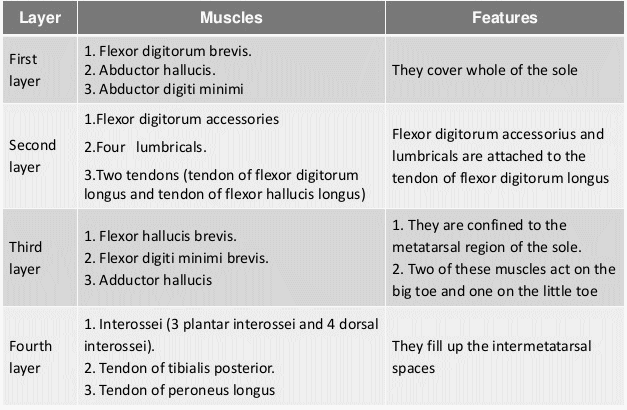
From superficial to deep, the layers are:

a. First layer

Mnemonic: Abs Flex Abs

  • Abductor hallucis
  • Flexor digitorum brevis (comparable to FDS of hand – both are superficial and insert into middle phalanx)
  • Abductor digiti minimii

b. Second layer

Mnemonic: Quadratus Lumborum OR you can also remember it with Flexor digitorum longus (comparable to FDP of hand – deeper and attaches to distal phalanx and the 2 muscles that attaches to FDL)

  • Quadratus plantae (Flexor digitorum accessorius)
  • Lumbricals (4)

Both of these muscles have attachment to the Flexor Digitorum Longus (FDL).

It also has 2 tendons of extrinsic muscles: Flexor digitorum longus (FDL) and Flexor hallucis longus (FHL).

It also has medial and lateral plantar nervers which are the terminal branches of tibial nerve.

c. Third layer

Mnemonic: Flex Add Flex (Opposite of first layer)

  • Flexor hallucis brevis
  • Adductor hallucis (like in hand, it has 2 heads – transverse and oblique)
  • Flexor digiti minimi

Both the flexor hallucis longus and brevis muscles have lateral origin, i.e. (distal fibula and cuboid/lateral cuneiform respectively) although they insert medially (towards great toe).

d. Fourth layer

Mnemonic: 4DAB and 3 PAD

  • 4 Dorsal interossei: ABduct MTP joint
  • 3 Plantar interossei: ADduct MTP joint
  • 2 tendons of extrinsic muscles: Peroneus longus and Tibialis posterior

9 compartments of foot
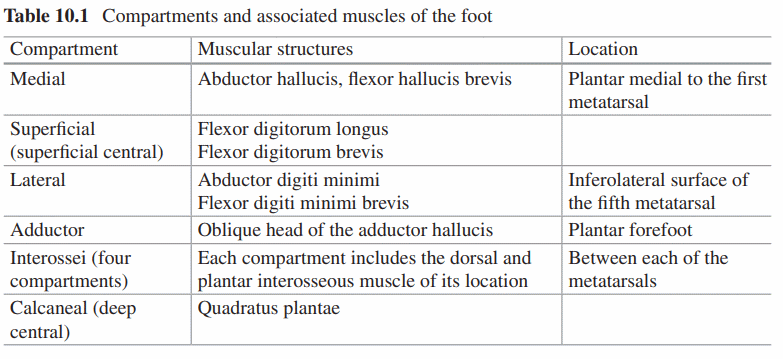
Please refer to an anatomy atlas and visualize for better understanding.
16 shares
  • Facebook
  • Twitter
PGMEE, MRCS, USMLE, MBBS, MD/MS AnatomyMusculoskeletal systemOrthopedics

Post navigation

Previous post
Next post

Related Posts

PGMEE, MRCS, USMLE, MBBS, MD/MS trinucleotide repeat disorders

Trinucleotide Repeat Disorders and Anticipation Mnemonics

Jan 23, 2017Jan 25, 2017

Anticipation in genetics refers to an increase in severity and decrease in age of onset in successive generations, most likely due to increased size of trinucleotide repeats. Paternal anticipation: Huntington’s disease, Friedreich’s Ataxia Maternal anticipation: Myotonic dystrophy, Fragile X syndrome Diseases Trinucleotide Repeat Affected gene Chromosome Fragile X syndrome CGG…

Read More
PGMEE, MRCS, USMLE, MBBS, MD/MS Mapleson breathing system

Mapleson Breathing Circuit Made Easy

Oct 17, 2016

Anatomy of Mapleson Breathing Circuit Basically, a mapleson breathing circuit consists of following parts: 1. Face mask (towards patient end) 2. Reservoir bag (towards operator end) Accommodates fresh gas flow during expiration acting as a reservoir available for the following inspiration. Acts as a monitor of patient’s ventilatory pattern during…

Read More
PGMEE, MRCS, USMLE, MBBS, MD/MS

Working formulation of NHL (Mnemonic)

Jan 16, 2019Feb 26, 2019

All follicular except large cell: Low grade All diffuse: Intermediate grade Blastic and non-cleaved: High grade

Read More

Leave a Reply Cancel reply

Your email address will not be published. Required fields are marked *

This site uses Akismet to reduce spam. Learn how your comment data is processed.

Epomedicine. Foot muscles – Layers and Compartments [Internet]. Epomedicine; 2020 Sep 3 [cited 2025 Dec 6]. Available from: https://epomedicine.com/medical-students/foot-muscles-layers-compartments/.

Pre-clinical (Basic Sciences)

Anatomy

Biochemistry

Community medicine (PSM)

Embryology

Microbiology

Pathology

Pharmacology

Physiology

Clinical Sciences

Anesthesia

Dermatology

Emergency medicine

Forensic

Internal medicine

Gynecology & Obstetrics

Oncology

Ophthalmology

Orthopedics

Otorhinolaryngology (ENT)

Pediatrics

Psychiatry

Radiology

Surgery

RSS Ask Epomedicine

  • What to study for Clinical examination in Orthopedics?
  • What is the mechanism of AVNRT?

Epomedicine weekly

  • About Epomedicine
  • Contact Us
  • Author Guidelines
  • Submit Article
  • Editorial Board
  • USMLE
  • MRCS
  • Thesis
©2025 Epomedicine . All rights reserved.