Skip to content
Epomedicine

Mnemonics, Simplified Concepts & Thoughts

Epomedicine

Mnemonics, Simplified Concepts & Thoughts

Enchondroma vs Chondrosarcoma (low grade) : Mnemonic

Epomedicine, Jan 24, 2024Jan 24, 2024

Among cartilaginous tumors, 2 pathologies can be misleading when trying to reach a correct diagnosis: enchondroma (E), a benign tumor, and low-grade chondrosarcoma (LGC), which is a low-aggressivity malignancy. This can be a problem when deciding treatment because E only requires regular follow-up, but LGC needs surgical treatment. 
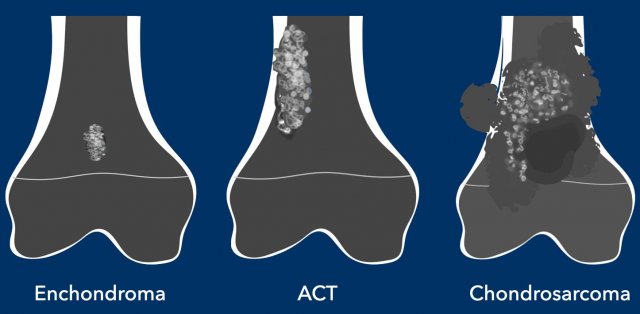
cartilage tumors
From: Cartilage tumors with special attention to Atypical Cartilaginous Tumors by Kirsten van Langevelde and Robin Smithuis (The Radiology Assistant : Cartilage tumors)

Mnemonic: ABCDE 3S

EnchondromaLow grade chondrosarcoma
AgeYoung adultsMiddle-aged
Bone scan uptakeIncreased in 20%Increased in 80%
Cortical breachSeen in 8%Seen in 88%
Deep endosteal scalloping (involving >2/3 cortical thickness)Seen in 10%Seen in 90%
Extra-osseous soft tissue massNot seenSeen
SiteAppendicular skeleton almost exclusively (when in phalanx, almost 100%)In axial skeleton, a chondral lesion is always a chondrosarcoma until the opposite is proven
Size<5 cm>5 cm
SufferingPainless unless pathologic fracturesInflammatory pain (almost always)

Reference:

  1. Enchondroma vs low grade chondrosarcoma | Radiology Reference Article | Radiopaedia.org
  2. Ferrer-Santacreu EM, Ortiz-Cruz EJ, González-López JM, Pérez Fernández E. Enchondroma versus Low-Grade Chondrosarcoma in Appendicular Skeleton: Clinical and Radiological Criteria. J Oncol. 2012;2012:437958. doi: 10.1155/2012/437958. Epub 2012 Apr 22. PMID: 22593766; PMCID: PMC3346996.

1 shares
  • Facebook
  • Twitter
PGMEE, MRCS, USMLE, MBBS, MD/MS Musculoskeletal systemOncologyOrthopedicsPathology

Post navigation

Previous post
Next post

Related Posts

PGMEE, MRCS, USMLE, MBBS, MD/MS

Pathophysiology of Acute Compartment syndrome

Apr 27, 2023Apr 27, 2023

Definition Mubarak and Hargens (1981) defined compartment syndrome as an elevation of the interstitial pressure in a closed osseofascial compartment that results in microvascular compromise. Pathophysiology Tissue perfusion = Capillary perfusion pressure – Interstitial fluid pressure 3 major theories for microvascular dysfunction and ischemia: Tissue survival: Vicious cycle of compartment…

Read More
PGMEE, MRCS, USMLE, MBBS, MD/MS

Patient Decision Making Capacities – CURVES mnemonic

Jun 27, 2020May 24, 2024

a. Choose and communicate Can the patient make a choice and communicate that choice? b. Understand Does the patient understand the risks, benefits, alternatives and consequences of the decision? c. Reason Can the patient provide logic or reason behind his/her decision? d. Value Is the choice the patient makes consistent…

Read More
PGMEE, MRCS, USMLE, MBBS, MD/MS

Proton Pump Inhibitors (PPI) Pharmacology : Mnemonics

Apr 28, 2021Apr 28, 2021

Relative Potency in Omeprazole Equivalent (OE) Mnemonic: PLOwER Pantoprazole (4.5 mg OE) Lansoprazole (13.5 mg OE) Omeprazole (20 mg OE) Esomeprazole (32 mg OE) Rabeprazole (36 mg OE) Side effects of PPI Mnemonic: KFC Kidney (Acute interstitial nephritis) Fractures (Hypochlorhydria leading to decreased serum calcium) C. difficile infection Besides, it…

Read More

Leave a Reply Cancel reply

Your email address will not be published. Required fields are marked *

This site uses Akismet to reduce spam. Learn how your comment data is processed.

Epomedicine. Enchondroma vs Chondrosarcoma (low grade) : Mnemonic [Internet]. Epomedicine; 2024 Jan 24 [cited 2026 Aug 12]. Available from: https://epomedicine.com/medical-students/enchondroma-vs-chondrosarcoma-low-grade-mnemonic/.

Pre-clinical (Basic Sciences)

Anatomy

Biochemistry

Community medicine (PSM)

Embryology

Microbiology

Pathology

Pharmacology

Physiology

Clinical Sciences

Anesthesia

Dermatology

Emergency medicine

Forensic

Internal medicine

Gynecology & Obstetrics

Oncology

Ophthalmology

Orthopedics

Otorhinolaryngology (ENT)

Pediatrics

Psychiatry

Radiology

Surgery

RSS Ask Epomedicine

  • What to study for Clinical examination in Orthopedics?
  • What is the mechanism of AVNRT?

Epomedicine weekly

  • About Epomedicine
  • Contact Us
  • Author Guidelines
  • Submit Article
  • Editorial Board
  • USMLE
  • MRCS
  • Thesis
©2026 Epomedicine | WordPress Theme by SuperbThemes