Skip to content
Epomedicine

Mnemonics, Simplified Concepts & Thoughts

Epomedicine

Mnemonics, Simplified Concepts & Thoughts

Osteoid Osteoma : Mnemonic

Epomedicine, May 13, 2022May 13, 2022

Epidemiology and Clinical features

Mnemonic: LMNOP

Lower extremity predilection (proximal femur > tibial diaphysis)

Male predilection (2:1 to 3:1)

Night pain relieved by NSAIDs (absent in osteoblastoma)

Osteogenic benign tumor

Prostaglandins (PGE2) and Cyclooxygenase (COX1 and 2) release by nidus (explains night pain and response to NSAIDs)
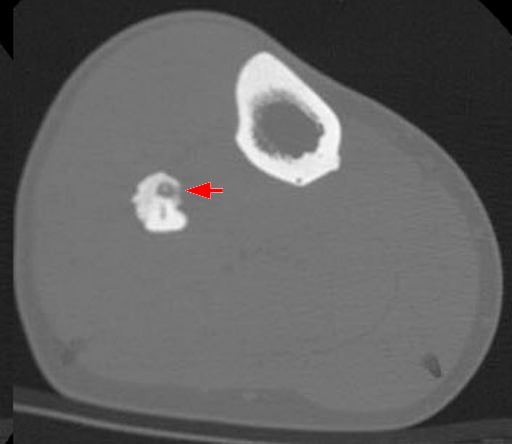
osteoid osteoma fibula nidus
Hellerhoff, CC BY-SA 3.0, via Wikimedia Commons

3 Concentric layers

Mnemonic: 3 R

  1. Radiolucent nidus in center (<1.5 cm) – centrally
    • Meshwork of dilated vessels, osteoblasts, osteoid and wove bone
    • Bull’s eye appearance on CT if center is calcified
    • Double density sign on Bone scan (hot uptake in nidus and cold uptake in reactive zone)
    • Size is >2 cm in osteoblastoma
  2. Rim of fibrovascular tissue – middle
    • Absent in osteoblastoma and osteosarcoma
  3. Reactive bone sclerosis – peripherally

Management

Mnemonic: MRSA

  1. MRgFUS (MR guided focused Ultrasound) ablation (new non-invasive and radiation free technique)
  2. Radiofrequency ablation (CT guided core biopsy followed by insertion of radiofrequency electrode through the cannula of biopsy needle and temperature of tip is increased to 90 degree celsius for 6 minutes)
    • Not indicated for vertebral lesions (risk of spinal cord injury)
    • Not indicated for small bones of hand and feet (risk of skin injury)
  3. Surgery (Curretage or En-bloc resection of nidus)
  4. Anti-inflammatory (Spontaneous healing of lesion may be attained in 3-4 years)
  • Facebook
  • Twitter
PGMEE, MRCS, USMLE, MBBS, MD/MS Musculoskeletal systemOncologyOrthopedics

Post navigation

Previous post
Next post

Related Posts

Emergency Medicine

Burn Injury : Mnemonic Approach (ATLS)

Aug 26, 2023Aug 26, 2023

Mnemonic: BURNS Burn depth and body surface area (BSA) Burn degree Burn depth Features Healing Mnemonic: Number of degrees = Number of structures involved Mnemonic: RBCS 1st Superficial (epidermis only) Red <1 wk 2nd Partial thickness – superficial (epidermis + papillary dermis) Blister + Blanches 1-3 wks Partial thickness –…

Read More
PGMEE, MRCS, USMLE, MBBS, MD/MS hip deformity

Hip and Shoulder Deformities

Jun 7, 2019Jun 7, 2019

HIP Flexion, Abduction, External rotation (FABER) + apparent lengthening: Synovitis Flexion, Abduction, External rotation (FABER) + true lengthening: Anterior dislocation of hip (Obturator) Extension+ Abduction + External rotation (EABER): Anterior dislocation of hip (Superior or Pubic) Flexion, Adduction, Internal rotation (FADIR) + true shortening: Arthritis, Posterior dislocation of hip Flexion,…

Read More
PGMEE, MRCS, USMLE, MBBS, MD/MS

Blood Supply of Talus

Jun 9, 2020Jun 9, 2020

3 Main Arteries Extraosseous and intraosseous anastomoses formed by 3 main arteries: Posterior tibial artery ~ 17% contribution Anterior tibial (dorsalis pedis) artery ~ 36% contribution Perforating peroneal artery ~ 47% contribution Major Branches Tarsal sinus artery: Arises from – Dorsalis pedis artery (frequently) or Lateral tarsal artery (branch of…

Read More

Leave a Reply Cancel reply

Your email address will not be published. Required fields are marked *

This site uses Akismet to reduce spam. Learn how your comment data is processed.

Pre-clinical (Basic Sciences)

Anatomy

Biochemistry

Community medicine (PSM)

Embryology

Microbiology

Pathology

Pharmacology

Physiology

Clinical Sciences

Anesthesia

Dermatology

Emergency medicine

Forensic

Internal medicine

Gynecology & Obstetrics

Oncology

Ophthalmology

Orthopedics

Otorhinolaryngology (ENT)

Pediatrics

Psychiatry

Radiology

Surgery

RSS Ask Epomedicine

  • What to study for Clinical examination in Orthopedics?
  • What is the mechanism of AVNRT?

Epomedicine weekly

  • About Epomedicine
  • Contact Us
  • Author Guidelines
  • Submit Article
  • Editorial Board
  • USMLE
  • MRCS
  • Thesis
©2026 Epomedicine | WordPress Theme by SuperbThemes