Opioid receptors are a group of inhibitory G protein-coupled receptors with opioids as ligands.
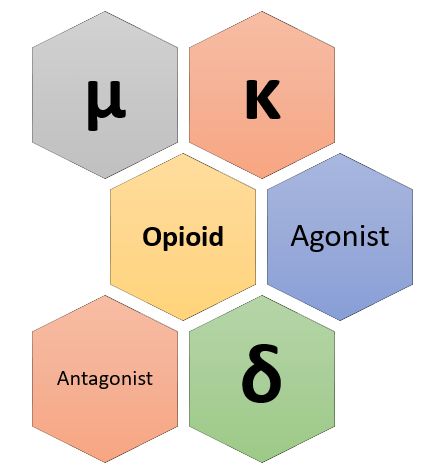
Mu (µ) Receptor (MOP)
Mnemonic: MU CARDS
- Miosis
- eUphoria
- Constipation
- Analgesia (Supraspinal + Spinal)
- Respiratory depression
- Rigidity (truncal)
- Dependency
- Sedation
µ1 mediates supraspinal analgesia, and most of other effects including spinal analgesia is mediated by µ2.
Kappa (κ) Receptor (KOP)
Mnemonic: CAPpA
- Constipation
- Analgesia (Spinal)
- Psychomimetic effects (Dysphoria)
- Anticonvulsant
Delta (δ) Receptor (DOP)
- Analgesia (Spinal)
- Modulation of hormone and neurotransmitter release
- Convulsant
Sigma (σ) Receptor
Mnemonic: S for Stimulation
- CNS stimulation: Hallucination and Dysphoria
- Respiratory stimulation
Other Receptors
- Nociceptin/Orphanin FQ (N/OFQ) or Orphanin like receptors (ORL1) or κ3, i.e. NOP
- Anxiety
- Depression
- Appetite
- Development of tolerance to mu-agonists
- Epsilon (ε) receptor
- Zeta (ζ) receptor
Selectivity of Opioids for receptors
|
RECEPTOR TYPE |
||||
|
Opioid |
MOP |
KOP |
DOP |
NOP |
| Endogenous | ||||
| Endorphin |
+++ |
+++ |
+++ |
– |
| Enkaphalin |
+ |
– |
+++ |
– |
| Dynorphin |
++ |
+++ |
+ |
+ |
| N/OFQ |
– |
– |
– |
+++ |
| Drugs | ||||
| Agonists | ||||
| Morphine |
+++ |
+ |
+ |
– |
| Pethidine |
+++ |
+ |
+ |
– |
| Diamorphine |
+++ |
+ |
+ |
– |
| Fentanyl |
+++ |
+ |
– |
– |
| Tramadol |
Weak agonist |
Weak agonist |
Weak agonist |
– |
| Codeine |
Weak agonist |
+ |
Weak agonist |
– |
| Partial agonists | ||||
| Buprenorphine |
Partial agonist |
Antagonistic |
Antagonistic |
– |
| Pentazocine, Nalbuphine |
Antagonist |
Agonist |
– |
– |
| Butorphanol, Nalorphine |
Antagonist |
Agonist/Parital-agonist |
– |
– |
| Antagonists | ||||
| Naloxone (parenteral) – nalmefene is long acting parenteral |
Antagonist |
Antagonist |
Weak antagonist |
– |
| Naltrexone (oral) |
Antagonist |
Antagonist |
Weak antagonist |
– |
Strong agonists of Mu are: 6 Ms
- Morphine
- Methadone
- Meperidine (Pethidine)
- hydroMorphone
- diaMorphine
- Methylfentanyl
Kappa receptor agonists and Mu receptor antagonists: BNP
- Butorphanol
- Nalorphine
- Nalbuphine
- Pentazocine
Partial agonist of Mu receptor and antagonist of other:
- Buprenorphine
Possess antimuscarinic effect: Contraindicated in MI but safe in biliary colic
Mnemonic: 2 Ps
- Pethidine
- Pentazocine
Management:
A. Opioid poisioning:
- Acute: Naloxone
- Maintenance: Naltrexone
B. Opioid de-addiction:
- Maintenance: Methadone
- Relapse prevention: Naltrexone
- Withdrawal symptom treatment: Beta-blockers/clonidine
C. Opioid induced constipation: Methyl-naltrexone

He is the section editor of Orthopedics in Epomedicine. He searches for and share simpler ways to make complicated medical topics simple. He also loves writing poetry, listening and playing music. He is currently pursuing Fellowship in Hip, Pelvi-acetabulum and Arthroplasty at B&B Hospital.
Superb…….
Thanks a million!