Skip to content
Epomedicine

Mnemonics, Simplified Concepts & Thoughts

Epomedicine

Mnemonics, Simplified Concepts & Thoughts

opioid receptors

Opioid Receptors Mnemonic

Dr. Sulabh Kumar Shrestha, MS Orthopedics, Jan 4, 2017Jan 7, 2017

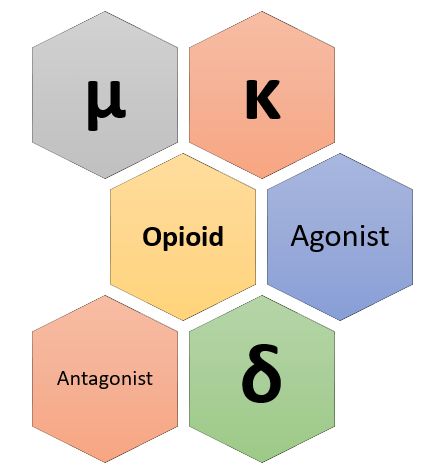
Opioid receptors are a group of inhibitory G protein-coupled receptors with opioids as ligands.
opioid receptors

Mu (µ) Receptor (MOP)

Mnemonic: MU CARDS

  1. Miosis
  2. eUphoria
  3. Constipation
  4. Analgesia (Supraspinal + Spinal)
  5. Respiratory depression
  6. Rigidity (truncal)
  7. Dependency
  8. Sedation

µ1 mediates supraspinal analgesia, and most of other effects including spinal analgesia is mediated by µ2.

Kappa (κ) Receptor (KOP)

Mnemonic: CAPpA

  1. Constipation
  2. Analgesia (Spinal)
  3. Psychomimetic effects (Dysphoria)
  4. Anticonvulsant

Delta (δ) Receptor (DOP)

  1. Analgesia (Spinal)
  2. Modulation of hormone and neurotransmitter release
  3. Convulsant

Sigma (σ) Receptor

Mnemonic: S for Stimulation

  1. CNS stimulation: Hallucination and Dysphoria
  2. Respiratory stimulation

Other Receptors

  1. Nociceptin/Orphanin FQ (N/OFQ) or Orphanin like receptors (ORL1) or κ3, i.e. NOP
    • Anxiety
    • Depression
    • Appetite
    • Development of tolerance to mu-agonists
  2. Epsilon (ε) receptor
  3. Zeta (ζ) receptor

Selectivity of Opioids for receptors


RECEPTOR TYPE

Opioid

MOP

KOP

DOP

NOP

Endogenous
Endorphin

+++

+++

+++

–

Enkaphalin

+

–

+++

–

Dynorphin

++

+++

+

+

N/OFQ

–

–

–

+++

Drugs
Agonists
Morphine

+++

+

+

–

Pethidine

+++

+

+

–

Diamorphine

+++

+

+

–

Fentanyl

+++

+

–

–

Tramadol

Weak agonist

Weak agonist

Weak agonist

–

Codeine

Weak agonist

+

Weak agonist

–

Partial agonists
Buprenorphine

Partial agonist

Antagonistic

Antagonistic

–

Pentazocine, Nalbuphine

Antagonist

Agonist

–

–

Butorphanol, Nalorphine

Antagonist

Agonist/Parital-agonist

–

–

Antagonists
Naloxone (parenteral) – nalmefene is long acting parenteral

Antagonist

Antagonist

Weak antagonist

–

Naltrexone (oral)

Antagonist

Antagonist

Weak antagonist

–

Strong agonists of Mu are: 6 Ms

  1. Morphine
  2. Methadone
  3. Meperidine (Pethidine)
  4. hydroMorphone
  5. diaMorphine
  6. Methylfentanyl

Kappa receptor agonists and Mu receptor antagonists: BNP

  1. Butorphanol
  2. Nalorphine
  3. Nalbuphine
  4. Pentazocine

Partial agonist of Mu receptor and antagonist of other:

  1. Buprenorphine

Possess antimuscarinic effect: Contraindicated in MI but safe in biliary colic

Mnemonic: 2 Ps

  1. Pethidine
  2. Pentazocine

Management:

A. Opioid poisioning:

  1. Acute: Naloxone
  2. Maintenance: Naltrexone

B. Opioid de-addiction:

  1. Maintenance: Methadone
  2. Relapse prevention: Naltrexone
  3. Withdrawal symptom treatment: Beta-blockers/clonidine

C. Opioid induced constipation: Methyl-naltrexone

dr. sulabh kumar shrestha
Dr. Sulabh Kumar Shrestha, MS Orthopedics

He is the section editor of Orthopedics in Epomedicine. He searches for and share simpler ways to make complicated medical topics simple. He also loves writing poetry, listening and playing music. He is currently pursuing Fellowship in Hip, Pelvi-acetabulum and Arthroplasty at B&B Hospital.

14 shares
  • Facebook13
  • Twitter
PGMEE, MRCS, USMLE, MBBS, MD/MS AnesthesiaNervous systemPharmacology

Post navigation

Previous post
Next post

Related Posts

PGMEE, MRCS, USMLE, MBBS, MD/MS

Rheumatoid hand

Oct 2, 2022Oct 2, 2022

Ulnar drift or deviation of fingers Normal anatomical factors contributing to ulnar drift of fingers at MCP joint: Normal mechanical advantage of ulnar intrinsic muscles Asymmetry and ulnar slope of metacarpal heads of index and middle fingers Greater ulnar deviation permitted by radial collateral ligament when MCP joint is flexed…

Read More
PGMEE, MRCS, USMLE, MBBS, MD/MS concentration effect

Concentration effect, Second gas effect and Diffusion hypoxia

Oct 20, 2016Oct 20, 2016

Concentration effect The higher the concentration of an inhaled anesthetic, the faster the alveolar concentration approaches the inhaled concentration. This is referred to as concentration effect and is clinically significant only in cases where gases are administered in high concentration: Nitrous oxide Xenon Ostwald’s blood gas solubility coefficient: ratio of…

Read More
PGMEE, MRCS, USMLE, MBBS, MD/MS

Lung Cancer : Mnemonics

Jun 20, 2024Jun 20, 2024

Types Most common cancer: Metastases Primary lung cancer: Type Frequency Location Association Features Small (oat) cell carcinoma 15% Sentral (central) Smoker Neuroendocrine differentiation (Kulchitsky cells)Aggressive (disseminate early – lymphadenopathy)Paraneoplastic syndrome (ACTH, ADH, Antibodies – Lambert eaton)InoperableChemosensitive Adenocarcinoma 40% Peripheral Non-smoker (most common) k-Ras, EGFR, ALK mutationsNodule/massHypertrophic osteoarthropathy (clubbing)Bronchio-alveolar subtype (pneumonia-like):…

Read More

Comments (2)

  1. Ahalya Sreeram Mallyath says:
    Jan 11, 2017 at 5:52 pm

    Superb…….

    Reply
  2. A.M says:
    Aug 14, 2024 at 8:41 am

    Thanks a million!

    Reply

Leave a Reply Cancel reply

Your email address will not be published. Required fields are marked *

This site uses Akismet to reduce spam. Learn how your comment data is processed.

Pre-clinical (Basic Sciences)

Anatomy

Biochemistry

Community medicine (PSM)

Embryology

Microbiology

Pathology

Pharmacology

Physiology

Clinical Sciences

Anesthesia

Dermatology

Emergency medicine

Forensic

Internal medicine

Gynecology & Obstetrics

Oncology

Ophthalmology

Orthopedics

Otorhinolaryngology (ENT)

Pediatrics

Psychiatry

Radiology

Surgery

RSS Ask Epomedicine

  • What to study for Clinical examination in Orthopedics?
  • What is the mechanism of AVNRT?

Epomedicine weekly

  • About Epomedicine
  • Contact Us
  • Author Guidelines
  • Submit Article
  • Editorial Board
  • USMLE
  • MRCS
  • Thesis
©2026 Epomedicine | WordPress Theme by SuperbThemes