Skip to content
Epomedicine

Mnemonics, Simplified Concepts & Thoughts

Epomedicine

Mnemonics, Simplified Concepts & Thoughts

Meniscal Tears on MRI

Epomedicine, Apr 24, 2025Apr 24, 2025

Meniscal tears are best seen on T1-weighted, gradient-echo and proton-density images. The menisci are low intensity on all sequences.

Morphologies

Meniscal tear morphologyDescriptionMRI appearance
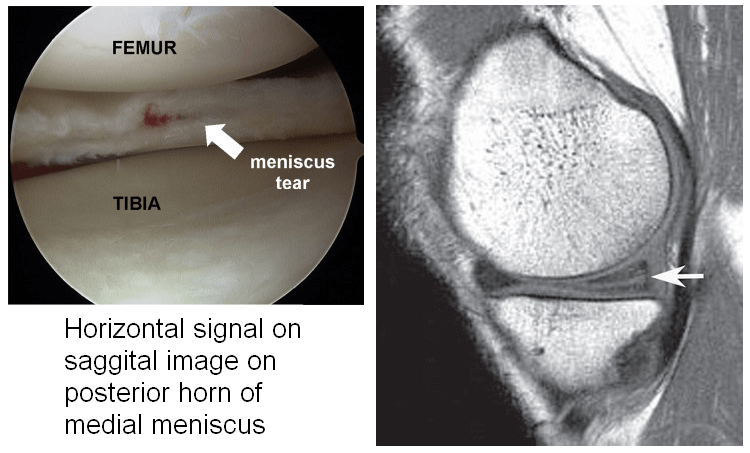
HorizontalSeparates meniscus into superior (femoral) & inferior (tibial) fragmentsPrimarily horizontal signal on sagittal images
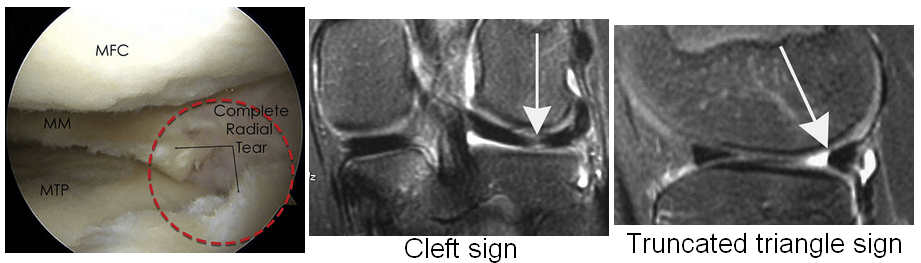
Vertical radialSplits central margin of meniscusVertical signal oriented perpendicular to the curvature of the meniscus (Cleft sign & Truncated triangle sign)
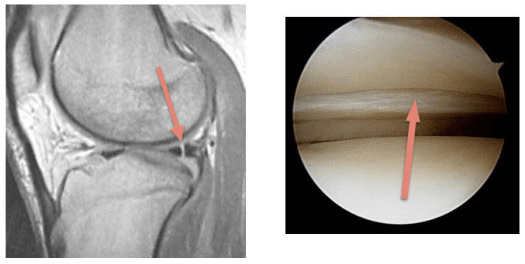
Vertical longitudinalExtends along length of meniscus; separates meniscus into inner & outer fragmentsVertical signal oriented parallel to the curvature of the meniscus
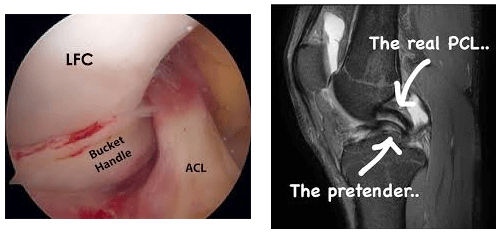
Bucket handleSubtype of the longitudinal tear in which the displaced central fragment resembles a bucket handle“Double PCL sign” – displaced fragment often seen parallel to the PCL in the intercondylar notch on sagittal images
ComplexCombination of multiple planes; commonly horizontal & radialCharacteristics of each tear type or fragmented/macerated
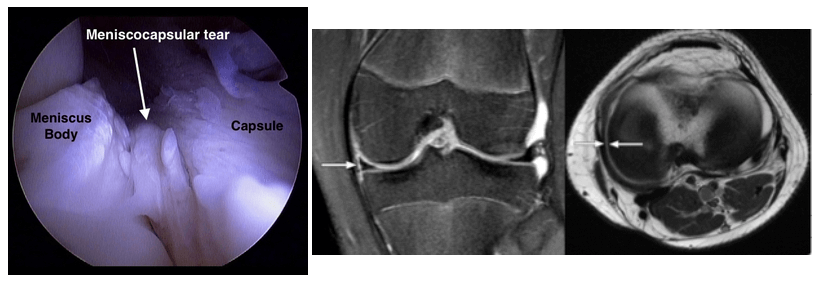
Meniscocapsular separationRupture of meniscus-capsule junctionIncreased signal between the edge of the meniscus & the capsule
horizontal meniscus tear
Horizontal meniscus tear
Radial meniscus tear
Vertical signal oriented perpendicular to the curvature of the meniscus – Radial meniscus tear
longitudinal meniscus tear
Vertical signal perpendicular to tibial plateau but parallel to the axis of meniscus – Longitudinal tear
bucket handle meniscus tear
Double PCL sign – Buckethandle tear
meniscocapsular separation
Increased signal between the edge of the meniscus & the capsule – Meniscocapsular separation

Grading

  • Grade 1: Degenerative process – focal, globular intrasubstance increased signal
  • Grade 2: Degenerative process – horizontal, linear intrasubstance increased signal
  • Grade 3: Meniscal tear – increased signal extends to or communicates with at least 1 articular surface
  • Grade 4: Complex tear/macerated meniscus
  • Facebook
  • Twitter
PGMEE, MRCS, USMLE, MBBS, MD/MS Musculoskeletal systemOrthopedicsRadiology

Post navigation

Previous post
Next post

Related Posts

PGMEE, MRCS, USMLE, MBBS, MD/MS rVSV-ZEBOV

Ebola Virus Disease

Feb 19, 2016May 5, 2016

Author: Sulabh Kumar Shrestha, KISTMCTH The “Red Death” had long devastated the country. No pestilence had ever been so fatal, or so hideous. Blood was its Avatar and its seal—the redness and the horror of blood. There were sharp pains, and sudden dizziness, and then profuse bleeding at the pores, with dissolution. The scarlet stains…

Read More
PGMEE, MRCS, USMLE, MBBS, MD/MS

Proton Pump Inhibitors (PPI) Pharmacology : Mnemonics

Apr 28, 2021Apr 28, 2021

Relative Potency in Omeprazole Equivalent (OE) Mnemonic: PLOwER Pantoprazole (4.5 mg OE) Lansoprazole (13.5 mg OE) Omeprazole (20 mg OE) Esomeprazole (32 mg OE) Rabeprazole (36 mg OE) Side effects of PPI Mnemonic: KFC Kidney (Acute interstitial nephritis) Fractures (Hypochlorhydria leading to decreased serum calcium) C. difficile infection Besides, it…

Read More
PGMEE, MRCS, USMLE, MBBS, MD/MS

How to check an Error in ABG ? ABG analysis

May 1, 2023May 1, 2023

Sometimes, clinicians might find ABG result not matching with the patient condition. These results might arise from technical errors in machine and there are certain points which can be used to check the error. How to Check whether ABG result is Right or has Error? X= 24X PaCO2/HCO3 Y= 80-…

Read More

Leave a Reply Cancel reply

Your email address will not be published. Required fields are marked *

This site uses Akismet to reduce spam. Learn how your comment data is processed.

Pre-clinical (Basic Sciences)

Anatomy

Biochemistry

Community medicine (PSM)

Embryology

Microbiology

Pathology

Pharmacology

Physiology

Clinical Sciences

Anesthesia

Dermatology

Emergency medicine

Forensic

Internal medicine

Gynecology & Obstetrics

Oncology

Ophthalmology

Orthopedics

Otorhinolaryngology (ENT)

Pediatrics

Psychiatry

Radiology

Surgery

RSS Ask Epomedicine

  • What to study for Clinical examination in Orthopedics?
  • What is the mechanism of AVNRT?

Epomedicine weekly

  • About Epomedicine
  • Contact Us
  • Author Guidelines
  • Submit Article
  • Editorial Board
  • USMLE
  • MRCS
  • Thesis
©2026 Epomedicine | WordPress Theme by SuperbThemes