Skip to content
Epomedicine

Mnemonics, Simplified Concepts & Thoughts

Epomedicine

Mnemonics, Simplified Concepts & Thoughts

Proapoptotic and Antiapoptotic

Apoptosis (Caspases and Genes) : Mnemonics

Epomedicine, Jan 5, 2017Aug 13, 2023

Caspases (Pro-apoptotics)

Initiator caspases:

  1. Intrinsic – 9 (IN for nINe); also 2 (Roman numeral II – I for Intrinsic)
  2. Extrinsic – 8 (E for Eight); also 10 (Roman numeral X – X for eXtrinsic)

Executioner caspases: 3 and 7

  • Executioner is synonymous to hangman.
  • Remember the gallow – it resembles “7“.
  • Executioner starts with “E” – reverse of E is 3 (most important).

Pro-apoptotic genes

Mnemonic: “B” followed by a vowel

  1. BAX
  2. BAD
  3. BAK
  4. BIM
  5. BID
  6. BIK
  7. BOK

Exception: BCL-XS is pro-apoptotic.

Others: CDEFgH

  1. Cytochrome C
  2. Diablo/Smac (Inhibits inhibitor of apoptosis)
  3. Endonuclease G
  4. Fas
  5. HtrA2
Proapoptotic and Antiapoptotic

Anti-apoptotic genes

Mnemonic: Contains “L” or “XL”

  1. BCL-2
  2. BCL-XL
  3. MCL-1
  4. BCL-W
  5. MCL-1

Other: Inhibitor of Apoptosis (XIAP)

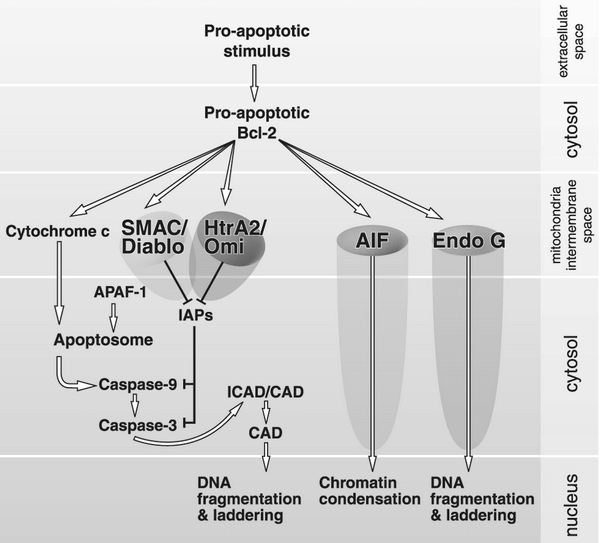
How all these genes and molecules work together to complete apoptosis? Find it here.
18 shares
  • Facebook18
  • Twitter
PGMEE, MRCS, USMLE, MBBS, MD/MS General conceptsPathology

Post navigation

Previous post
Next post

Related Posts

PGMEE, MRCS, USMLE, MBBS, MD/MS

Unhappy Triad of O’Donoghue : Mnemonic

Oct 19, 2024Oct 19, 2024

O’Donoghue unhappy triad is occurrence of 3 different soft tissue injuries of knee simultaneously. It includes: Mnemonic: MAM Mechanism: valgus stress with rotation of the knee Later on, more studies emerged showing that injuries in the lateral meniscus were more prevalent than injuries in the medial meniscus. The unhappy triad…

Read More
PGMEE, MRCS, USMLE, MBBS, MD/MS

Osteogenesis Imperfecta : Mnemonic

Oct 28, 2022Aug 13, 2023

Synonym: Brittle Bone Disease Incidence: 1 in 20,000 Gene defect: Col1A1 (17q) and Col1A2 (7q) Mnemonic: Remember “one” for “bone”. Collagen one is the main composition of bone. OI is a disorder of bone. Hence, the defect is is in Col1. Features Mnemonic: BLOOD Sillence Type Inheritance Features Mnemonic Collagen…

Read More
PGMEE, MRCS, USMLE, MBBS, MD/MS erythropoietin mechanism

Erythropoietin (EPO) Physiology

Sep 2, 2017

Structure of erythropoietin (EPO) Glycoprotein hormone 165 amino acids Molecular mass – 30 kDa Site of production/synthesis of erythropoietin (EPO) Kidneys (75-90%): Peritubular interstitial cells Liver (15%; chief source in fetus and neonates): Centrilobular hepatocytes After birth, erythropoietin is not detectable until 8-12 weeks after birth leading to physiological anaemia…

Read More

Leave a Reply Cancel reply

Your email address will not be published. Required fields are marked *

This site uses Akismet to reduce spam. Learn how your comment data is processed.

Epomedicine. Apoptosis (Caspases and Genes) : Mnemonics [Internet]. Epomedicine; 2017 Jan 5 [cited 2026 May 21]. Available from: https://epomedicine.com/medical-students/learning-apoptosis-mnemonics/.

Pre-clinical (Basic Sciences)

Anatomy

Biochemistry

Community medicine (PSM)

Embryology

Microbiology

Pathology

Pharmacology

Physiology

Clinical Sciences

Anesthesia

Dermatology

Emergency medicine

Forensic

Internal medicine

Gynecology & Obstetrics

Oncology

Ophthalmology

Orthopedics

Otorhinolaryngology (ENT)

Pediatrics

Psychiatry

Radiology

Surgery

RSS Ask Epomedicine

  • What to study for Clinical examination in Orthopedics?
  • What is the mechanism of AVNRT?

Epomedicine weekly

  • About Epomedicine
  • Contact Us
  • Author Guidelines
  • Submit Article
  • Editorial Board
  • USMLE
  • MRCS
  • Thesis
©2026 Epomedicine | WordPress Theme by SuperbThemes