Skip to content
Epomedicine

Mnemonics, Simplified Concepts & Thoughts

Epomedicine

Mnemonics, Simplified Concepts & Thoughts

trinucleotide repeat disorders

Trinucleotide Repeat Disorders and Anticipation Mnemonics

Epomedicine, Jan 23, 2017Jan 25, 2017

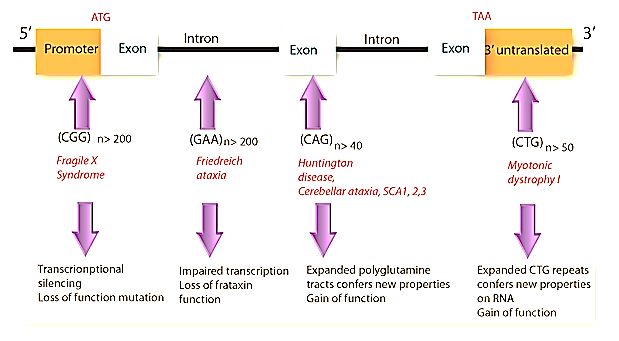
Anticipation in genetics refers to an increase in severity and decrease in age of onset in successive generations, most likely due to increased size of trinucleotide repeats.

  • Paternal anticipation: Huntington’s disease, Friedreich’s Ataxia
  • Maternal anticipation: Myotonic dystrophy, Fragile X syndrome
Diseases
Trinucleotide Repeat Affected gene Chromosome
Fragile X syndrome CGG FMR1 X chromosome
Friedrich’s ataxia GAA FXN 9
Huntington’s disease CAG HTT 4
Myotonic dystrophy – type 1 CTG DMPK 19

Friedrich’s ataxia

  • Trinucleotide repeat: GAA (Out of the four, only one to start with letter G).
  • Chromosomal mapping of affected gene: Chromosome 9 (Mnemonic: FRIEDRICH has 9 letters).
  • Clinical features: Mnemonic – FRIEDREICH’S Ataxia
    • Foot – Pes cavus
    • Reflexes (Knee and Ankle jerks) – Absent
    • Intention tremors
    • Extensor plantar response, Eye – Optic atrophy
    • Diabetes mellitus, Dorsal column degeneration
    • Recessive Inheritance
    • Cerebellar signs, Cranial nerve 7, 10 and 12 involvement
    • Hypertrophic cardiomyopathy
    • Scoliosis
    • Ataxia, Axonal neuropathy

trinucleotide repeat disorders

Trinucleotide repeat of the other 3 disorders, starts with C and ends with G, i.e. C_G.

Huntington’s disease

Mnemonic: Hunter’s CAGe

  • Trinucleotide repeat: CAG
  • Chromosomal mapping of affected gene: Chromosome 4 (Cage has 4 letters).
  • Clinical features and Pathophysiology: Mnemonic – CAGED
    • Caudate and putamen atrophy and Choreiform movements
    • Agression/psychosis, depression and dementia
    • Glutamate excitotoxicity mediated death
    • Ex-vacuo hydrocephalus
    • Dopamine increased; GABA and ACh decreased
    • Deacetylation of histone increased – Deacetylation makes DNA-histone bond strong and genomes unavailable for transcription (transcriptional repression or silencing)

Myotonic dystrophy

Mnemonic: See the 4th letter. dysTrophia myoTonica

  • Trinucleotide repeat: CTG
  • Chromosomal mapping of affected gene: Chromosome 19 (dystrophia myotonica has 19 letters)
  • Clinical features: Mnemonic – DySTROPHIC
    • Distal muscles weakness and wasting, Dysmotility of GI muscles and biliary tree, Dementia
    • Swan-like neck
    • Testicular atrophy
    • Reflexes depressed or absent
    • Ocular cataract and ptosis
    • Pilomatrixomas (skin), Pulmonary infections, Pseudodrop attack due to quadriceps weakness
    • Haggard or Hatchet facies, Hair loss (frontal balding)
    • Intrinsic muscles of hand wasting, IQ low, Irritable Bowel Syndrome
    • Cardiomyopathy and arrhythmias

Fragile X syndrome

Mnemonic: See the 4th letter. fraGile

  • Trinucleotide repeat: CGG
  • Chromosomal mapping of affected gene: X chromosome (fragile X)
  • Clinical features and Pathophysiology: Everything is big
    • Thick brain: Mental retardation (2nd most common genetic cause of mental retardation after Down’s syndome), ADHD (female), Autism
    • Long face
    • Large jaw
    • Large ears
    • Large testicles (macro-orchidism)
    • Increased methylation (Hypermethylation of FMR gene due to >200 CGG repeats) leading to inactivation and prevention of transcription.
8 shares
  • Facebook8
  • Twitter
PGMEE, MRCS, USMLE, MBBS, MD/MS BiochemistryGeneral conceptsPathology

Post navigation

Previous post
Next post

Related Posts

PGMEE, MRCS, USMLE, MBBS, MD/MS aion

Sudden Vision Loss : Simplified Approach

Aug 11, 2015Aug 18, 2015

Acute or sudden vision loss is due to one of the following causes: Opacification of normally transparent structures anterior to retina Retinal abnormalities Abnormalities of optic nerve and visual pathway Systematic history and ocular examination is necessary. Step 1: Unilateral or Bilateral Sudden vision loss ? Monocular loss of vision:…

Read More
PGMEE, MRCS, USMLE, MBBS, MD/MS priming, precurarization and self-taming

Priming, Precurarization and Self taming

Oct 21, 2016

Priming Administration of a small sub-paralyzing dose of non-depolarizing muscular blocking agent (usually 10% of the intubating dose) is given 2-4 minutes before administering a 2nd large dose for tracheal intubation to accelerate the onset of non-depolarizing NM blockade by 30-60 seconds. Mechanism and Concept of Priming 2 theories have…

Read More
PGMEE, MRCS, USMLE, MBBS, MD/MS

Beta-Blockers : Mnemonics

Aug 12, 2019Aug 12, 2019

We have 1 heart and 2 lungs. a. B1 – heartb. B2 – bronchial wall Cardioselective (B1) vs Non-selective (B1 and B2) beta blockers Beta blockers with 1st letter from A to N are Cardioselective: Acebutolol Atenolol Bispoprolol Betaxolol Celiprolol Esmolol Metoprolol Nebivolol Nebivolol = NO donor Beta blockers with…

Read More

Comment

  1. Rasha says:
    Mar 5, 2021 at 12:26 am

    I love the the way you simplify the subject especially the mnemonics and but could you add the age of onset and death, cause of death and images if available thanks

    Reply

Leave a Reply to Rasha Cancel reply

Your email address will not be published. Required fields are marked *

This site uses Akismet to reduce spam. Learn how your comment data is processed.

Pre-clinical (Basic Sciences)

Anatomy

Biochemistry

Community medicine (PSM)

Embryology

Microbiology

Pathology

Pharmacology

Physiology

Clinical Sciences

Anesthesia

Dermatology

Emergency medicine

Forensic

Internal medicine

Gynecology & Obstetrics

Oncology

Ophthalmology

Orthopedics

Otorhinolaryngology (ENT)

Pediatrics

Psychiatry

Radiology

Surgery

RSS Ask Epomedicine

  • What to study for Clinical examination in Orthopedics?
  • What is the mechanism of AVNRT?

Epomedicine weekly

  • About Epomedicine
  • Contact Us
  • Author Guidelines
  • Submit Article
  • Editorial Board
  • USMLE
  • MRCS
  • Thesis
©2026 Epomedicine | WordPress Theme by SuperbThemes