Skip to content
Epomedicine

Mnemonics, Simplified Concepts & Thoughts

Epomedicine

Mnemonics, Simplified Concepts & Thoughts

somogyi dawn waning effect

Somogyi effect and Dawn Phenomenon – Mnemonic

Epomedicine, Jul 25, 2019Jul 25, 2019

Both Somogyi effect and Dawn phenomenon are the cause of MORNING FASTING HYPERGLYCEMIA.

Mnemonic:

Somogyi = So Much Insulin
Dawn = Down Insulin

a. Somogyi effect:

Excess exogenous insulin → Middle night hypoglycemia → Release of counter-regulatory hormones → Rebound morning hyperglycemia

b. Dawn effect:

Normal release of morning hormones (growth hormones, cortisol, catecholamines) → Inadequate endogenous insulin production → Morning hyperglycemia
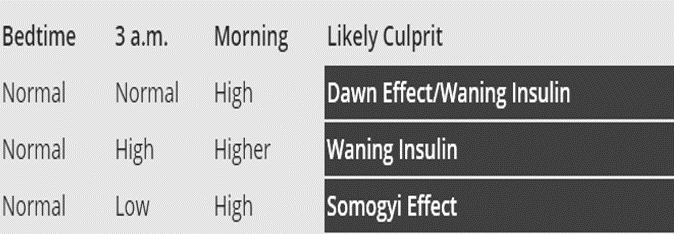
Differentiating somogyi and dawn effect as the cause of morning hyperhlycemia:

Measure blood glucose at 2-3 AM, and at normal wake-up time for several nights:

  1. Low blood glucose at 2-3 AM: Somogyi effect
  2. Normal or high blood glucose at 2-3 AM: Dawn phenomenon
6 shares
  • Facebook6
  • Twitter
PGMEE, MRCS, USMLE, MBBS, MD/MS Endocrine systemInternal medicinePediatrics

Post navigation

Previous post
Next post

Related Posts

PGMEE, MRCS, USMLE, MBBS, MD/MS VDJ diversity

VDJ (Somatic) Recombination Made Easy

Jun 19, 2016

Many students feel that, this is one of the most difficult to explain topic in Immunology. Here, we will try to explain the process and clinical relevance of V(D)J or Somatic recombination in simple and interactive way. Question your mind Humans only have about 25,000 genes.  Since, an antibody made…

Read More
PGMEE, MRCS, USMLE, MBBS, MD/MS liporptoein receptors

Lipoprotein Metabolism Simplified

Jul 6, 2016Jul 30, 2018

Lipoproteins Composition of Lipoproteins: Non-polar core – mainly triglycerides and cholesteryl esters Single surface layer – amphipathic phospholipids and cholesterol Apoprotein or Apolipoprotein Class Abbreviation Density Protein Lipid content Electrophoretic mobility Chylomicrons CM lowest lowest highest (exogenous triacylglycerol) don’t migrate Very low density lipoproteins VLDL .. .. .. (endogenous triacylglycerol)…

Read More
PGMEE, MRCS, USMLE, MBBS, MD/MS

ASA Classification: Made Easy

May 26, 2023Aug 16, 2023

The purpose of the system is to assess and communicate a patient’s pre-anesthesia medical co-morbidities. The classification system alone does not predict the perioperative risks, but used with other factors (e.g., type of surgery, frailty, level of deconditioning), it can be helpful in predicting perioperative risks. ASA grade Definition Mortality…

Read More

Comments (2)

  1. Deepak Das says:
    Jul 26, 2019 at 5:23 am

    Good morning.Excellent mnemonics.

    Reply
  2. Kelvin says:
    Jul 17, 2023 at 6:43 am

    Great mnemonics, awesome

    Reply

Leave a Reply to Kelvin Cancel reply

Your email address will not be published. Required fields are marked *

This site uses Akismet to reduce spam. Learn how your comment data is processed.

Pre-clinical (Basic Sciences)

Anatomy

Biochemistry

Community medicine (PSM)

Embryology

Microbiology

Pathology

Pharmacology

Physiology

Clinical Sciences

Anesthesia

Dermatology

Emergency medicine

Forensic

Internal medicine

Gynecology & Obstetrics

Oncology

Ophthalmology

Orthopedics

Otorhinolaryngology (ENT)

Pediatrics

Psychiatry

Radiology

Surgery

RSS Ask Epomedicine

  • What to study for Clinical examination in Orthopedics?
  • What is the mechanism of AVNRT?

Epomedicine weekly

  • About Epomedicine
  • Contact Us
  • Author Guidelines
  • Submit Article
  • Editorial Board
  • USMLE
  • MRCS
  • Thesis
©2026 Epomedicine | WordPress Theme by SuperbThemes