Skip to content
Epomedicine

Mnemonics, Simplified Concepts & Thoughts

Epomedicine

Mnemonics, Simplified Concepts & Thoughts

somogyi dawn waning effect

Somogyi effect and Dawn Phenomenon – Mnemonic

Epomedicine, Jul 25, 2019Jul 25, 2019

Both Somogyi effect and Dawn phenomenon are the cause of MORNING FASTING HYPERGLYCEMIA.

Mnemonic:

Somogyi = So Much Insulin
Dawn = Down Insulin

a. Somogyi effect:

Excess exogenous insulin → Middle night hypoglycemia → Release of counter-regulatory hormones → Rebound morning hyperglycemia

b. Dawn effect:

Normal release of morning hormones (growth hormones, cortisol, catecholamines) → Inadequate endogenous insulin production → Morning hyperglycemia
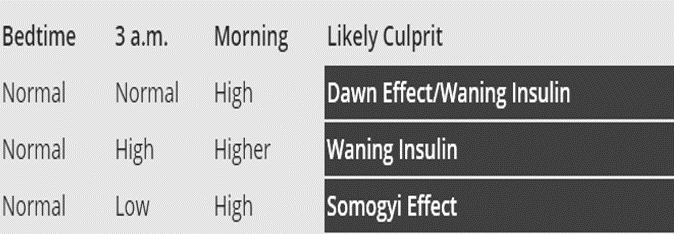
Differentiating somogyi and dawn effect as the cause of morning hyperhlycemia:

Measure blood glucose at 2-3 AM, and at normal wake-up time for several nights:

  1. Low blood glucose at 2-3 AM: Somogyi effect
  2. Normal or high blood glucose at 2-3 AM: Dawn phenomenon
6 shares
  • Facebook6
  • Twitter
PGMEE, MRCS, USMLE, MBBS, MD/MS Endocrine systemInternal medicinePediatrics

Post navigation

Previous post
Next post

Related Posts

PGMEE, MRCS, USMLE, MBBS, MD/MS

Branches of Celiac trunk, Superior and Inferior mesenteric arteries and veins

May 13, 2024May 13, 2024

Celiac trunk (T12) Mnemonic: LHS (Left Hand Side) Supplies Foregut (Upto opening of bile duct in 2nd part of duodenum) 1. Left gastric artery 2. Hepatic artery (common) 3. Splenic artery Superior Mesenteric Artery (L1) Mnemonic: IMRIS Supplies Midgut (Upto proximal 2/3 of transverse colon) 1. Inferior pancreaticoduodenal artery 2….

Read More
PGMEE, MRCS, USMLE, MBBS, MD/MS

Idiopathic Scoliosis Made Easy

Jul 30, 2022Oct 28, 2022

Definition Cobb’s angle >10° Diagnosis of exclusion: Congenital scoliosis and Neuromuscular scoliosis ruled out Types: Early onset (<10 years): Infantile: 0-3 years Juvenile: 4-10 years Late onset (>10 years) Adolescent: 10-18 years Adult: >18 years Indications for MRI in general Mnemonic: Left JAPAN Left thoracic curves Juvenile onset (<10 years)…

Read More
PGMEE, MRCS, USMLE, MBBS, MD/MS

Protected: MRCS Part A, September 2023 – Recalls

Jan 20, 2024May 17, 2024

There is no excerpt because this is a protected post.

Read More

Comments (2)

  1. Deepak Das says:
    Jul 26, 2019 at 5:23 am

    Good morning.Excellent mnemonics.

    Reply
  2. Kelvin says:
    Jul 17, 2023 at 6:43 am

    Great mnemonics, awesome

    Reply

Leave a Reply to Deepak Das Cancel reply

Your email address will not be published. Required fields are marked *

This site uses Akismet to reduce spam. Learn how your comment data is processed.

Pre-clinical (Basic Sciences)

Anatomy

Biochemistry

Community medicine (PSM)

Embryology

Microbiology

Pathology

Pharmacology

Physiology

Clinical Sciences

Anesthesia

Dermatology

Emergency medicine

Forensic

Internal medicine

Gynecology & Obstetrics

Oncology

Ophthalmology

Orthopedics

Otorhinolaryngology (ENT)

Pediatrics

Psychiatry

Radiology

Surgery

RSS Ask Epomedicine

  • What to study for Clinical examination in Orthopedics?
  • What is the mechanism of AVNRT?

Epomedicine weekly

  • About Epomedicine
  • Contact Us
  • Author Guidelines
  • Submit Article
  • Editorial Board
  • USMLE
  • MRCS
  • Thesis
©2026 Epomedicine | WordPress Theme by SuperbThemes