Skip to content
Epomedicine

Mnemonics, Simplified Concepts & Thoughts

Epomedicine

Mnemonics, Simplified Concepts & Thoughts

ORS resomal

ORS and ReSoMal – Mnemonic

Epomedicine, Jun 11, 2019Jun 11, 2019

Oral Rehydration Solution (ORS)

Grams per litre:

  1. SoDIum C-hloride: 2.6 gm
  2. SoDIum Ci-Trate: 2.9 gm
  3. Potassium chloride: 1.5 gm
  4. Glucose anhydrous: 13.5 gm

Mnemonic:

DI = 2 and C = 6
Ci-Trate = Rotate 6, i.e. 9
For Potassium chloride: Deduct 1 from the whole number and decimal both, i.e. (2-1).(6-1) = 1.5 gm

mmol per litre:

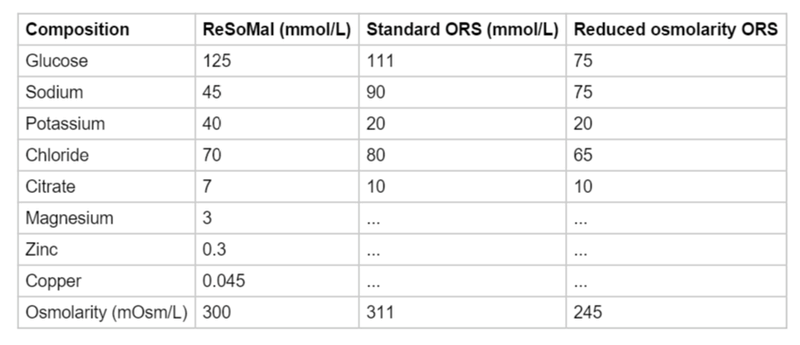
  1. Sodium and Glucose (Sugar): 75 each
  2. Chloride: 65
  3. Potassium: 20
  4. Citrate: 10
    Total: 245

Mnemonic:

S for Sodium and Sugar; S for 75
Sodium – 10 = Chloride = 65
Potassium – 10 = Citrate = 10
ors resomal

Rehydration Solution for Malnutrition (ReSoMal)

1 ORS packet + 50 gm sugar + 40 gm electrolytes and minerals (Cu, Zn, Mg) + 2 litre water

mmol/litre

  1. Sodium: ORS – 30 = 75-30 = 45
  2. Citrate: ORS – 3 = 10-3 = 7
  3. Glucose: ORS + 50 = 75+50 = 125
  4. Chloride: ORS + 5 = 65+5 = 70
  5. Potassium: ORS X 2 = 20 X 2 = 40
  6. Cu, Zn, Mn = 4
    Total = 300

Another Mnemonic:
1. Sodium and Potassium are almost equal. Take the mean of their ORS concentration, i.e. (75+20)/2 ~ 45 + 40
2. Remember the pairs:
Potassium and Minerals: 40 and 4 respsectively
Chloride and Citrate: 70 and 7 respectively
  • Facebook
  • Twitter
PGMEE, MRCS, USMLE, MBBS, MD/MS Gastrointestinal systemPediatrics

Post navigation

Previous post
Next post

Related Posts

PGMEE, MRCS, USMLE, MBBS, MD/MS

Scapular Dyskinesis

Apr 16, 2025Apr 16, 2025

Definition: Abnormal scapular motion which may refer to – Causes: 1. Primary: Due to abnormalities arising in Scapulo-thoracic articulation, periscapular muscles and nerves 2. Secondary: Response to shoulder abnormalities Types: It is categorized into three main types based on the prominence of specific areas of the scapula during movement. Clinical…

Read More
PGMEE, MRCS, USMLE, MBBS, MD/MS s2 split

Abnormalities of First and Second Heart Sound

Aug 30, 2016

In the chapter of cardiac cycle, we have discussed the mechanism of production of heart sounds and their physiologic splitting. First Heart Sound (S1) Mechanism Closure of atrioventricular valves. It is best appreciated in mitral and tricuspid area of chest for respective components. Loud S1 Slamming a door from a…

Read More
PGMEE, MRCS, USMLE, MBBS, MD/MS

Pathophysiology of Osteomyelitis

Aug 15, 2020Jul 23, 2022

Osteomyelitis is defined as an inflammation of the bone (single portion or numerous regions, like marrow, cortex, periosteum and surrounding soft tissue) caused by an infecting organism (usually monomicrobial but polymicrobial can occur, especially in diabetic foot). Definitions, Criteria and Classifications of different types of Osteomyelitis have been discussed in…

Read More

Comment

  1. Deepak Das says:
    Jun 14, 2019 at 5:00 am

    Excellent mnemonics every week you send to me.Extremely grateful.I need more like the following.
    1.Ac.pancreatitis :BISHAP,RANSON score etc.
    2.Hepatic encephalopathy

    Reply

Leave a Reply Cancel reply

Your email address will not be published. Required fields are marked *

This site uses Akismet to reduce spam. Learn how your comment data is processed.

Pre-clinical (Basic Sciences)

Anatomy

Biochemistry

Community medicine (PSM)

Embryology

Microbiology

Pathology

Pharmacology

Physiology

Clinical Sciences

Anesthesia

Dermatology

Emergency medicine

Forensic

Internal medicine

Gynecology & Obstetrics

Oncology

Ophthalmology

Orthopedics

Otorhinolaryngology (ENT)

Pediatrics

Psychiatry

Radiology

Surgery

RSS Ask Epomedicine

  • What to study for Clinical examination in Orthopedics?
  • What is the mechanism of AVNRT?

Epomedicine weekly

  • About Epomedicine
  • Contact Us
  • Author Guidelines
  • Submit Article
  • Editorial Board
  • USMLE
  • MRCS
  • Thesis
©2026 Epomedicine | WordPress Theme by SuperbThemes