Capture or Tethering
- Increased vascular permeability and vasodilation are mediated by inflammatory mediators like histamine released by inflammatory cells in response to PAMPs expressed by pathogens.
- Hemoconcentration (owing to increased vascular permeability) and decreased velocity of blood flow (owing to vasodilation) leads to peripheral pooling of the leukocytes (i.e. towards the endothelium) – process called as margination.
- Following margination, capture occurs and this process is mediated by interaction between P-selectin on endothelium and PSGL-1 (P-Selectin Glycoprotein Ligand -1) on leukocytes
Rolling
Rolling occurs below the critical velocity (velocity separating freely flowing cells like RBCs and rolling leukocytes). It is mediated by selectin-addressins interaction.
Selectins
- P-selectins are expressed on the endothelial surface.
- Remember P-selectins are found on Platelets and webel-Pallade bodies present on human endothelium.
- P-selectins are the largest and most important of all selectins.
- L-selectins are expressed on Leukocytes
- L-selectin is more efficient than P-selectin in mediating rolling
- Smallest selectin (Remember: L for Little)
- E-selectins on activated endothelium
- Responsible for slow rolling and initiation of of firm adhesion
Addressins (Selectin Ligands)
- P-selectin: PSGL-1 (expressed on blood cells and contains Sialyl Lewis-X)
- L-selectin: GlyCAM-1 (Glycosylation Dependent Cell Adhesion Molecular), MAdCAM-1 (Mucosal Addressin Cell Adhesion Molecule) and CD34
- E-selectin: Not yet known
Activation by Chemoattractants
Activators
- IL-8
- C5a
- N-formyl peptide
Activation
- Confirmational change of leukocyte to high affinity states by activation of integrins

Arrest and Adhesion
Tight binding of phagocytes to the endothelial cell.
Integrins – IgCAMs (Immunoglobulin superfamily Cellular Adhesion Molecules) mediated.
Integrins
- Contains large α and small β subunits
- Contain binding sites for divalent cations necessary for adhesive functions (Mg, Ca)
- β2 integrins: LFA-1 (Lymphocyte Function Associated), CD18
- β1 integrins: VLA-4 (Very Late Antigen)
Immunoglobulins
- LFA-1: ICAM (Intercellular Adhesion Molecule) or CD 54
- VLA-4: VCAM-1 (Vascular Cell Adhesion Moecule)
Diapedesis or Transmigration
The phagocytes extends pseudopodia through the vessel wall and extravasates into the tissues.
Mediated by: PECAM-1 in between cells and other adhesion molecules
Clinical Relevance – Leukocyte Adhesion Deficiency (LAD)
These are autosomal recessive diseases.
LAD I (Adhesion defect)
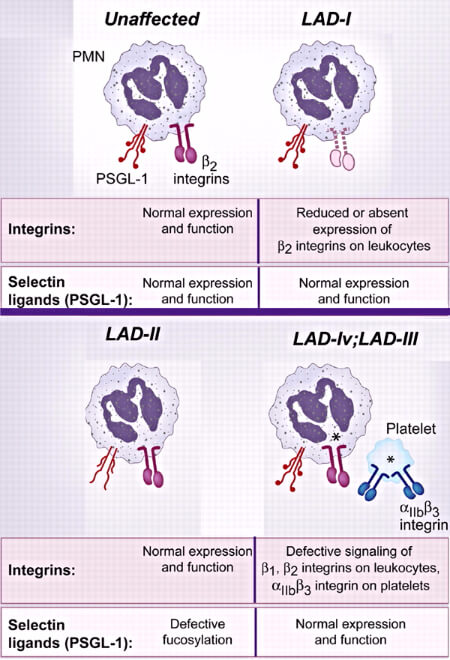
- Failure to express CD 18, which composes common β2 subunit of LFA-1 family (β2 integrins) – interaction with ICAM and VCAM on endothelium is impaired.
- First indication of defect: Omphalitis
- Recurrent, chronic bacterial infections
- Abnormally high number of granulocytes in circulation (margination defect)
- Diagnosed by evaluating expression (or lack) of CD 18 by flow cytometry.
- Defective granulocyte migration to infection site – absence of abscess or pus.
- History of delayed separation of umbilical cord stump
LAD II (Rolling defect)
- Defective fucosylation of PSGL-1 (selectin ligand) – impaired interaction with endothelial E- and P- selectins.
- Extremely rare; seen in people with Bombay blood group phenotype
- Recurrent bacterial infections with psychomotor and mental retardation
- Responds to oral fucose
LAD III (LAD-I + Glanzmann thrombasthenia)
- Due to FERMT3 mutation
- Defective signalling of β1, β2 integrins on leukocytes, αIIβ3 integrin on platelets
- Usually the first signs occur in infancy or early childhood.
- Patients present LAD-I life-threatening infections and a Glanzmann thrombasthenia-like bleeding disorder.