Skip to content
Epomedicine

Mnemonics, Simplified Concepts & Thoughts

Epomedicine

Mnemonics, Simplified Concepts & Thoughts

somogyi dawn waning effect

Somogyi effect and Dawn Phenomenon – Mnemonic

Epomedicine, Jul 25, 2019Jul 25, 2019

Both Somogyi effect and Dawn phenomenon are the cause of MORNING FASTING HYPERGLYCEMIA.

Mnemonic:

Somogyi = So Much Insulin
Dawn = Down Insulin

a. Somogyi effect:

Excess exogenous insulin → Middle night hypoglycemia → Release of counter-regulatory hormones → Rebound morning hyperglycemia

b. Dawn effect:

Normal release of morning hormones (growth hormones, cortisol, catecholamines) → Inadequate endogenous insulin production → Morning hyperglycemia
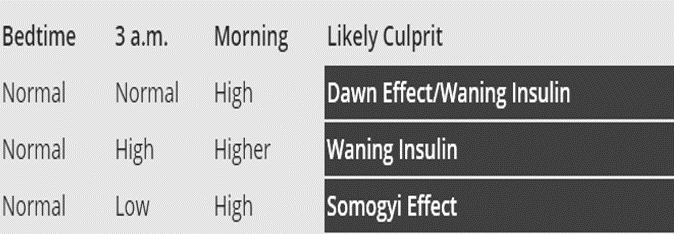
Differentiating somogyi and dawn effect as the cause of morning hyperhlycemia:

Measure blood glucose at 2-3 AM, and at normal wake-up time for several nights:

  1. Low blood glucose at 2-3 AM: Somogyi effect
  2. Normal or high blood glucose at 2-3 AM: Dawn phenomenon
6 shares
  • Facebook6
  • Twitter
PGMEE, MRCS, USMLE, MBBS, MD/MS Endocrine systemInternal medicinePediatrics

Post navigation

Previous post
Next post

Related Posts

PGMEE, MRCS, USMLE, MBBS, MD/MS renal embryology schematic

Renal (Kidney) Development – Embryology Made Easy

Aug 7, 2016Aug 8, 2016

Kidney development occurs chronologically from cranial to caudal direction from urogenital ridge (intermediate mesoderm) in 3 different phases. Intermediate mesoderm → urogenital ridge (longitudinal elevation along dorsal body wall) → nephrogenic cord → Pronephros, Mesonephros and Metanephric mesoderm/blastema Remember the embryology of brain – from cranial to caudal, the primordial…

Read More
Emergency Medicine

Burn Injury : Mnemonic Approach (ATLS)

Aug 26, 2023Aug 26, 2023

Mnemonic: BURNS Burn depth and body surface area (BSA) Burn degree Burn depth Features Healing Mnemonic: Number of degrees = Number of structures involved Mnemonic: RBCS 1st Superficial (epidermis only) Red <1 wk 2nd Partial thickness – superficial (epidermis + papillary dermis) Blister + Blanches 1-3 wks Partial thickness –…

Read More
PGMEE, MRCS, USMLE, MBBS, MD/MS

Acute Undifferentiated Febrile Illness – Mnemonic

Jun 8, 2021Jun 8, 2021

Acute undifferentiated febrile illnesses (AUFI) are characterised by fever of less than two weeks’ duration without organ-specific symptoms at the onset. Mnemonic MA-ESR lists the five main disease groups that cause acute undifferentiated febrile illnesses a. Malaria: Including all malaria due to Plasmodium falciparum, P vivax, P ovale, P malariae,…

Read More

Comments (2)

  1. Deepak Das says:
    Jul 26, 2019 at 5:23 am

    Good morning.Excellent mnemonics.

    Reply
  2. Kelvin says:
    Jul 17, 2023 at 6:43 am

    Great mnemonics, awesome

    Reply

Leave a Reply Cancel reply

Your email address will not be published. Required fields are marked *

This site uses Akismet to reduce spam. Learn how your comment data is processed.

Epomedicine. Somogyi effect and Dawn Phenomenon – Mnemonic [Internet]. Epomedicine; 2019 Jul 25 [cited 2025 Dec 6]. Available from: https://epomedicine.com/medical-students/somogyi-effect-and-dawn-phenomenon-mnemonic/.

Pre-clinical (Basic Sciences)

Anatomy

Biochemistry

Community medicine (PSM)

Embryology

Microbiology

Pathology

Pharmacology

Physiology

Clinical Sciences

Anesthesia

Dermatology

Emergency medicine

Forensic

Internal medicine

Gynecology & Obstetrics

Oncology

Ophthalmology

Orthopedics

Otorhinolaryngology (ENT)

Pediatrics

Psychiatry

Radiology

Surgery

RSS Ask Epomedicine

  • What to study for Clinical examination in Orthopedics?
  • What is the mechanism of AVNRT?

Epomedicine weekly

  • About Epomedicine
  • Contact Us
  • Author Guidelines
  • Submit Article
  • Editorial Board
  • USMLE
  • MRCS
  • Thesis
©2025 Epomedicine . All rights reserved.