Skip to content
Epomedicine

Mnemonics, Simplified Concepts & Thoughts

Epomedicine

Mnemonics, Simplified Concepts & Thoughts

pedigree analysis

Solving Pedigree Analysis in 3 steps

Epomedicine, Jan 23, 2017

First: Look for Mitochondrial Inheritance

  1. Female transmits disease to all the offsprings (both males and females).
  2. Male doesn’t transmit the disease and only the females transmit the disease.

If Mitochondrial inheritance is absent, go to second step.

Second: Look if the gene is Dominant, Recessive

  1. Dominant:
    • Atleast one member in all generations will have the disease.
    • Both affected parents can produce normal offsprings. Parents must be heterozygous.
  2. Recessive inheritance:
    • There will be some generations without the disease also (skips generation).
    • Both normal parents can produce affected offsprings. In such case, parents must be heterozygous.
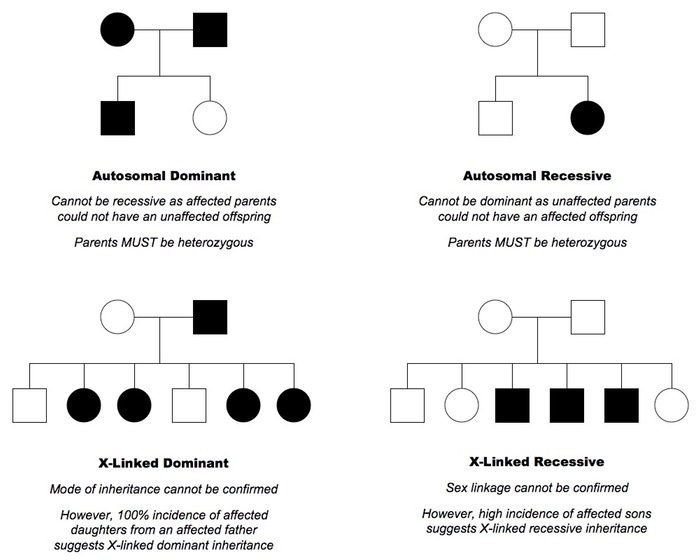
pedigree analysis

Third: Look if the disease is X-linked or Autosomal or Y-linked

  1. X-linked dominant:
    • Male transmits disease only to the daughters (all daughters).
    • Female transmits disease to half of sons and half of daughters.
  2. X-linked recessive:
    • If only males are affected, it is likely to be X-linked recessive.
    • Female only acts as carriers and remain unaffected.
  3. Autosomal dominant:
    • No sex predilection
    • Affected individual transmits disease to 1/2 of offsprings.
  4. Autosomal recessive:
    • No sex predilection
    • Affected individual transmits disease to 1/4 of offsprings.
    • Consanguinity increases risk of autosomal recessive disorders.
  5. Y-linked (Holandric):
    • Never skips generation
    • Only males are affected (father transmits the disease to son).

Codominant Inheritiance

This is similar to autosomal dominant inheritance but in codominant inheritance, two different versions (alleles) of a gene can be expressed, and each version makes a slightly different protein. e.g. Blood group, HLA.
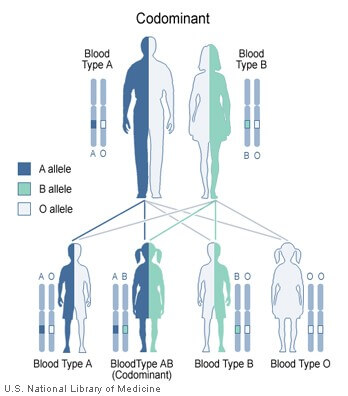
codominant inheritance

53 shares
  • Facebook18
  • Twitter
PGMEE, MRCS, USMLE, MBBS, MD/MS BiochemistryGeneral conceptsPathology

Post navigation

Previous post
Next post

Related Posts

PGMEE, MRCS, USMLE, MBBS, MD/MS

Facial Nerve : Mnemonics

May 3, 2024May 3, 2024

Course Origin: Ponto-medullary junction (Nucleus solitarius, Facial nucleus and Superior salivatory nucleus) Internal acoustic meatus: 7 up, Coke down Facial canal: After exiting skull from stylomastoid foramen: Further reading: Facial nerve lesions 1. Supranuclear lesion: Contralateral lower 1/2 face paralyzed; forehead wrinkling spared (Bilateral cortical innervation) 2. Infranuclear lesion: Entire…

Read More
PGMEE, MRCS, USMLE, MBBS, MD/MS

Mirel’s Criteria or Score – Mnemonic

Apr 10, 2020Apr 10, 2020

Mirel’s scoring system rates 4 criteria from 1 to 3 with maximum possible score of 12 to assess the risk of pathological fracture due to metastases and also serves as a guide for considering prophylactic fixation. The parameters of the criteria can be remembered using the mnemonic MIREL’S. M –…

Read More
PGMEE, MRCS, USMLE, MBBS, MD/MS

Juncturae Tendinum

Oct 5, 2020Oct 5, 2020

Synonyms: Connexus intertendinei, Intertendinous connections Plural: Juncturae tendinae Location: Intermetacarpal spaces in dorsum of hand between the extensor digitorum tendons Morphologic types: The usual pattern is that it gets thicker from radial to ulnar side. Type 1: Thin filamentous (square, rhomboidal or triangular) – present only in 2nd metacarpal space…

Read More

Comments (5)

  1. Aya Arafat says:
    Dec 6, 2019 at 11:21 pm

    amazing

    Reply
  2. Ritheka S says:
    Sep 7, 2020 at 4:59 am

    its really Osm
    Thanks for the author

    Reply
  3. Rohit says:
    Jul 14, 2021 at 11:36 am

    Wow. Thank you sir for explaining this concept with such good language.

    Reply
  4. Manglem Shagolsem says:
    Jul 29, 2021 at 7:02 am

    Outstanding tricks

    Reply
  5. Murielle says:
    Oct 2, 2024 at 5:08 pm

    Thank you so much, amazing trick.
    I’m super grateful.

    Reply

Leave a Reply to Ritheka S Cancel reply

Your email address will not be published. Required fields are marked *

This site uses Akismet to reduce spam. Learn how your comment data is processed.

Epomedicine. Solving Pedigree Analysis in 3 steps [Internet]. Epomedicine; 2017 Jan 23 [cited 2026 Jan 21]. Available from: https://epomedicine.com/medical-students/solving-pedigree-analysis-3-steps/.

Pre-clinical (Basic Sciences)

Anatomy

Biochemistry

Community medicine (PSM)

Embryology

Microbiology

Pathology

Pharmacology

Physiology

Clinical Sciences

Anesthesia

Dermatology

Emergency medicine

Forensic

Internal medicine

Gynecology & Obstetrics

Oncology

Ophthalmology

Orthopedics

Otorhinolaryngology (ENT)

Pediatrics

Psychiatry

Radiology

Surgery

RSS Ask Epomedicine

  • What to study for Clinical examination in Orthopedics?
  • What is the mechanism of AVNRT?

Epomedicine weekly

  • About Epomedicine
  • Contact Us
  • Author Guidelines
  • Submit Article
  • Editorial Board
  • USMLE
  • MRCS
  • Thesis
©2026 Epomedicine . All rights reserved.