Skip to content
Epomedicine

Mnemonics, Simplified Concepts & Thoughts

Epomedicine

Mnemonics, Simplified Concepts & Thoughts

surface lungs

Respiratory Examination – Relevant Anatomy and Physiology

Epomedicine, Apr 4, 2015

1. Division of Airway:

  • Extrathoracic (Upper) airway: Nose to Upper trachea
  • Intrathoracic (Lower) airway: Lower trachea to Alveoli and lungs

Note: Vocal fold is also regarded as the demarcating line between upper and lower respiratory tract

2. Angle of Louis: Junction of body of sternum to manubrium (2nd costal cartilage anteriorly and T4/5 sternal angle
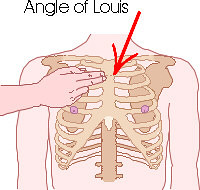
posteriorly)

  • 2nd rib joins manubrium (Start counting ribs)
  • Bifurcation of trachea
  • Beginning and end of arch of aorta
  • Division of pulmonary trunk
  • Division of mediastinum into superior and inferior
  • Thoracic duct crosses from left to right

3. Bronchi and bronchioles: About 25 divisions of which last 16 are bronchioles (no cartilage, less goblet cells and less musculature)

4. Lungs and pleura:

a. Base

At Mid-clavicular line (Midpoint between tip of acromion and suprasternal notch)

  • Lungs: 6th rib
  • Pleura: 8th rib

At Mid-axillary line (Midpoint between anterior and posterior axillary line)

  • Lungs: 8th rib
  • Pleura: 10th rib

At Vertebral line (Vertical line over spinous process midline)

  • Lungs: 10th rib
  • Pleura: 12th rib

b. Apex: 1 inch above the clavicle in midclavicular line

c. Medial border: Touches parasternal line at Angle of Louis

  • Right lung: Passes vertically downwards to reach base
  • Left lung: Follows outer margin of heart to reach base

d. Interlobar fissures:

  • Oblique/Major fissure: 6th rib in MCL – 5th rib MAL – medial border of scapula with hyperabducted arm – T2 spine
  • Horizontal/Minor fissure (Only on right): Sternum at level of 4th costal cartilage – first line of oblique fissure

Anteriorly: Most upper lobe and whole middle lobe; Posteriorly: Most lower lobe
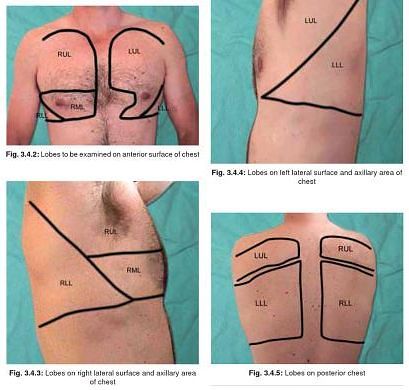
surface lungs

5. Ribs: 1-7 attach to sternum by cartilage; 8-10 attach to eachother by cartilage; 11-12 floating ribs

6. Topographical division of chest:

a. Anteriorly:

  • Supraclavicular region
  • Infraclavicular region
  • Mammary region: Upper border of 3rd rib to Upper border of 6th rib (sternum to anterior axillary fold)
  • Infra-mammary region: Upper margin of 6th rib to lower margin of thorax

b. Laterally: between axillary folds

  • Axillary region: Upto upper margin of 6th rib
  • Infra-axillary region: Upper margin of 6th rib to lower edge of thorax

c. Posteriorly:

  • Suprascapular: Above spine of scapula
  • Scapular: Body of scapula below spine
  • Infrascapular: Below angle of scapula (7th rib)
  • Interscapular: Between posterior edge of scapula

PHYSIOLOGY
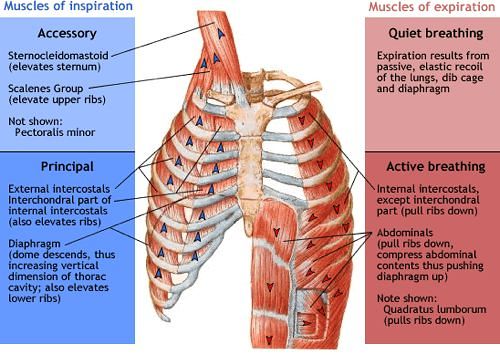
respiratory muscles

a. Inspiration:

  • Primary muscle: Diaphragm (Phrenic nerve – C3,4,5), External intercostal
  • Accessory muscle: Scalene, Sternocleidomastoid, Alae nasi, Serratus anterior, Others
    • Lift and expand chest wall up creating more negative intrathoracic pressure and thus more air enters lung

b. Expiration:

  • Primarily: Elastic recoil
  • Secondarily: Internal intercostal, Anterior abdominal wall muscles
53 shares
  • Facebook13
  • Twitter
PGMEE, MRCS, USMLE, MBBS, MD/MS AnatomyClinical examinationPhysiologyRespiratory system

Post navigation

Previous post
Next post

Related Posts

PGMEE, MRCS, USMLE, MBBS, MD/MS concentration effect

Concentration effect, Second gas effect and Diffusion hypoxia

Oct 20, 2016Oct 20, 2016

Concentration effect The higher the concentration of an inhaled anesthetic, the faster the alveolar concentration approaches the inhaled concentration. This is referred to as concentration effect and is clinically significant only in cases where gases are administered in high concentration: Nitrous oxide Xenon Ostwald’s blood gas solubility coefficient: ratio of…

Read More
PGMEE, MRCS, USMLE, MBBS, MD/MS

Heart Sounds – Abnormal

Apr 24, 2019May 23, 2020

The basic clinical examination of the Cardiac System is by Auscultation (listening to the sounds made by the heart). As explained in the previous article physiological sounds made in each cardiac cycle viz. S1 and S2 due to the closure of the Atrio-Ventricular Valves and Outlet Valve in synchrony. Please…

Read More
PGMEE, MRCS, USMLE, MBBS, MD/MS

Pharmacology of Carbapenems : Mnemonics

Mar 30, 2021Mar 30, 2021

Commonly used Carbapenems Mnemonic: MEDIC Meropenem Ertapenem Doripenem Imipenem/Cilastatin (renal dehydropeptidase I inhibitor) Besides these, there are other drugs like tebipenem (1st oral carbapenem), panipenem, tomopenem (has MRSA activity), etc. which fall under carbapenems. Coverage As the name suggests, they have carbapenems attached to beta-lactam ring which provides protection against…

Read More

Comment

  1. Shivani says:
    Sep 10, 2020 at 4:29 am

    Very clearly explained

    Reply

Leave a Reply Cancel reply

Your email address will not be published. Required fields are marked *

This site uses Akismet to reduce spam. Learn how your comment data is processed.

Epomedicine. Respiratory Examination – Relevant Anatomy and Physiology [Internet]. Epomedicine; 2015 Apr 4 [cited 2025 Nov 29]. Available from: https://epomedicine.com/medical-students/respiratory-examination-relevant-anatomy-and-physiology/.

Pre-clinical (Basic Sciences)

Anatomy

Biochemistry

Community medicine (PSM)

Embryology

Microbiology

Pathology

Pharmacology

Physiology

Clinical Sciences

Anesthesia

Dermatology

Emergency medicine

Forensic

Internal medicine

Gynecology & Obstetrics

Oncology

Ophthalmology

Orthopedics

Otorhinolaryngology (ENT)

Pediatrics

Psychiatry

Radiology

Surgery

RSS Ask Epomedicine

  • What to study for Clinical examination in Orthopedics?
  • What is the mechanism of AVNRT?

Epomedicine weekly

  • About Epomedicine
  • Contact Us
  • Author Guidelines
  • Submit Article
  • Editorial Board
  • USMLE
  • MRCS
  • Thesis
©2025 Epomedicine . All rights reserved.