Skip to content
Epomedicine

Mnemonics, Simplified Concepts & Thoughts

Epomedicine

Mnemonics, Simplified Concepts & Thoughts

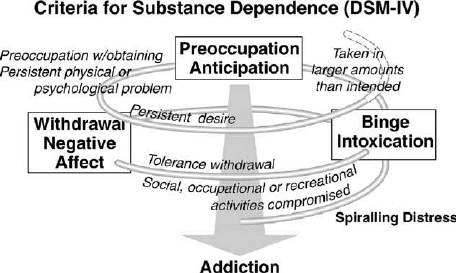
dependence cycle

Substance abuse vs Substance dependence

Epomedicine, Nov 4, 2016Nov 10, 2016

Both of these substance use disorders are maladpative patterns of substance use, leading to clinically significant impairment/distress but defined by separate criteria.

Substance abuse

≥1 of the following occurring within a 12 month period:

Mnemonic: 4 Rs

  1. Role failure: Recurrent use resulting in failure to fulfill role obligation
  2. Risky behavior: Recurrent use in situations which it is physically hazardous
  3. Run in with the law: Recurrent substance related legal problems
  4. Relationship problems: Continued use despite interference with social or interpersonal functioning
Substance abuse vs dependence
Nice illustration from sketchymedicine

Substance dependence

≥3 of the following in same 12 month period:

Mnemonic: WTC

  1. Withdrawal or use to avoid withdrawal
  2. Tolerance
  3. Time wasted in obtaining or using the substance
  4. Compulsive use in larger amount and longer period than intended
  5. Control and cut-down efforts unsuccessful
  6. Continuous use despite consequences (physical and psychological)
  7. Curtailment in activities of interest

dependence cycle

Changes in DSM-V

In DSM-V, the line of distinction between abuse and dependence has been erased and use of single diagnosis as “substance use disorder” has been proposed to remove possible confusion.

Broadly speaking, in DSM-V, following must be met out of 11 criteria:

  1. Mild: 2-3 symptoms
  2. Moderate: 4-5 symptoms
  3. Severe: 6-7 symptoms

The new list of 11 elements is the mixture of 4 “R”s and WTC as mentioned above with some changes:

  1. Addition: Drug craving
  2. Removal: Run in with the laws
12 shares
  • Facebook9
  • Twitter
PGMEE, MRCS, USMLE, MBBS, MD/MS PharmacologyPsychiatry

Post navigation

Previous post
Next post

Related Posts

PGMEE, MRCS, USMLE, MBBS, MD/MS voulantary horizontal conjugate gaze

Horizontal Conjugate Gaze Pathway

Jul 27, 2016May 19, 2019

Components of Pathway For both eyes to look at a side: Contralateral Frontal Eye Field (Brodmann area 8) Ipsilateral PPRF (Paramedial Pontine Reticular Formation) Ipsilateral CN VI Nucleus Contralateral Medial Longitudinal Fasciculus (MLF) Contralateral CN III Nucleus Horizontal Conjugate Gaze Pathway Lesions of Conjugate Gaze Pathway Abducens (CN VI) nerve:…

Read More
PGMEE, MRCS, USMLE, MBBS, MD/MS henrique durao

Ophthalmology Mnemonics

Sep 16, 2019Sep 16, 2019

PERIORBITAL EDEMA P: Pregnancy E: Edema: angioedema, cellulitis R: Renal: nephrotic I: Infectious mononucleosis: Hoagland’s sign O: Obstruction: SVC R: Rheumatic: Dermatomyositis, Cutaneous SLE B: Bitten by insect triatomine bug: T cruzi, Chagas disease – Romana’ sign I: Inside cavernous sign thrombosis T: Thyroid [Enroth fullness], Trichinosis A: Allergies,  Albumin low L:…

Read More
PGMEE, MRCS, USMLE, MBBS, MD/MS Submandibular gland

Applied Anatomy of Submandibular Salivary Gland

May 31, 2014Jun 19, 2023

Synonyms: Submaxillary gland (SMG), Mandibular gland Definition: Submandibular glands are one of the major salivary glands comprised of mixed serous and mucous acini and located below the lower border of the body of mandible. It is the second largest salivary gland and produces approximately 70% of the saliva. Location: Submandibular triangle…

Read More

Leave a Reply Cancel reply

Your email address will not be published. Required fields are marked *

This site uses Akismet to reduce spam. Learn how your comment data is processed.

Pre-clinical (Basic Sciences)

Anatomy

Biochemistry

Community medicine (PSM)

Embryology

Microbiology

Pathology

Pharmacology

Physiology

Clinical Sciences

Anesthesia

Dermatology

Emergency medicine

Forensic

Internal medicine

Gynecology & Obstetrics

Oncology

Ophthalmology

Orthopedics

Otorhinolaryngology (ENT)

Pediatrics

Psychiatry

Radiology

Surgery

RSS Ask Epomedicine

  • What to study for Clinical examination in Orthopedics?
  • What is the mechanism of AVNRT?

Epomedicine weekly

  • About Epomedicine
  • Contact Us
  • Author Guidelines
  • Submit Article
  • Editorial Board
  • USMLE
  • MRCS
  • Thesis
©2026 Epomedicine | WordPress Theme by SuperbThemes