Skip to content
Epomedicine

Mnemonics, Simplified Concepts & Thoughts

Epomedicine

Mnemonics, Simplified Concepts & Thoughts

maxillary artery

Maxillary Artery : Mnemonic

Epomedicine, Oct 16, 2017Aug 23, 2023

Origin of Maxillary artery: Terminal branch of External Carotid Artery (ECA)

Derived from: 1st Arch

Divisions of Maxillary artery: 3 parts by lateral pterygoid

  1. 1st part (Mandibular part): winds around deep to neck of mandible
  2. 2nd part (Pterygoid part): travels between 2 heads of lateral pterygoid
  3. 3rd part (Pterygopalatine part): enters pterygopalatine fossa containing pterygopalatine galnglion
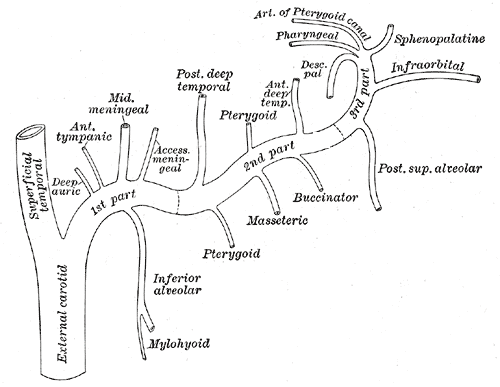
maxillary artery branches
Henry Vandyke Carter, Public domain, via Wikimedia Commons

Branches of Maxillary artery

Remember:

  1. Each of the 3 divisions gives off 5 branches.
  2. Mandibular artery, i.e. Inferior alveolar artery is a branch of maxillary artery
  3. 2nd part: Branches supply muscles of mastication and do not cross through foramina in bones (all branches from 1st and 3rd part do cross)

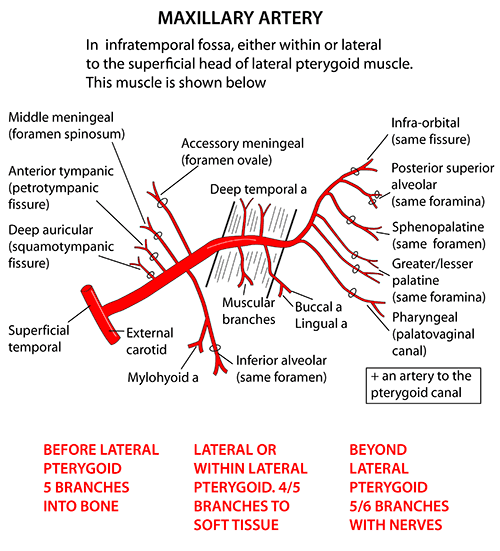
Branches from 1st part

Mnemonic: Mandibular part gives off branches to 5 “M“s and the branches can be remembered as “DAMIA“

  1. Meatus (External auditory meatus) – Deep auricular
  2. Membrane (tympanic membrane) – Anterior tympanic
  3. Meninges and mater (duramater) – Medial meningeal
  4. Mandible – Inferior alveolar
  5. Meckel’s cave – Accessory meningeal

Clinical significance: Middle meningeal artery (MMA) injury results in Extradural hematoma (EDH). Auriculotemporal nerve wraps around it.

Branches from the 2nd part

Mnemonic: They supply muscles of mastication which are also derivatives of the 1st arch.

  1. Posterior deep temporal artery: Temporalis
  2. Pterygoid artery: Lateral and medial pterygoids
  3. Masseteric artery: Masseter
  4. Buccinator artery: Buccinator
  5. Anterior deep temporal artery: Temporalis

Branches from the 3rd part

Mnemonic: Remember the 5 “P“s

  1. Posterior superior alveolar artery: Maxilla
  2. Pterygoid canal artery: Upper part of pharynx and tympanic cavity
  3. Palatine – Descending palatine artery: Gives off greater and lesser palatine artery and supplies hard and soft palate respectively
  4. Palatine – Sphenopalatine or Nasopalatine artery: Nasal cavity
  5. Pharyngeal artery: Pharynx

There’s one more branch from the 3rd part, i.e. Infraorbital artery which gives off Anterior and Middle Superior Alveolar Artery.

Clinical significance: Sphenopalatine artery is a common cause of posterior epistaxis and may need ESPAL (Endoscopic Sphenopalatine Artery Ligation).
85 shares
  • Facebook35
  • Twitter
PGMEE, MRCS, USMLE, MBBS, MD/MS AnatomyCardiovascular system

Post navigation

Previous post
Next post

Related Posts

PGMEE, MRCS, USMLE, MBBS, MD/MS

Thyroid Hormone Function & Synthesis : Mnemonics

Aug 19, 2023May 21, 2024

Thyroid Hormone Functions Mnemonic: 7 X B’s Thyroid Hormone Synthesis Mnemonic: ATE ICE 1. Active transport of iodide: 2. Thyroglobulin (rich in Tyrosine): formed in follicular ribosomes 3. Exocytosis of thyroglobulin into follicular lumen: stored as colloid 4. Iodination: Peroxidase enzyme – 5. Coupling: 6. Endocytosis: of T3 and T4…

Read More
PGMEE, MRCS, USMLE, MBBS, MD/MS

Paranasal sinus drainage in Nasal cavity : Mnemonic

Aug 4, 2023Aug 4, 2023

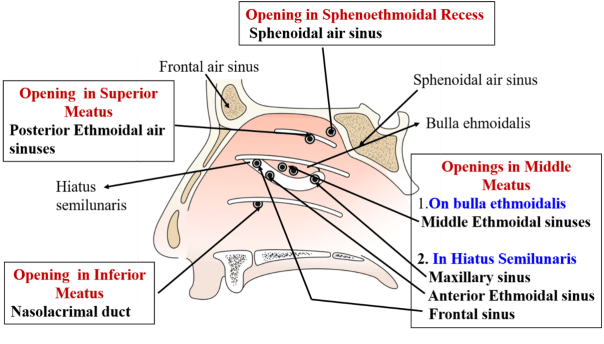
Lateral wall of nasal cavity has: Mnemonic: SPIN 1. Superior meatus: Posterior ethmoidal sinus 2. Inferior meatus: Nasolacrimal duct The sphenoidal sinus drains into spheno-ethmoidal recess (superior to superior concha). All others drain into middle meatus: Mnemonic: AM/FM

Read More
PGMEE, MRCS, USMLE, MBBS, MD/MS thyroglossal cyst

Thyroglossal Duct Cyst

May 6, 2014May 6, 2014

Synonyms: Thyroglossal cyst, Thyrolingual cyst, Thyroglossal duct remnant, TGDC, TDC, TGDR Definition: Thyroglossal duct cyst is a congenital malformation that occurs due to incomplete closure of the thyroglossal duct which presents as a cystic midline neck swelling at birth. Thyroglossal fistulas are usually recognized by their external opening (typically located…

Read More

Comments (4)

  1. Zubbie says:
    May 3, 2018 at 1:55 pm

    This was super helpful!!! Thanks! God bless whoever shared this.

    Reply
  2. Ayesha haroon says:
    Jul 27, 2019 at 3:27 pm

    Beautifully explained…starred this website in my browser..thanks a lot

    Reply
  3. Zokagon K Mahnlugbae says:
    Jan 20, 2023 at 6:19 am

    Thanks so much for these mnemonics. I’m done with this part of my lesson already, in just 5minutes

    Reply
  4. Enough says:
    Sep 14, 2024 at 6:30 pm

    Thank you so much.

    Reply

Leave a Reply to Zokagon K Mahnlugbae Cancel reply

Your email address will not be published. Required fields are marked *

This site uses Akismet to reduce spam. Learn how your comment data is processed.

Pre-clinical (Basic Sciences)

Anatomy

Biochemistry

Community medicine (PSM)

Embryology

Microbiology

Pathology

Pharmacology

Physiology

Clinical Sciences

Anesthesia

Dermatology

Emergency medicine

Forensic

Internal medicine

Gynecology & Obstetrics

Oncology

Ophthalmology

Orthopedics

Otorhinolaryngology (ENT)

Pediatrics

Psychiatry

Radiology

Surgery

RSS Ask Epomedicine

  • What to study for Clinical examination in Orthopedics?
  • What is the mechanism of AVNRT?

Epomedicine weekly

  • About Epomedicine
  • Contact Us
  • Author Guidelines
  • Submit Article
  • Editorial Board
  • USMLE
  • MRCS
  • Thesis
©2026 Epomedicine | WordPress Theme by SuperbThemes