Skip to content
Epomedicine

Mnemonics, Simplified Concepts & Thoughts

Epomedicine

Mnemonics, Simplified Concepts & Thoughts

How Hyperchloremia Impairs Renal Function

Epomedicine, Jul 7, 2025Jul 7, 2025

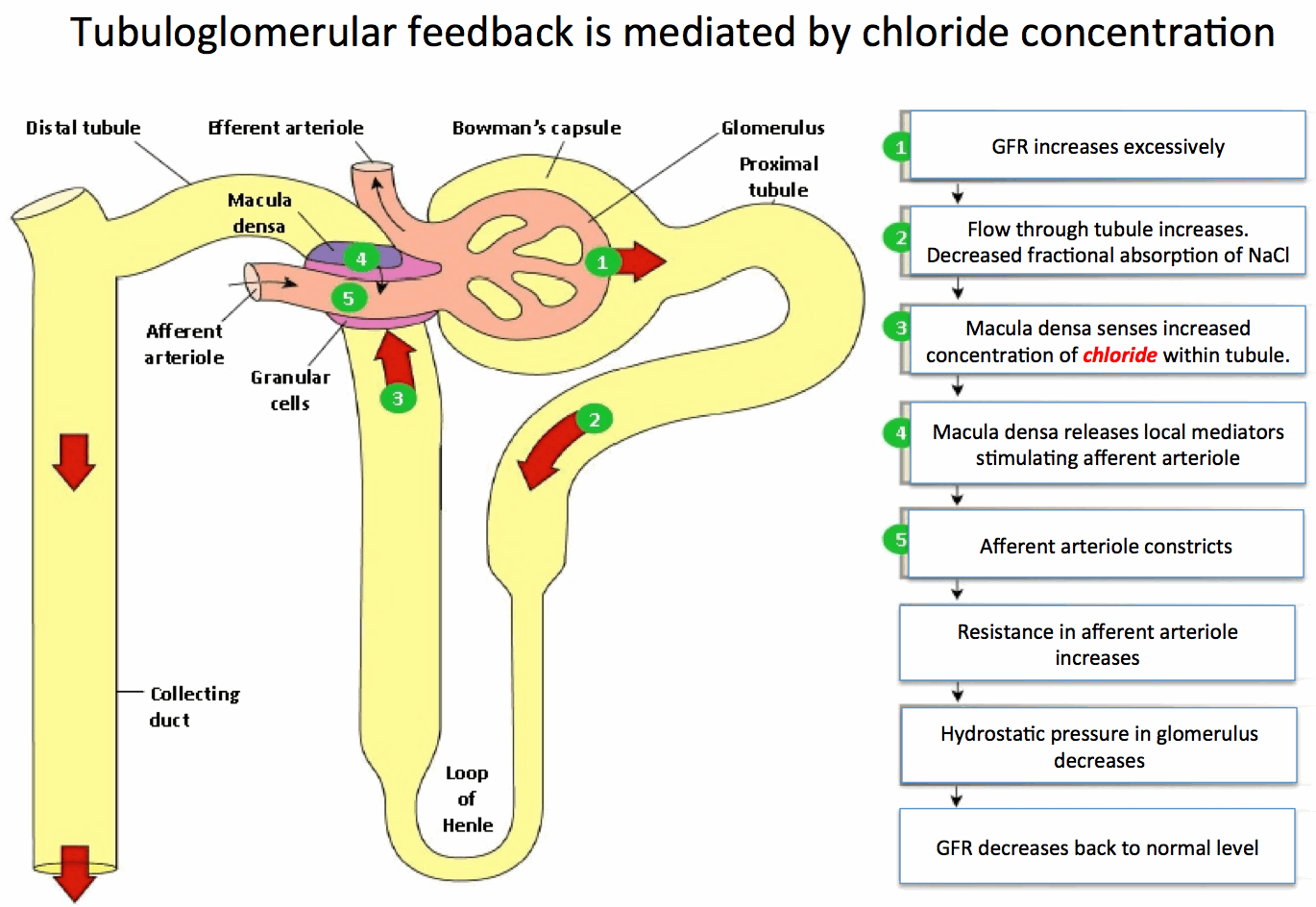
While historically, NS and RL have been thought to be generally equivalent for resuscitation, there has been an associated risk of hyperchloremic metabolic acidosis with large-volume resuscitation using normal saline. Hyperchoremic metabolic acidosis has been found to increase the risk of acute kidney injury. This is thought to be due to the vasoconstrictive effects of hyperchloremia and a consequent reduction in glomerular filtration rate (GFR).

hyperchloremia gfr
Source: https://i0.wp.com/1.bp.blogspot.com/-40Il1Sm0LzM/VHKZJfvqOmI/AAAAAAAAAnA/7rNXzMh03II/s1600/tubuloglomerularfeed.gif

Hyperchloremia causes vasoconstriction of the afferent arterioles of the kidney. However, this is a side effect of how the kidneys auto-regulate renal blood flow and glomerular filtration rate (GFR). Recall that blood flows into the glomerulus of the kidney via afferent arterioles. The renal blood flow determines the GFR or the flow of plasma filtered into the kidney. Chloride concentration at the macula densa within the distal tubule is one way the kidney can sense and adjust the glomerular filtration rate. How does this work?

Under normal circumstances, the increased chloride concentration at the distal tubule is due to impaired absorption in the proximal tubule. This indicates to the kidney’s sensory mechanisms that GFR is too high, and the proximal tubule cannot absorb the chloride quickly enough. Increased chloride then triggers vasoconstriction to decrease the GFR. Conversely, low perfusion will result in hypochloremia at the macula densa, leading to vasodilation to increase GFR.

However, in iatrogenic hyperchloremia due to high-volume NS infusion, the underlying issue is not increased GFR. However, the feedback mechanism is the same, stimulating vasoconstriction of the afferent arteriole with inappropriate (in this case) reduction in GFR. In this case, a decrease in GFR worsens the hypoperfusion.
  • Facebook
  • Twitter
PGMEE, MRCS, USMLE, MBBS, MD/MS Renal and Electroloyte

Post navigation

Previous post
Next post

Related Posts

PGMEE, MRCS, USMLE, MBBS, MD/MS

Thyroid Hormone Function & Synthesis : Mnemonics

Aug 19, 2023May 21, 2024

Thyroid Hormone Functions Mnemonic: 7 X B’s Thyroid Hormone Synthesis Mnemonic: ATE ICE 1. Active transport of iodide: 2. Thyroglobulin (rich in Tyrosine): formed in follicular ribosomes 3. Exocytosis of thyroglobulin into follicular lumen: stored as colloid 4. Iodination: Peroxidase enzyme – 5. Coupling: 6. Endocytosis: of T3 and T4…

Read More
PGMEE, MRCS, USMLE, MBBS, MD/MS inheritance patterns mnemonic

Inheritance of Disease – Mnemonics

Jun 29, 2016Aug 4, 2018

Lets work with some generalizations 1. X-linked dominant, mitochondrial and Y-linked conditions are rare. You need to remember them. 2. Usually inherited in autosomal dominant pattern are: Mostly mutations in non-enzymatic structural proteins (e.g. collagen, fibrillin, cytoskeletal proteins of RBC) or in membrane receptors (e.g. LDL receptor) Diseases due to diminished…

Read More
PGMEE, MRCS, USMLE, MBBS, MD/MS

Diacerin : Mnemonic

May 15, 2023May 15, 2023

Diacerin is a DMOAD (Diseases Modifying Osteoarthritis Drug) – D – Diarrhea (not recommended in >65 years – more vulnerable to diarrhea) I – IL-1 Inhibition A – Anthraquinone C – Chondroprotective effects E – Eczema R – Rashes I – Increase in hepatic enzymes (contraindicated in patients with history…

Read More

Leave a Reply Cancel reply

Your email address will not be published. Required fields are marked *

This site uses Akismet to reduce spam. Learn how your comment data is processed.

Pre-clinical (Basic Sciences)

Anatomy

Biochemistry

Community medicine (PSM)

Embryology

Microbiology

Pathology

Pharmacology

Physiology

Clinical Sciences

Anesthesia

Dermatology

Emergency medicine

Forensic

Internal medicine

Gynecology & Obstetrics

Oncology

Ophthalmology

Orthopedics

Otorhinolaryngology (ENT)

Pediatrics

Psychiatry

Radiology

Surgery

RSS Ask Epomedicine

  • What to study for Clinical examination in Orthopedics?
  • What is the mechanism of AVNRT?

Epomedicine weekly

  • About Epomedicine
  • Contact Us
  • Author Guidelines
  • Submit Article
  • Editorial Board
  • USMLE
  • MRCS
  • Thesis
©2026 Epomedicine | WordPress Theme by SuperbThemes