Skip to content
Epomedicine

Mnemonics, Simplified Concepts & Thoughts

Epomedicine

Mnemonics, Simplified Concepts & Thoughts

Wound Strength

Epomedicine, Jul 5, 2025Jul 5, 2025

Wound strength is determined by both quantity and quality of collagen and an appropriate balance of deposition and breakdown. The amount of collagen in a wound plateaus at several weeks post-injury.

Timeline:

1. First few weeks: Strength increases rapidly, reaching about 20% of pre-injury strength at 3 weeks. 

2. Around 6 weeks: Wound strength increases significantly, nearing about 80% of the original strength. 

3. 3 months: Wound strength reaches approximately 80% of its original strength. 

4. Beyond 3 months: Strength continues to increase slowly, but the wound area will likely never be as strong as the original skin, typically reaching about 70-80%. 
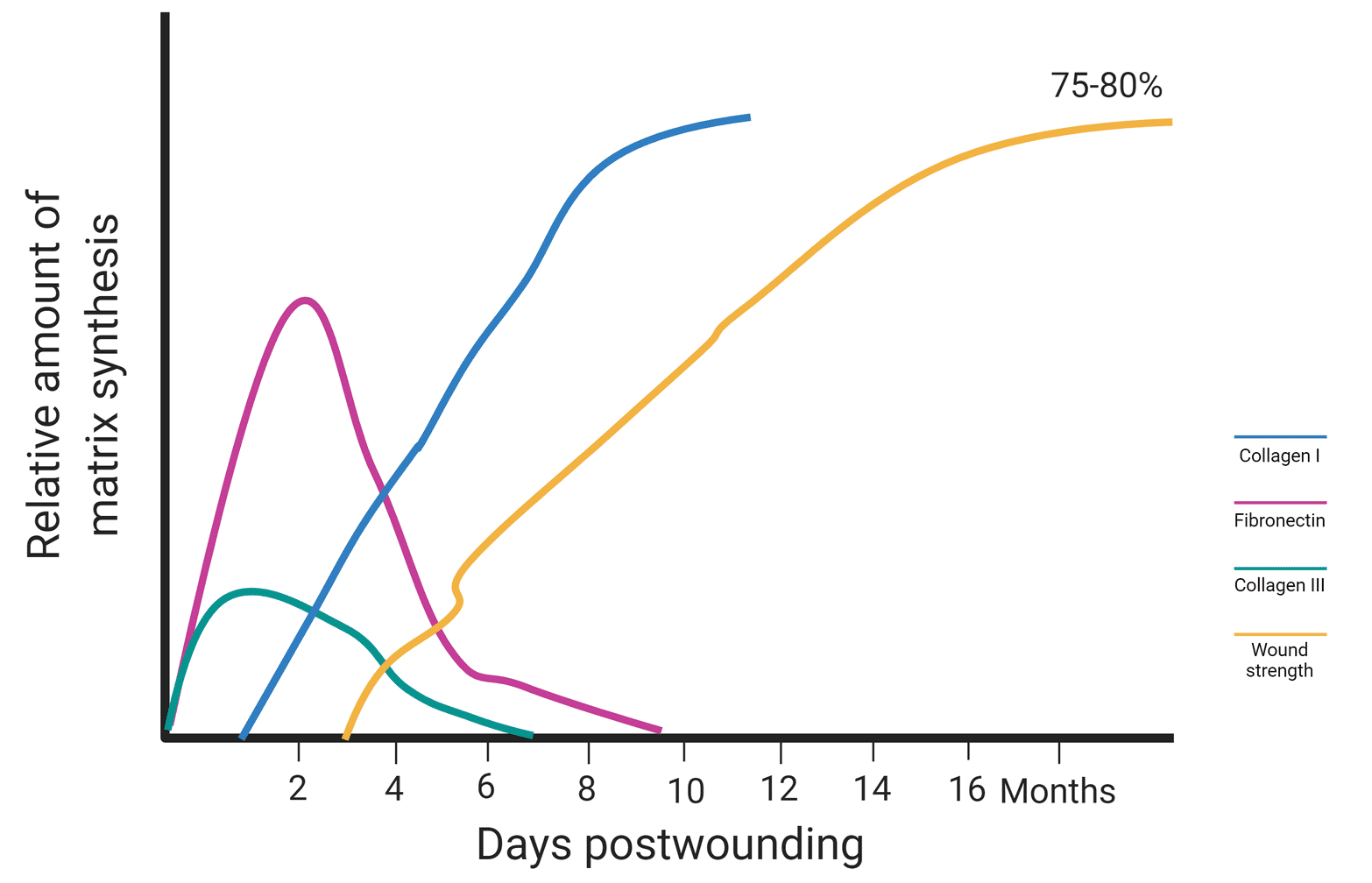
The tensile strength of the wound gradually increases over time. At 3 weeks, the wound has achieved 20% of its full strength. A wound’s maximum tensile strength peaks at 3 months, where it reaches at 80% of its pre-injury level.

  • Facebook
  • Twitter
PGMEE, MRCS, USMLE, MBBS, MD/MS General Surgery

Post navigation

Previous post
Next post

Related Posts

PGMEE, MRCS, USMLE, MBBS, MD/MS mechanoreceptors

Mechanoreceptors : Mnemonic

Jul 27, 2018Jun 15, 2022

Adaptation of Mechanoreceptors Mnemonic: Life is fast for MPs (Member of Parliament) and slow for MRs. In alphabetical order, meIssner’s come becore meRkel. Hence, Meissner’s corpuscle are the quicker among two. 1. Fast adapting receptors: MP Meissner’s corpuscle Pacinian corpuscle 2. Slowly adapting receptors: MR Merkel disc Ruffini corpuscle/ending Location of…

Read More
PGMEE, MRCS, USMLE, MBBS, MD/MS dependence cycle

Substance abuse vs Substance dependence

Nov 4, 2016Nov 10, 2016

Both of these substance use disorders are maladpative patterns of substance use, leading to clinically significant impairment/distress but defined by separate criteria. Substance abuse ≥1 of the following occurring within a 12 month period: Mnemonic: 4 Rs Role failure: Recurrent use resulting in failure to fulfill role obligation Risky behavior:…

Read More
PGMEE, MRCS, USMLE, MBBS, MD/MS ORS resomal

ORS and ReSoMal – Mnemonic

Jun 11, 2019Jun 11, 2019

Oral Rehydration Solution (ORS) Grams per litre: SoDIum C-hloride: 2.6 gm SoDIum Ci-Trate: 2.9 gm Potassium chloride: 1.5 gm Glucose anhydrous: 13.5 gm Mnemonic: DI = 2 and C = 6Ci-Trate = Rotate 6, i.e. 9For Potassium chloride: Deduct 1 from the whole number and decimal both, i.e. (2-1).(6-1) =…

Read More

Leave a Reply Cancel reply

Your email address will not be published. Required fields are marked *

This site uses Akismet to reduce spam. Learn how your comment data is processed.

Pre-clinical (Basic Sciences)

Anatomy

Biochemistry

Community medicine (PSM)

Embryology

Microbiology

Pathology

Pharmacology

Physiology

Clinical Sciences

Anesthesia

Dermatology

Emergency medicine

Forensic

Internal medicine

Gynecology & Obstetrics

Oncology

Ophthalmology

Orthopedics

Otorhinolaryngology (ENT)

Pediatrics

Psychiatry

Radiology

Surgery

RSS Ask Epomedicine

  • What to study for Clinical examination in Orthopedics?
  • What is the mechanism of AVNRT?

Epomedicine weekly

  • About Epomedicine
  • Contact Us
  • Author Guidelines
  • Submit Article
  • Editorial Board
  • USMLE
  • MRCS
  • Thesis
©2026 Epomedicine | WordPress Theme by SuperbThemes