Skip to content
Epomedicine

Mnemonics, Simplified Concepts & Thoughts

Epomedicine

Mnemonics, Simplified Concepts & Thoughts

hypertensive retinopathy

Hypertensive Retinopathy Grading – Simplified

Epomedicine, Jun 1, 2019Jun 1, 2019

Hypertensive retinopathy has been classified by Keith, Wagener & Barker and Scheie (hypertensive and arteriosclerotic features). With this mnemonic, we will have a grading with combination of all these classifications.
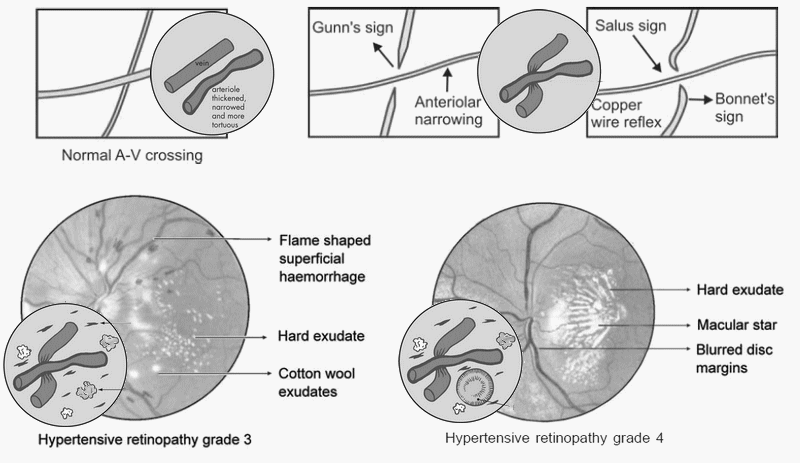
hypertensive retinopathy
Hypertensive retinopathy changes – schematic

Mnemonic: SAFEs

I – Slight Systemic (generalized) narrowing of arterioles

II – AV deflection (at Angle) and focal narrowing of arteriorles

  • Angled deflection of vein at AV crossing: Salu’s sign

III – Flame hemorrhages, Flame color arterioles and Frank AV crossing changes

  • Frank AV crossing changes:
    • Bonnet sign: Banking of veins at AV crossing
    • Marcus-gunn sign: Tapering of veins at AV crossing
  • Flame color arterioles: Copper wiring
  • Flame shaped hemorrhages, Cotton wool exudates and hard exudates

Mnemonic for Eponymous AV crossing changes:

Salu’s sign: “S” like venous deflection at AV crossing
Bonnet sign: “B” for Banking of vein distal to AV crossing
Gunn sign:

IV – Edema and Exudates surrounding macula + silver wiring

  • Edema: Papilledema
  • Exudates surrounding macula: Macular star
20 shares
  • Facebook20
  • Twitter
PGMEE, MRCS, USMLE, MBBS, MD/MS Emergency medicineInternal medicineOphthalmology

Post navigation

Previous post
Next post

Related Posts

PGMEE, MRCS, USMLE, MBBS, MD/MS lymphedema risk reduction

Axillary Lymph Node Dissection

Dec 30, 2015

A) Indications: Clinical or radiological evidence of involvement of axillary nodes Microscopically positive sentinel node(s) due to metastasis from primary malignant tumor In sentinel node negative: 98 % accurate in predicting that the other nodes are negative In sentinel node positive: possibility of microscopic disease in any of the remaining lymph nodes is 15–30…

Read More
PGMEE, MRCS, USMLE, MBBS, MD/MS

Trauma Scoring Systems

Mar 26, 2025Mar 26, 2025

Scoring systems Score type Brief description Score interpretation Revised trauma score (RTS) Physiologic RR + SBP + GCS Each parameter is scored 0-4 (Total range = 0-12) Lower score indicates more severe injury (RTS 12 = <1% mortality; RTS 0 = >99% mortality) Score <11 – transfer to trauma center…

Read More
PGMEE, MRCS, USMLE, MBBS, MD/MS

Spondylolisthesis : Summary

Aug 31, 2024Aug 31, 2024

Indications for surgery Age group Spondylolisthesis Indications Pediatric Low grade Failure to respond to conservative treatment (9-12 months)Progressive slippageIntractable low back or radicular painNeurological deficit and deterioration High grade Neurological symptomsSevere sagittal plane spinal deformity Adult Low grade Failure of non-operative treatmentProgressive slippageSymptomatic and radiographically unstable isthmic spondylolisthesis High grade…

Read More

Leave a Reply Cancel reply

Your email address will not be published. Required fields are marked *

This site uses Akismet to reduce spam. Learn how your comment data is processed.

Pre-clinical (Basic Sciences)

Anatomy

Biochemistry

Community medicine (PSM)

Embryology

Microbiology

Pathology

Pharmacology

Physiology

Clinical Sciences

Anesthesia

Dermatology

Emergency medicine

Forensic

Internal medicine

Gynecology & Obstetrics

Oncology

Ophthalmology

Orthopedics

Otorhinolaryngology (ENT)

Pediatrics

Psychiatry

Radiology

Surgery

RSS Ask Epomedicine

  • What to study for Clinical examination in Orthopedics?
  • What is the mechanism of AVNRT?

Epomedicine weekly

  • About Epomedicine
  • Contact Us
  • Author Guidelines
  • Submit Article
  • Editorial Board
  • USMLE
  • MRCS
  • Thesis
©2026 Epomedicine | WordPress Theme by SuperbThemes