Skip to content
Epomedicine

Mnemonics, Simplified Concepts & Thoughts

Epomedicine

Mnemonics, Simplified Concepts & Thoughts

Gout : Mnemonics

Dr. Sulabh Kumar Shrestha, MS Orthopedics, Sep 20, 2022Sep 20, 2022

Urate Lowering Therapy (ULT)

Mnemonic: 1, 2, 3, 4, 5, 6

Start Urate Lowering Therapy if:

  1. ≥1 subcutaneous tophi
  2. ≥2 flares per year
  3. ≥3 stage CKD with Serum uric acid (SUA) ≥ 9 mg/dl

Other indications: Urate renal stone, Evidence of joint destruction in X-ray

4. ≥4 weeks to be waited after last flare to start ULT

5. 5 days to start and taper anti-inflammatory for acute flare

6. <6 mg/dl is the target SUA

Hyperuricemia is defined as serum uric acid (SUA) level >7 mg/dl in men and >6 mg/dl in women.
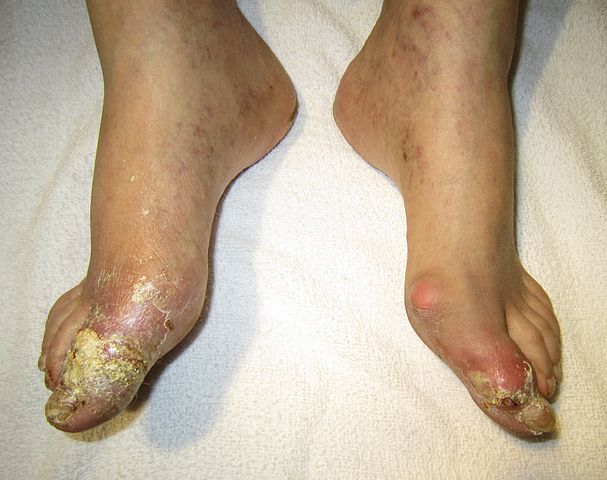
tophaceous gout
James Heilman, MD, CC BY-SA 3.0, via Wikimedia Commons

Causes of Gout

Mnemonic: DRINK NO ALCOHOL

  1. Dehydration, Diuretics (Furosemide, Thiazides)
  2. Rash (Psoriasis)
  3. Idiopathic
  4. Nicotinic acid
  5. Killing cells (Cytolytic therapties)
  6. Nephron failure (renal failure)
  7. Obesity (risk factor for primary gout)
  8. Acidosis (DKA, lactic acidosis, starvation), Alcohol, Aspirin (low-dose)
  9. Lead poisoning, Lesch-Nyhan syndrome
  10. Cyclosporine
  11. Over-exercising (Extreme exercise)
  12. High purine diet
  13. Other drugs (ethambutol, pyrazinamide)
  14. Lymphoproliferative or myeloproliferative disorders

Mnemonic for crystals in gout and pseudogout

Synovial Fluid Analysis – Made Easy

References:

  1. FitzGerald JD, Dalbeth N, Mikuls T, Brignardello-Petersen R, Guyatt G, Abeles AM, Gelber AC, Harrold LR, Khanna D, King C, Levy G, Libbey C, Mount D, Pillinger MH, Rosenthal A, Singh JA, Sims JE, Smith BJ, Wenger NS, Bae SS, Danve A, Khanna PP, Kim SC, Lenert A, Poon S, Qasim A, Sehra ST, Sharma TSK, Toprover M, Turgunbaev M, Zeng L, Zhang MA, Turner AS, Neogi T. 2020 American College of Rheumatology Guideline for the Management of Gout. Arthritis Care Res (Hoboken). 2020 Jun;72(6):744-760. doi: 10.1002/acr.24180. Epub 2020 May 11. Erratum in: Arthritis Care Res (Hoboken). 2020 Aug;72(8):1187. Erratum in: Arthritis Care Res (Hoboken). 2021 Mar;73(3):458. PMID: 32391934.
  2. Apley and Solomon’s System of Orthopaedics and Trauma – 13th Edition

dr. sulabh kumar shrestha
Dr. Sulabh Kumar Shrestha, MS Orthopedics

He is the section editor of Orthopedics in Epomedicine. He searches for and share simpler ways to make complicated medical topics simple. He also loves writing poetry, listening and playing music. He is currently pursuing Fellowship in Hip, Pelvi-acetabulum and Arthroplasty at B&B Hospital.
1 shares
  • Facebook1
  • Twitter
PGMEE, MRCS, USMLE, MBBS, MD/MS OrthopedicsRheumatology

Post navigation

Previous post
Next post

Related Posts

PGMEE, MRCS, USMLE, MBBS, MD/MS retroperitoneal-structures

Retroperitoneal Organs : Mnemonic

Jun 27, 2018May 13, 2024

Retroperitoneal organs are partly covered on one side with parietal peritoneum. They are immobile or fixed. The classification of retroperitoneal organs divides primary and secondary retroperitoneal organs due to the embryonic development – Retroperitoneal structures Mnemonic: SAD PUCKER Primary retroperitoneal structures Mnemonic: SAUKER Secondary retroperitoneal structures Clinical significance Kocher maneuver…

Read More
PGMEE, MRCS, USMLE, MBBS, MD/MS anemia mcv-rdw

Understanding Red cell indices

Feb 4, 2017

Rule of 3s The measured hemoglobin concentration is 3 times the RBC count, and the calculated hematocrit is 3 times the Hb level. A significant deviation means artifacts in the value estimated or the RBCs are smaller or larger than the normal. HCt = 3 X Hb RBC count =…

Read More
PGMEE, MRCS, USMLE, MBBS, MD/MS

ANCA : Mnemonics

Aug 4, 2023Aug 4, 2023

ANCA = Anti-Neutrophil Cytoplasmic Antibodies Types Mnemonics: 1. “P” is not going with “P”2. p-ANCA is positively charged and hence, attacks negatively charged MPO (free radicals)3. c-ANCA (C is 3rd letter) attacks PR-3 ANCA positive conditions 1. c-ANCA: Mnemonic: Common Wealth Games 2. p-ANCA: Most of other conditions are p-ANCA…

Read More

Comment

  1. Kelvin says:
    Dec 20, 2023 at 7:38 am

    Awesome teaching as always, thank you. God bless you for teaching and sharing ❤️❤️❤️❤️❤️

    Reply

Leave a Reply Cancel reply

Your email address will not be published. Required fields are marked *

This site uses Akismet to reduce spam. Learn how your comment data is processed.

Pre-clinical (Basic Sciences)

Anatomy

Biochemistry

Community medicine (PSM)

Embryology

Microbiology

Pathology

Pharmacology

Physiology

Clinical Sciences

Anesthesia

Dermatology

Emergency medicine

Forensic

Internal medicine

Gynecology & Obstetrics

Oncology

Ophthalmology

Orthopedics

Otorhinolaryngology (ENT)

Pediatrics

Psychiatry

Radiology

Surgery

RSS Ask Epomedicine

  • What to study for Clinical examination in Orthopedics?
  • What is the mechanism of AVNRT?

Epomedicine weekly

  • About Epomedicine
  • Contact Us
  • Author Guidelines
  • Submit Article
  • Editorial Board
  • USMLE
  • MRCS
  • Thesis
©2026 Epomedicine | WordPress Theme by SuperbThemes