Skip to content
Epomedicine

Mnemonics, Simplified Concepts & Thoughts

Epomedicine

Mnemonics, Simplified Concepts & Thoughts

Synovial Fluid Analysis – Made Easy

Epomedicine, Jun 13, 2020Jun 13, 2020

What investigations to order for synovial fluid sample?

Mnemonic: 5 Cs

  1. Chemistry (pH, LDH, glucose, protein)
  2. Cell counts
  3. Cytology
  4. Culture
  5. Crystals
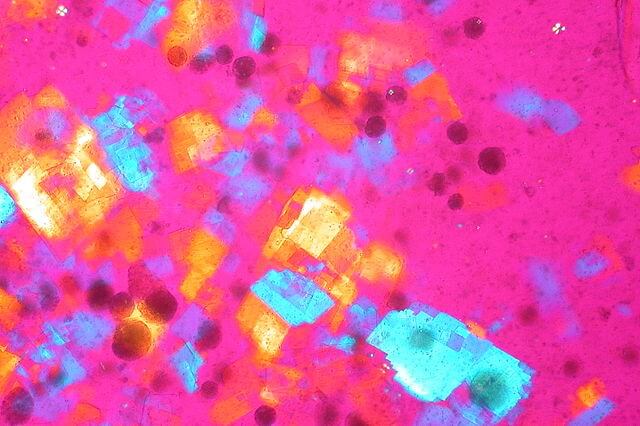
polarized microscopy
Cholesterol crystals in polarized microscopy
Ed Uthman, MD, pathologist, Houston, Texas, USA / CC BY

Interpretation of synovial fluid analysis

GrossNormalNon-inflammatoryInflammatorySepticCrystalHemorrhagic
Volume (ml)<3.5>3.5>3.5>3.5>3.5>3.5
ViscosityHighHighLowVariableVariableVariable
ColorColorless to strawStraw to yellowYellow
Cloudy
Yellow-white
Cloudy
Yellow
Cloudy
Red
Xanthochromic
Routine lab
WBC<200200-20002000-75000Often >1000002000-7500050-10000
PMN (%)<25<25>50>75>50<50
CrystalsNegativeNegativeNegativeNegativePositiveNegative
Mucin clotFirmFirmFriableFriableFriable
Glucose (AM fasting)Nearly equal to bloodNearly equal to blood<50 mg% lower than blood>50 mg% lower than blood>50 mg% lower than bloodNearly equal to blood
ExamplesOA, Trauma, AVN, SLERA, Reiter’s, SLE, Viral, Fungal, TBBacterialGout, PseudogoutTrauma, fracture, ligament tear, hemophilia, charcot arthritis, PVN
OA – Osteoarthritis; AVN – Avascular necrosis; SLE – Systemic Lupus Erythematosus; RA – Rheumatoid Arthritis; TB – Tuberculosis; PVNS – Pigmented Villonodular Synovitis

Crystals in Gout and Pseudogout

Mnemonic: “P” for Pseudogout

Pseudogout:

  • Polarized microscopy
  • Positive birefrengence
  • Pyrophosphate crystals
  • Polygon (Rhomboid) shaped
  • Purple (blue) color

Gout:

  • Negative birefrengence
  • Needle shaped
  • Urate crystals
  • Yellow color

Mnemonic: Look for ABC (Alignment, Blue, Calcium) in crystal analysis. If the crystal aligned with the red-plate compensator is blue, it is calcium pyrophosphate dihydrate. Urate crystals are the opposite, being yellow when parallel to the compensator.

References:

1. Clinical Laboratory Medicine edited by Kenneth D. McClatchey

2. Rheumatology Secrets By Sterling G. West
  • Facebook
  • Twitter
PGMEE, MRCS, USMLE, MBBS, MD/MS Internal medicineOrthopedicsRheumatology

Post navigation

Previous post
Next post

Related Posts

PGMEE, MRCS, USMLE, MBBS, MD/MS

Foot Drop : Differentials

Jun 8, 2023Jun 8, 2023

Foot drop can result from: L5 radiculopathy Lumbar plexopathy Sciatic neuropathy Peroneal neuropathy Causes Disc herniation, Spinal canal stenosis Pelvic surgery, hematoma, prolonged labor Hip surgery, Injection injury Compression/trauma Motor Weakness includes muscles and hip abductors Weakness includes hip abductors and anal sphincter Weakness includes tibial and hamstring muscles Weakness…

Read More
PGMEE, MRCS, USMLE, MBBS, MD/MS

How to Fix the Skin That Overreacts to Almost Everything

Jul 3, 2025Jul 22, 2025

If your skin throws a tantrum every time you try something new, you’re certainly not alone, and no, it’s not “all in your head.” While it may seem like your face has declared war on every product in existence, the reality is far different.  Studies show that dermatological disorders affect…

Read More
PGMEE, MRCS, USMLE, MBBS, MD/MS

Sarcomere Structure : Mnemonic

Feb 2, 2019Sep 10, 2020

Remember the sequence: Zahir Is A Hungry Man Z line (Zwischen = between [German]) I band A band H zone M line Z is the final alphabet: Z lines represents the end of sarcomere M for middle: M line represents the midline of sarcomere I is a thin letter: I…

Read More

Leave a Reply Cancel reply

Your email address will not be published. Required fields are marked *

This site uses Akismet to reduce spam. Learn how your comment data is processed.

Epomedicine. Synovial Fluid Analysis – Made Easy [Internet]. Epomedicine; 2020 Jun 13 [cited 2025 Dec 6]. Available from: https://epomedicine.com/medical-students/synovial-fluid-analysis-easy/.

Pre-clinical (Basic Sciences)

Anatomy

Biochemistry

Community medicine (PSM)

Embryology

Microbiology

Pathology

Pharmacology

Physiology

Clinical Sciences

Anesthesia

Dermatology

Emergency medicine

Forensic

Internal medicine

Gynecology & Obstetrics

Oncology

Ophthalmology

Orthopedics

Otorhinolaryngology (ENT)

Pediatrics

Psychiatry

Radiology

Surgery

RSS Ask Epomedicine

  • What to study for Clinical examination in Orthopedics?
  • What is the mechanism of AVNRT?

Epomedicine weekly

  • About Epomedicine
  • Contact Us
  • Author Guidelines
  • Submit Article
  • Editorial Board
  • USMLE
  • MRCS
  • Thesis
©2025 Epomedicine . All rights reserved.