Skip to content
Epomedicine

Mnemonics, Simplified Concepts & Thoughts

Epomedicine

Mnemonics, Simplified Concepts & Thoughts

venous draianage of face schematic

Venous drainage of Face : “W” shaped arrangement

Epomedicine, Oct 18, 2017

When we look from lateral side, the veins on each side form a “W” shaped arrangement.

Each corner of the “W” is prolonged upward into the scalp, and downward into the neck. Remember the 3 verticla stems of letter “W”:

  • 1st stem (in face): Facial vein
  • 2nd stem (behind mandible, in front of ear): Retromandibular vein
  • 3rd stem (behind ear): Posterior auricular vein

The two diagonal stems branching from the middle stem represents anterior and posterior division of retromandibular vein.
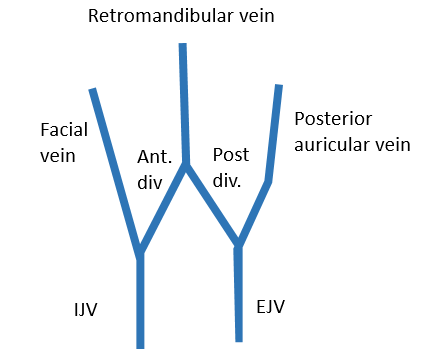
venous draianage of face schematic

Supraorbital vein + Supratrochlear vein = Facial vein

Superficial temporal vein + Maxillary vein = Retromandibular vein

Posterior auricular vein + Posterior division of retromandibular vein = External jugular vein (EJV)

Facial vein + Anterior division of retromandibular vein = Common facial vein (drains in Internal Jugular Vein – IJV)

Deep connection of Facial vein

  1. Facial vein drains pterygoid plexus (pterygoid venous plexus drains deep veins) via deep facial vein.
  2. Pterygoid plexus has connection with cavernous sinus through the emissary veins.

How does facial vein communicate with the cavernous sinus ?

Through 3 deep connections:

  1. Superior ophthalmic vein
  2. Inferior ophthalmic vein
  3. Pterygoid plexus

Always remember!!! Facial veins are valveless.
8 shares
  • Facebook8
  • Twitter
PGMEE, MRCS, USMLE, MBBS, MD/MS AnatomyCardiovascular system

Post navigation

Previous post
Next post

Related Posts

PGMEE, MRCS, USMLE, MBBS, MD/MS

Morel Lavallee Lesion

May 22, 2025May 22, 2025

Definition: Post-traumatic closed degloving injury, in which the skin and subcutaneous tissue is detached from the underlying fascia by a shearing force which can disrupt perforating vessels and nerves, creating a potential space that fills with blood, lymph, debris and fat (necrotic and/or viable). Clinical features: The diagnosis can be…

Read More
PGMEE, MRCS, USMLE, MBBS, MD/MS

Ollier’s Disease and Maffucci Syndrome : Mnemonic

Dec 1, 2024Dec 1, 2024

Ollier’s disease Maffucci syndrome

Read More
PGMEE, MRCS, USMLE, MBBS, MD/MS

AO fracture classification made easy

Oct 8, 2022Dec 2, 2024

It is an alpha-numeric system of classification developed by Muller and colleagues. Step 1: 1st digit specifies bone Step 2: 2nd digit specifies segment of bone Square definition: Proximal and distal segments are defined by a square whose sides = length of widest part of epiphysis Exceptions of square definition:…

Read More

Leave a Reply Cancel reply

Your email address will not be published. Required fields are marked *

This site uses Akismet to reduce spam. Learn how your comment data is processed.

Pre-clinical (Basic Sciences)

Anatomy

Biochemistry

Community medicine (PSM)

Embryology

Microbiology

Pathology

Pharmacology

Physiology

Clinical Sciences

Anesthesia

Dermatology

Emergency medicine

Forensic

Internal medicine

Gynecology & Obstetrics

Oncology

Ophthalmology

Orthopedics

Otorhinolaryngology (ENT)

Pediatrics

Psychiatry

Radiology

Surgery

RSS Ask Epomedicine

  • What to study for Clinical examination in Orthopedics?
  • What is the mechanism of AVNRT?

Epomedicine weekly

  • About Epomedicine
  • Contact Us
  • Author Guidelines
  • Submit Article
  • Editorial Board
  • USMLE
  • MRCS
  • Thesis
©2026 Epomedicine | WordPress Theme by SuperbThemes