Skip to content
Epomedicine

Mnemonics, Simplified Concepts & Thoughts

Epomedicine

Mnemonics, Simplified Concepts & Thoughts

Floating Knee – Quick Review

Dr. Sulabh Kumar Shrestha, MS Orthopedics, Oct 27, 2026Oct 27, 2026

The term “floating knee,” introduced by Blake and McBryde in 197 is used to describe fractures of the ipsilateral femur and tibia. Fractures can occur anywhere along the femur and the tibia and must occur in both bones to be considered a floating knee injury. 

Classification of Floating Knee

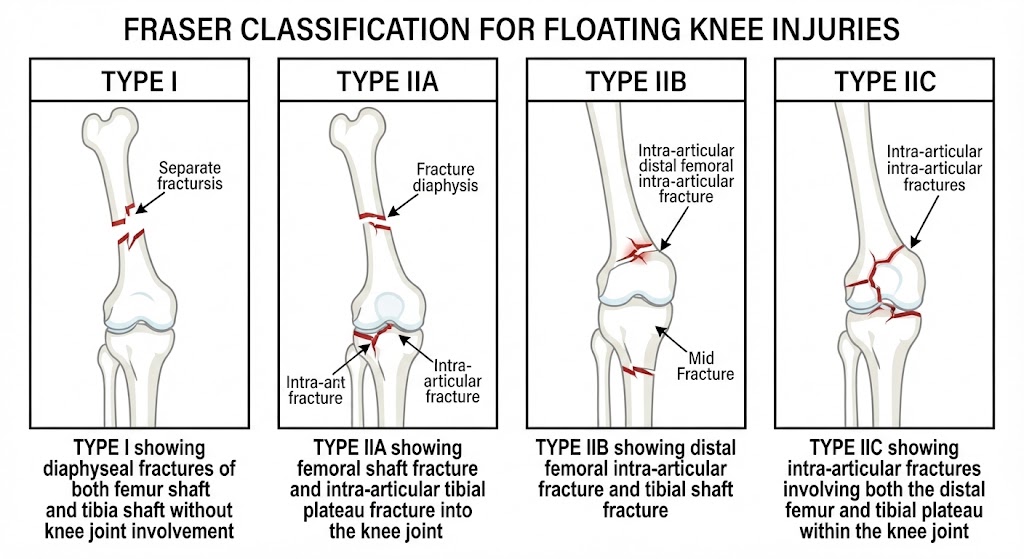
TypesBlake-McBryde [1]Bohn-Durbin [2]Fraser [3]TypesLetts-Vincent [4]
IDouble shaftDouble shaftWithout knee involvementAClosed – double shaft
IIJuxta-articular injuriesWith knee involvementBClosed – 1 shaft + 1 metaphysis
– IIaWith knee involvementTibial plateauCClosed – 1 shaft + 1 epiphysis
– IIbWith hip or ankle joint involvementDistal femur – intra-articularD1 open fracture
– IIcBoth tibial plateau & intra-articular distal femurEBoth open fractures
IIIInvolvement of epiphysis (knee, hip, ankle)
Fraser classification floating knee

Management of Floating Knee [5]

Injury personalityManagement
1. Unstable patient, Severe soft tissue damage or Vascular injuryDamage control (Spanning external fixation)
2. Stable patient and Limb fit for surgeryDefinitive fixation
a. Fraser I1. Femur retrograde nail
2. Tibia antegrade nail
b. Fraser IIa1. Femur retrograde nail
2. Tibia plating
c. Fraser IIb1. Tibia suprapatellar nail
2. Femur plating
d. Fraser IIc1. Tibia plating
2. Femur plating
  1. Blake R, McBryde A. The floating knee: Ipsilateral fractures of the tibia and femur. South Med J. 1975 Jan;68(1):13-6.
  2. Anari JB, Neuwirth AL, Horn BD, Baldwin KD. Ipsilateral femur and tibia fractures in pediatric patients: A systematic review. World J Orthop. 2017 Aug 18;8(8):638-643.
  3. Fraser RD, Hunter GA, Waddell JP. Ipsilateral fracture of the femur and tibia. J Bone Joint Surg Br. 1978 Nov;60-B(4):510-5.
  4. Letts M, Vincent N. The pediatric floating knee. J Bone Joint Surg Br. 1986;68(3):442-6.
  5. Piedra-Calle CA, García-Sánchez Y, Teixidor-Serra J, Tomás-Hernández J, Selga-Marsá J, Porcel-Vázquez JA, Molero-García V, Andrés-Peiró JV. Challenges and outcomes in the treatment of floating knees. A case series of ipsilateral femur and tibia fractures around the knee. Eur J Orthop Surg Traumatol. 2022 Feb;32(2):325-331. doi: 10.1007/s00590-021-02981-7. Epub 2021 Apr 21. PMID: 33884493.

dr. sulabh kumar shrestha
Dr. Sulabh Kumar Shrestha, MS Orthopedics

He is the section editor of Orthopedics in Epomedicine. He searches for and share simpler ways to make complicated medical topics simple. He also loves writing poetry, listening and playing music. He is currently pursuing Fellowship in Hip, Pelvi-acetabulum and Arthroplasty at B&B Hospital.
  • Facebook
  • Twitter
PGMEE, MRCS, USMLE, MBBS, MD/MS Musculoskeletal systemOrthopedicsTrauma

Post navigation

Previous post
Next post

Related Posts

PGMEE, MRCS, USMLE, MBBS, MD/MS

Venous Drainage of Heart : Mnemonic

Jun 12, 2023Jun 12, 2023

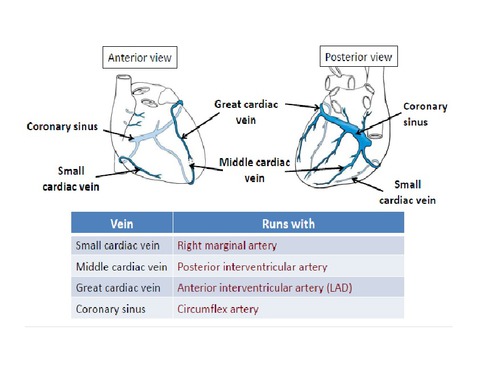
Mnemonic: CAT 1. Coronary sinus (50%): Drains blood from left side of heart → Thebesian valve → Right Atrium 2. Anterior cardiac veins (20%): Drain blood from right side of heart → Right Atrium 3. Thebesian veins/Venae cordis minimi (30%): Drain deoxygenated blood from endocardium and myocardium → Respective chamber…

Read More
PGMEE, MRCS, USMLE, MBBS, MD/MS

TLICS vs SLICS

Mar 15, 2025Mar 15, 2025

Thoracolumbar Injury Classification and Severity (TLICS) and Subaxial Cervical Spine Injury Classification System (SLICS) are based on 3 components of injury: TLICS score and SLICS score provide a scoring system to guide management: Characteristics TLICS SLIC 1. Injury morphology (Radiographs, CT) a. No abnormality 0 0 b. Compression 1 1…

Read More
PGMEE, MRCS, USMLE, MBBS, MD/MS

Forearm muscles : Tricks to remember

Oct 28, 2015Oct 27, 2022

Anterior Forearm (Compartment) Muscles Total muscles: 8 (4 superficial + 1 intermediate + 3 deep) Mnemonic: Do it yourself as shown in the figure below! Place your thenar/hypothenar eminence over medial epicondyle and fan out 5 fingers with thumb resting below the 4 fingers. The 4 fingers represent superficial flexors…

Read More

Leave a Reply Cancel reply

Your email address will not be published. Required fields are marked *

This site uses Akismet to reduce spam. Learn how your comment data is processed.

Shrestha SK. Floating Knee – Quick Review [Internet]. Epomedicine; 2026 Oct 27 [cited 2026 Nov 15]. Available from: https://epomedicine.com/medical-students/floating-knee-quick-review/.

Pre-clinical (Basic Sciences)

Anatomy

Biochemistry

Community medicine (PSM)

Embryology

Microbiology

Pathology

Pharmacology

Physiology

Clinical Sciences

Anesthesia

Dermatology

Emergency medicine

Forensic

Internal medicine

Gynecology & Obstetrics

Oncology

Ophthalmology

Orthopedics

Otorhinolaryngology (ENT)

Pediatrics

Psychiatry

Radiology

Surgery

RSS feed: Ask Epomedicine Ask Epomedicine

  • What to study for Clinical examination in Orthopedics?
  • What is the mechanism of AVNRT?

Epomedicine weekly

  • About Epomedicine
  • Contact Us
  • Author Guidelines
  • Submit Article
  • Editorial Board
  • USMLE
  • MRCS
  • Thesis
©2026 Epomedicine | WordPress Theme by SuperbThemes