Skip to content
Epomedicine

Mnemonics, Simplified Concepts & Thoughts

Epomedicine

Mnemonics, Simplified Concepts & Thoughts

midbrain cross-section

How to Draw Midbrain Cross-section ?

Dr. Sulabh Kumar Shrestha, MS Orthopedics, Jul 17, 2016Jul 17, 2016

The cross-section of midbrain can be compared to the “upside down striped face of a red-eyed demon“.
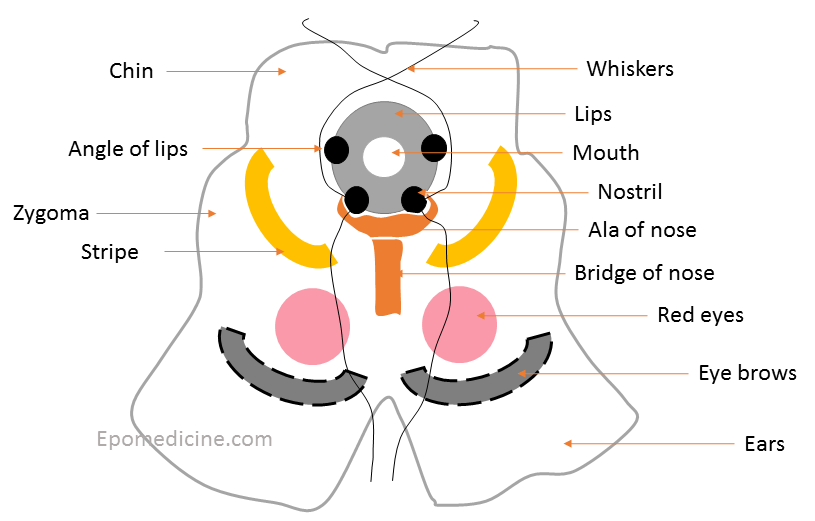
midbrain demon

Using this analogy of a demon face, lets assign the structures found on the cross-section of midbrain:

  1. Ear = Crus cerebri
    • Medial – frontopontine fibers
    • Middle – corticonuclear and corticospinal tract
    • Lateral – temporopontine fibers
  2. Eye brows = Substantia nigra
  3. Red eyes = Red nucleus
  4. Bridge of nose = Raphe nucleus
  5. Ala of nose = Median longitudinal fasciculus (MLF)
  6. Nostrils = Cranial nerve nucleus
    • CN III in superior section
    • CN IV in inferior section
  7. Whiskers = Cranial nerves
    • CN III – towards head
    • CN IV – towards chin
  8. Stripe = Lemniscus
    • Towards head – Medial lemniscus
    • Middle – Spinal lemniscus (Spinothalamic tract)
    • Towards chin – Lateral lemniscus
  9. Zygoma = Medial geniculate body
  10. Mouth = Cerebral Aqueduct
  11. Lips = Peri-aqueductal grey
  12. Angle of mouth = Mesencephalic trigeminal nucleus
  13. Chin = Colliculus
    • Superior colliculus in superior section
    • Inferior colliculus in inferior section

Now, lets label them:
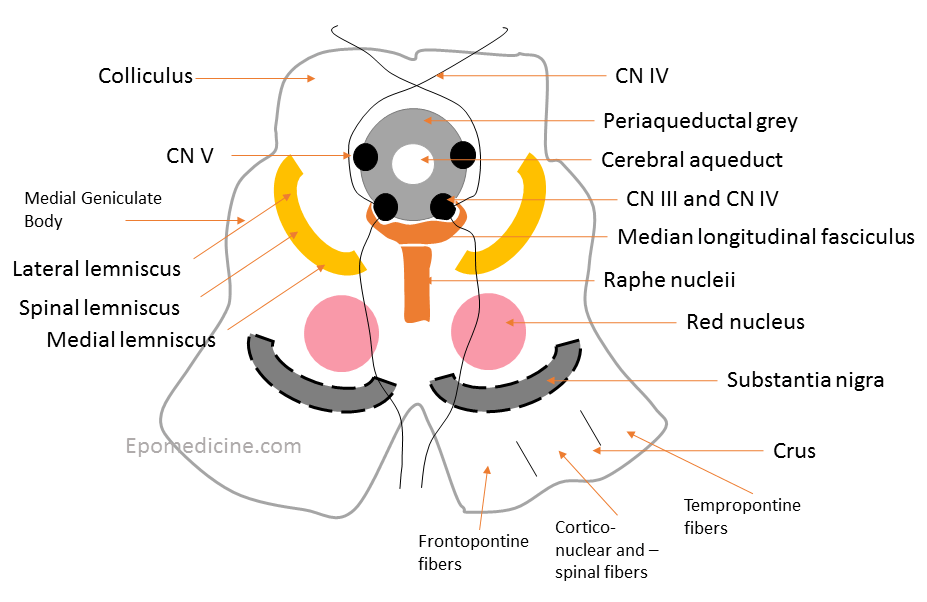
midbrain cross-section

Another important mnemonic that everyone must remember is that:

  • Motor tracts are towards Midline
  • Sensory tracts are towards Side
dr. sulabh kumar shrestha
Dr. Sulabh Kumar Shrestha, MS Orthopedics

He is the section editor of Orthopedics in Epomedicine. He searches for and share simpler ways to make complicated medical topics simple. He also loves writing poetry, listening and playing music. He is currently pursuing Fellowship in Hip, Pelvi-acetabulum and Arthroplasty at B&B Hospital.
9 shares
  • Facebook9
  • Twitter
PGMEE, MRCS, USMLE, MBBS, MD/MS AnatomyNervous system

Post navigation

Previous post
Next post

Related Posts

PGMEE, MRCS, USMLE, MBBS, MD/MS

Surgical Site Infection Risk Factors : Mnemonic

Jul 25, 2024Jul 25, 2024

Various types of surgical site infection (SSI) have been defined by CDC. Patient related factors Mnemonic: WASHING 1. Weight: Obesity (>20% of ideal body weight) 2. Antibiotic resistant skin flora: MRSA colonization 3. Advancing age 4. Smoking 5. HIV and other immune deficiency conditions 6. Infection coexisting at other sites…

Read More
PGMEE, MRCS, USMLE, MBBS, MD/MS esr

ESR and CRP in Musculoskeletal infection

Aug 5, 2020Jan 27, 2022

ESR (Erythrocyte Sedimentation Rate) Usually elevated within 48-72 hours of the infection onset (less reliable in the first 48 hours of infection) Continues to rise for 3-5 days after institution of successful therapy and continuing rise beyond 4th-5th day of treatment can be an indication of treatment failure (not good…

Read More
PGMEE, MRCS, USMLE, MBBS, MD/MS Postaural wilde's incision

Approaches to Middle ear and Mastoid surgery

May 11, 2014

Endomeatal (Transcanal or Transmeatal) Approach: Not used commonly in children owing to relatively small ear canal This incision is used when the mesotympanum and hypotympanum are the surgical sites A posterior tympanomeatal flap is raised to enter into the middle ear. The flap includes skin over the medial two-thirds of the bony…

Read More

Comment

  1. khizar says:
    Aug 10, 2016 at 7:21 am

    levell bro

    Reply

Leave a Reply to khizar Cancel reply

Your email address will not be published. Required fields are marked *

This site uses Akismet to reduce spam. Learn how your comment data is processed.

Shrestha SK. How to Draw Midbrain Cross-section ? [Internet]. Epomedicine; 2016 Jul 17 [cited 2025 Dec 12]. Available from: https://epomedicine.com/medical-students/draw-midbrain-cross-section/.

Pre-clinical (Basic Sciences)

Anatomy

Biochemistry

Community medicine (PSM)

Embryology

Microbiology

Pathology

Pharmacology

Physiology

Clinical Sciences

Anesthesia

Dermatology

Emergency medicine

Forensic

Internal medicine

Gynecology & Obstetrics

Oncology

Ophthalmology

Orthopedics

Otorhinolaryngology (ENT)

Pediatrics

Psychiatry

Radiology

Surgery

RSS Ask Epomedicine

  • What to study for Clinical examination in Orthopedics?
  • What is the mechanism of AVNRT?

Epomedicine weekly

  • About Epomedicine
  • Contact Us
  • Author Guidelines
  • Submit Article
  • Editorial Board
  • USMLE
  • MRCS
  • Thesis
©2025 Epomedicine . All rights reserved.