There are various terminologies used to describe hypertension which may overlap and are a source of confusion to the medical students and health professionals.
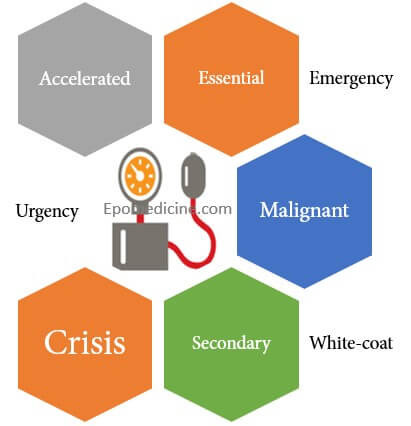
Essential or Primary or Idiopathic hypertension
- Hypertension in which secondary causes have been excluded.
- Identifiable etiologic factors of essential hypertension:
- Obesity
- Insulin resistance
- High alcohol intake
- High salt intake (in salt-sensitive patients)
- Aging
- Sedentary lifestyle
- Stress
- Low potassium intake
- Low calcium intake
Secondary hypertension
- Hypertension due to secondary causes like:
- Renovascular disease
- Renal failure
- Pheochromocytoma
- Endocrinopathies
- Mendelian inheritnace, etc.
Pre-hypertension
- Systolic Blood Pressure 120-139 mmHg OR
- Diastolic Blood Pressure 80-89 mmHg
Stage I hypertension
- Systolic Blood Pressure 140-159 mmHg OR
- Diastolic Blood Pressure 90-99 mmHg
Stage II hypertension
- Systolic Blood Pressure ≥160 mmHg OR
- Diastolic Blood Pressure ≥100 mmHg
JNC 8, rather than classifying the hypertension has provided the cut-off value for Blood pressure, at which the pharmacotherapy must be started and below which the target of therapy should be:
- ≥60 years old: ≥150/90 mmHg
- All others: ≥140/90 mmHg
Pregnancy Induced Hypertension and Hypertensive emergencies
Hypertensive Disorders in Pregnancy
Isolated Systolic hypertension
- Systolic Blood Pressure ≥140 mmHg AND
- Diastolic Blood Pressure <90 mmHg
Isolated systolic hypertension may be seen in cases of Patent Ductus Arteriosus, Atherosclerosis, Aortic regurgitation or Hyperthyoroidism.
White-coat hypertension
- Office or Clinic systolic/diastolic blood pressure readings of ≥140/90 mm Hg AND
- 24-hour or ambulatory blood pressure <130/80 mm Hg
Isolated ambulatory or Masked hypertension
- Elevated ambulatory blood pressure AND
- Normal clinic blood pressure (BP)
Pseudohypertension
- Indirect blood pressure measured by the cuff method overestimates the true intra-arterial blood pressure, i.e. falsely elevated blood pressure due to stiff non-compliant vessels usually seen in elderly.
- Also known as Osler’s sign or Noncompressibility artery syndrome
Resistant hypertension
Conventional blood pressure remains uncontrolled by 3 classes of antihypertensive agents, including a diuretic.
Hypertensive Urgency
- Systolic Blood Pressure >180 mmHg OR
- Diastolic Blood Pressure >120 mmHg
- No new-onset target organ damage
Hypertensive urgency has not been mentioned in JNC 8.
Hypertensive Emergency
- Systolic Blood Pressure >180 mmHg OR
- Diastolic Blood Pressure >120 mmHg
- With new-onset target organ damage:
- Hypertensive encephalopathy
- Dissecting aortic aneurysm
- Acute left ventricular failure with pulmonary edema
- Acute myocardial infarction
- Eclampsia
- Acute renal failure
- Symptomatic microangiopathic hemolytic anemia
Accelerated Hypertension
Hypertensive emergency with grade III retinopathy
Malignant Hypertension
Hypertensive emergency with grade IV retinopathy
Since, the clinical outcome doesn’t depend upon the fundoscopic findings – now, the preferred term is accelerated-malignant hypertension.
Hypertensive Crisis
The term hypertensive crisis encompasses both the hypertensive urgency and emergency.