Cerebrospinal Fluid (CSF) Production and Absorption
CSF is produced by the choroid plexus that lines the ventricles.
Choroid plexus = Infoldings of blood vessels of piamater + Modified ciliated ependymal cells
Tight junctions of the choroid plexus cells form Blood-CSF barrier.
CSF is reabsorbed by arachnoid granulations to enter dural venous sinuses.
Turnover of entire volume of CSF is 3-4 times per day.
- There is approximately 120mL (average 90-150 ml) of CSF at any one time.
- It is formed and reabsorbed at a rate of 0.33 mL/min.
- During Lumbar puncture (LP), depending on the purpose, the amount of fluid withdrawn ranges few milliliters to as much as 40 ml; however, in a typical lumbar puncture roughly 12mL of fluid is withdrawn.
- What percent of the CSF in the nervous system is this? 10%.
- And how quickly is it replaced? In about half-an-hour (or, more exactly, in 36 min).
Normal Composition of CSF
Clear fluid, isotonic with serum (290-295 mOSm/L)
Mononuclear cells upto 4 cells/µl
Glucose levels = 66% of blood glucose level (50-75 mg/dl)
Protein levels = 15-45 mg/dl
CSF pressure = 80-180 mm of water
Compared to serum:
- ↓↓ protein and immunoglobulins
- ↓ [glucose]
- ↓ pH (7.33 compared to arterial blood 7.4 and venous blood 7.36)
- equal [Na+]
- ↑ [Cl-] and [Mg2+]
- ↓ [K+], [Ca2+], [HCO3-]
Ventricular System and CSF circulation
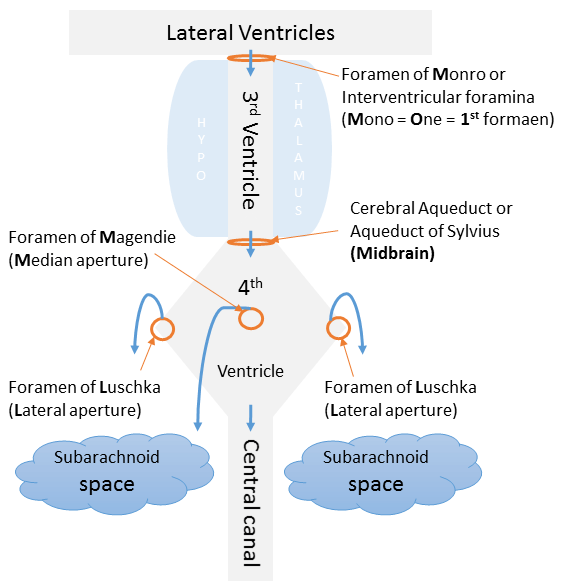
- CSF from the lateral ventricles passes through the interventricular foramina of Monro into the 3rd ventricle.
- CSF from the 3rd ventricle passes through the cerebral aqueduct into the 4th ventricle.
- 4th ventricle is continuous with the spinal canal which progressively obliterates by the 2nd decade.
- CSF from the 4th ventricle passes through the 2 lateral (foramen of Luschka) and 1 middle (formane of Magendie) into the subarachnoid space.
Functions of CSF
- Cushion of the brain
- Transports hormones and hormone releasing factors
- Removes metabolic waste products through absorption
Clinical Relevance
CSF composition in meningitis

Hydrocephalus
Choroid plexus papilloma = Overproduction of CSF = Communicating hydrocephalus
Arachnoid granulations adhesions (post-meningitis) = Decreased CSF absorption = Communicating hydrocephalus
Obstruction at foramen of monro or cerebral aqueduct or formane of Magendie or Luschka = Non-communicating hydrocephalus
CSF not absorbed by arachnoid villi = Chronic dilation of ventricles and normal CSF pressure = Normal pressure hydrocephalus
- Wet: Urinary incontinence
- Wobbly: Apraxic gait
- Wacky: Dementia
Brain atrophy = Increased CSF = Hydrocephalus Ex-vacuo
- Stroke
- Alzheimer’s disease
- Advanced HIV
- Trauma
Pseudotumor Cerebri (Benign Intracranial Hypertension)
- Due to increased resistance to CSF at arachnoid villi
- Occurs in obese young women
- Papilledema without mass, elevated CSF pressure, deteriorating vision

He is the section editor of Orthopedics in Epomedicine. He searches for and share simpler ways to make complicated medical topics simple. He also loves writing poetry, listening and playing music. He is currently pursuing Fellowship in Hip, Pelvi-acetabulum and Arthroplasty at B&B Hospital.