Skip to content
Epomedicine

Mnemonics, Simplified Concepts & Thoughts

Epomedicine

Mnemonics, Simplified Concepts & Thoughts

Bile duct injuries – Mnemonic

Epomedicine, Aug 28, 2023Aug 28, 2023

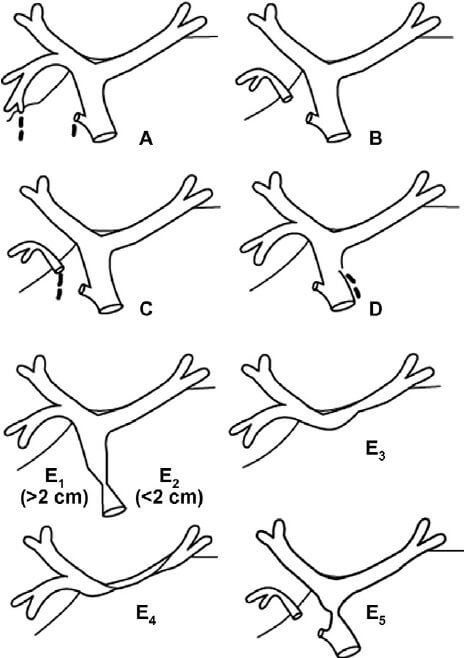
Strasberg and Bismuth classification

A – bile leak from part ATTACHED to biliary tree (cystic duct or duct of Luschka)

B – BLOCK in part of biliary tree

C – bile leak from CUT-OFF duct (not in communication) with the biliary tree

D – DEFECT (<50%) in common hepatic duct

E – ENTIRE circumference (100%) injury to common hepatic duct (sub-classified using Bismuth classification from E1 to E4 with strictures moving proximally towards confluence; E5 is a separate entity)

  • E1 – >2 cm distal to hepatic duct confluence
  • E2 – <2 cm distal to hepatic duct confluence
  • E3 – hilar stricture with intact confluence
  • E4 – hilar stricture with involvement of confluence
  • E5 – strictures involving right aberrant sectoral duct and common hepatic duct
strasberg bismuth classification
(PDF) Is There a Role for Endoscopic Therapy as a Definitive Treatment for Post-Laparoscopic Bile Duct Injuries? (researchgate.net)

Management

Strasberg typeManagement
A
– Without retained stoneERCP + Sphincterotomy + Stent
– With retained stoneERCP + Sphincterotomy + Removal of stone + Stent
B and CHepatico-jejunostomy
D
– Small injuryPrimary repair around stent
– Extensive injuryHepatico-jejunostomy
EHepatico-jejunostomy
  • Facebook
  • Twitter
PGMEE, MRCS, USMLE, MBBS, MD/MS Gastrointestinal systemGeneral Surgery

Post navigation

Previous post
Next post

Related Posts

PGMEE, MRCS, USMLE, MBBS, MD/MS

Blood Supply of Talus

Jun 9, 2020Jun 9, 2020

3 Main Arteries Extraosseous and intraosseous anastomoses formed by 3 main arteries: Posterior tibial artery ~ 17% contribution Anterior tibial (dorsalis pedis) artery ~ 36% contribution Perforating peroneal artery ~ 47% contribution Major Branches Tarsal sinus artery: Arises from – Dorsalis pedis artery (frequently) or Lateral tarsal artery (branch of…

Read More
PGMEE, MRCS, USMLE, MBBS, MD/MS

Inguinal Canal : Mnemonics

Jul 1, 2024Jul 1, 2024

Walls of Inguinal Canal Mnemonic: SALP 2 X MALT Starting from superior, moving counterclockwise in order to posterior: 1. Superior (Roof): 2 Muscles (Internal oblique, Transverse abdominus) 2. Anterior: 2 Aponeuroses (External abdominal oblique, Internal abdominal oblique) 3. Lower (Floor): 2 Ligaments (Lacunar and Inguinal) 4. Posterior: 2 T‘s (conjoint…

Read More
PGMEE, MRCS, USMLE, MBBS, MD/MS

Spinal segments vs Vertebral level

Aug 9, 2023Aug 9, 2023

Spinal segment: The part of spinal cord to which a pair of spinal nerves (right and left) is attached. Cause of mismatch between spinal segments and vertebral level: General rule: Vertebral level Add Spinal segment Cervical + 0 Same C7-T1 C8 T1-T3 +1 T1-T4 T3-T6 +2 T5-T8 T7-T8 +3 T9-T11…

Read More

Comments (2)

  1. Ajay Shanker verma says:
    Oct 15, 2023 at 11:14 am

    Awesome

    Reply
  2. Koch says:
    May 28, 2024 at 9:01 am

    Thank you!

    Reply

Leave a Reply to Koch Cancel reply

Your email address will not be published. Required fields are marked *

This site uses Akismet to reduce spam. Learn how your comment data is processed.

Epomedicine. Bile duct injuries – Mnemonic [Internet]. Epomedicine; 2023 Aug 28 [cited 2025 Dec 19]. Available from: https://epomedicine.com/medical-students/bile-duct-injuries-mnemonic/.

Pre-clinical (Basic Sciences)

Anatomy

Biochemistry

Community medicine (PSM)

Embryology

Microbiology

Pathology

Pharmacology

Physiology

Clinical Sciences

Anesthesia

Dermatology

Emergency medicine

Forensic

Internal medicine

Gynecology & Obstetrics

Oncology

Ophthalmology

Orthopedics

Otorhinolaryngology (ENT)

Pediatrics

Psychiatry

Radiology

Surgery

RSS Ask Epomedicine

  • What to study for Clinical examination in Orthopedics?
  • What is the mechanism of AVNRT?

Epomedicine weekly

  • About Epomedicine
  • Contact Us
  • Author Guidelines
  • Submit Article
  • Editorial Board
  • USMLE
  • MRCS
  • Thesis
©2025 Epomedicine . All rights reserved.