Skip to content
Epomedicine

Mnemonics, Simplified Concepts & Thoughts

Epomedicine

Mnemonics, Simplified Concepts & Thoughts

Ulnar styloid impaction syndrome

Epomedicine, Apr 8, 2025Apr 8, 2025

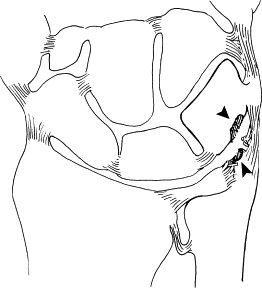
Definition: Impaction of triquetrum against the ulnar styloid causing chondromalacia, synovitis and ulnar-sided wrist pain

Pathology:

  • Normal anatomy: Meniscus homologue will be interposed between tip of ulnar styloid and triquetrum
  • Ulnar styloid impaction syndrome:
    • Early: Soft tissue erosion
    • Late: Contact of ulnar styloid tip with triquetrum resulting in degeneration

Etiology:

  1. Reduced stylo-triquetral distance (bringing styloid to triquetrum or brining triquetrum to ulnar styloid)
  2. Dynamic styloid prominence based on ligamentous laxity, instability or loading activities
  3. Combination of both
ulnar styloid impaction syndrome

Clinical features:

1. Asymptomatic

2. Ulnar-sided wrist pain, aggravated by wrist extension and specific positioning (having hands on hip or back pockets)

3. Potential history of trauma to distal radius or ulna, surgery to carpus, generalized ligamentous laxity or other features suggestive of a disturbance to normal wrist mechanics at the lunotriquetral interval

4. Examination:

  • Point tenderness over ulnar styloid tip
  • Ruby’s ulnar styloid provocation test: This is performed with patient’s elbow resting on the examiner’s table and the forearm initially in neutral rotation. The dorsiflexed wrist is rotated into full supination decreasing the distance between the styloid process and triquetrum and also makes ulnar variance negative (differentiating from ulno-carpal impaction of the ulnar head against lunate). Reproduction of pain with the maneuver is considered as positive provocation.

Diagnosis:

Long ulnar styloid radiographically + Ruby’s ulnar styloid provocation test

Standard PA X-ray:

  • Ulnar styloid process >6 mm
  • Ulnar styloid process index (USPI) >0.21 ± 0.07
    • The USPI is defined as (styloid length − ulnar variance)/width of the ulnar head.
  • Ulnar styloid capitate ratio (SCR) >0.18 ± 0.05 (stronger correlation than USPI)
  • Degenerative changes including cystic changes in the triquetrum and distal ulna in early stages before degenerative ulnar-sided progression ensues

Dynamic fluoroscopic assessment and 3D CT: used to confirm impingement

MRI (for late stage): focal subchondral sclerosis and chondromalacia of styloid tip as well as proximal triquetral chondromalacia

Treatment:

1. Non-operative:

  • Wrist splinting
  • Activity modification
  • Analgesia +/- Steroid injection

2. Operative:

  • Partial ulnar styloid resection (open or arthroscopic) – preserving TFCC attached to the base of styloid
  • Co-existing ulnar head impaction: Ulnar shortening procedure
  • Facebook
  • Twitter
PGMEE, MRCS, USMLE, MBBS, MD/MS Orthopedics

Post navigation

Previous post
Next post

Related Posts

PGMEE, MRCS, USMLE, MBBS, MD/MS

Perkin’s Timetable for Fracture Healing

Oct 19, 2022

One needs to understand the difference between bone union and consolidation first Union Consolidation Definition Partial/Incomplete repair Full/Complete repair Callus Calcified Ossified Attempted angulation Painful Painless Fracture line in X-ray Still visible Obliterated and crossed by bony trabeculae Full weight bearing Cannot be undertaken Can be undertaken Reference: Physiotherapy in…

Read More
PGMEE, MRCS, USMLE, MBBS, MD/MS

Simplified Guide to Statin Therapy

Aug 15, 2019Aug 15, 2019

Statins Equivalent Dose Mnemonic: PRASLPF 2-5-10-20-40-40-80 Pituvastatin 2 mg Rosuvastatin 5 mg Atorvastatin 10 mg Simvastatin 20 mg Lovastatin 40 mg Pravastatin 40 mg Fluvastatin 80 mg Intensity of Statins a. High intensity (LDL lowering >/= 50%) Atorvastatin 40-80 mg Rosuvastatin 20-40 mg b. Moderate intenstity (LDL lowering 30-49%) Atorvastatin…

Read More
PGMEE, MRCS, USMLE, MBBS, MD/MS sleep eeg

Sleep Stages and EEG : Mnemonic

Jul 2, 2018

Mnemonic: BATS Drink Blood – in sleep 1. Awake with eyes open: Beta wave (highest frequency and lowest amplitude) 2. Awake with eyes closed: Alpha wave (synchronized brain activity) 3. NREM/Slow wave/Orthodox sleep (70-80%): Stage 1 (light sleep): Theta waves Stage 2 (intermediate): Sleep spindles and K-complex Stage 3 and…

Read More

Leave a Reply Cancel reply

Your email address will not be published. Required fields are marked *

This site uses Akismet to reduce spam. Learn how your comment data is processed.

Epomedicine. Ulnar styloid impaction syndrome [Internet]. Epomedicine; 2025 Apr 8 [cited 2026 Aug 9]. Available from: https://epomedicine.com/medical-students/ulnar-styloid-impaction-syndrome/.

Pre-clinical (Basic Sciences)

Anatomy

Biochemistry

Community medicine (PSM)

Embryology

Microbiology

Pathology

Pharmacology

Physiology

Clinical Sciences

Anesthesia

Dermatology

Emergency medicine

Forensic

Internal medicine

Gynecology & Obstetrics

Oncology

Ophthalmology

Orthopedics

Otorhinolaryngology (ENT)

Pediatrics

Psychiatry

Radiology

Surgery

RSS Ask Epomedicine

  • What to study for Clinical examination in Orthopedics?
  • What is the mechanism of AVNRT?

Epomedicine weekly

  • About Epomedicine
  • Contact Us
  • Author Guidelines
  • Submit Article
  • Editorial Board
  • USMLE
  • MRCS
  • Thesis
©2026 Epomedicine | WordPress Theme by SuperbThemes