Skip to content
Epomedicine

Mnemonics, Simplified Concepts & Thoughts

Epomedicine

Mnemonics, Simplified Concepts & Thoughts

Femoral Hernia : Mnemonic

Epomedicine, Aug 27, 2023Aug 27, 2023

Mnemonic: FEMORAL

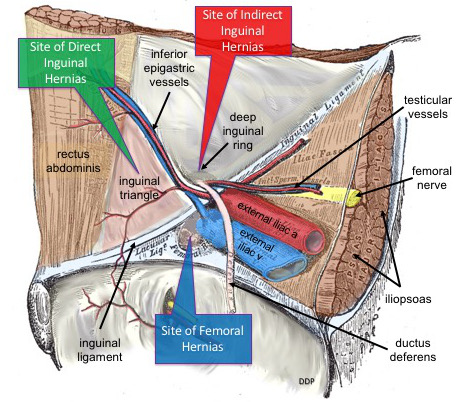
hernia sites
Dennis M. DePace, PhD, CC BY-SA 4.0, via Wikimedia Commons

Females (4 times more common)

  • Women are always right (more common on right side)

Elderly

McEvedey operation (incision above inguinal ligament – preferred in emergency intervention due to easy access to compromised bowel for any resection if required)

Obstruction/incarceration/strangulation risk is higher (rigid walls of femoral ring)

  • 3 months risk of strangulation = 22%
  • 21 months risk of strangulation = 45%

Richter’s hernia – most common location

Above inguinal ligament – lump can present above inguinal ligament (confusing with inguinal hernia)

  • But neck of hernia is always below and lateral to pubic tubercle

Lotheissen operation (inguinal approach)

Lockwood operation (incision below inguinal ligament)

Laparoscopic approach

Further reading:
https://twitter.com/santalum_aurum/status/1349024900275728392
  • Facebook
  • Twitter
PGMEE, MRCS, USMLE, MBBS, MD/MS Gastrointestinal systemGeneral Surgery

Post navigation

Previous post
Next post

Related Posts

PGMEE, MRCS, USMLE, MBBS, MD/MS

Pregabalin : Pharmacology

Dec 5, 2021Dec 5, 2021

Pharmacokinetics After oral ingestion, Pregabalin is rapidly absorbed (Tmax 1.3 hr) Bioavailability is >90% and independent of dose Pregabalin is NOT protein bound Vd is 0.4 L/kg Serum pregabalin concentrations are linearly related to dosage Pregabalin is NOT metabolized Pregabalin is primarily excreted unchanged in urine (98%) with a clearance…

Read More
PGMEE, MRCS, USMLE, MBBS, MD/MS trinucleotide repeat disorders

Trinucleotide Repeat Disorders and Anticipation Mnemonics

Jan 23, 2017Jan 25, 2017

Anticipation in genetics refers to an increase in severity and decrease in age of onset in successive generations, most likely due to increased size of trinucleotide repeats. Paternal anticipation: Huntington’s disease, Friedreich’s Ataxia Maternal anticipation: Myotonic dystrophy, Fragile X syndrome Diseases Trinucleotide Repeat Affected gene Chromosome Fragile X syndrome CGG…

Read More
PGMEE, MRCS, USMLE, MBBS, MD/MS myeloid differentiation aml

Concept of Acute Myeloid Leukemia (AML) FAB Classification

Aug 23, 2016Mar 10, 2018

There is no need of mnemonics to remember the FAB classification of Acute Myeloid Leukemia (AML); just remember the process myeloid differentiation. A simple schematic diagram with few intermediate processes and stimulating factors eliminated will meet our purpose here. The cells belonging to the myeloid lineage are: Granulocytes: Neutrophils, Eosinophils…

Read More

Leave a Reply Cancel reply

Your email address will not be published. Required fields are marked *

This site uses Akismet to reduce spam. Learn how your comment data is processed.

Pre-clinical (Basic Sciences)

Anatomy

Biochemistry

Community medicine (PSM)

Embryology

Microbiology

Pathology

Pharmacology

Physiology

Clinical Sciences

Anesthesia

Dermatology

Emergency medicine

Forensic

Internal medicine

Gynecology & Obstetrics

Oncology

Ophthalmology

Orthopedics

Otorhinolaryngology (ENT)

Pediatrics

Psychiatry

Radiology

Surgery

RSS Ask Epomedicine

  • What to study for Clinical examination in Orthopedics?
  • What is the mechanism of AVNRT?

Epomedicine weekly

  • About Epomedicine
  • Contact Us
  • Author Guidelines
  • Submit Article
  • Editorial Board
  • USMLE
  • MRCS
  • Thesis
©2026 Epomedicine | WordPress Theme by SuperbThemes