Skip to content
Epomedicine

Mnemonics, Simplified Concepts & Thoughts

Epomedicine

Mnemonics, Simplified Concepts & Thoughts

Bile duct injuries – Mnemonic

Epomedicine, Aug 28, 2023Aug 28, 2023

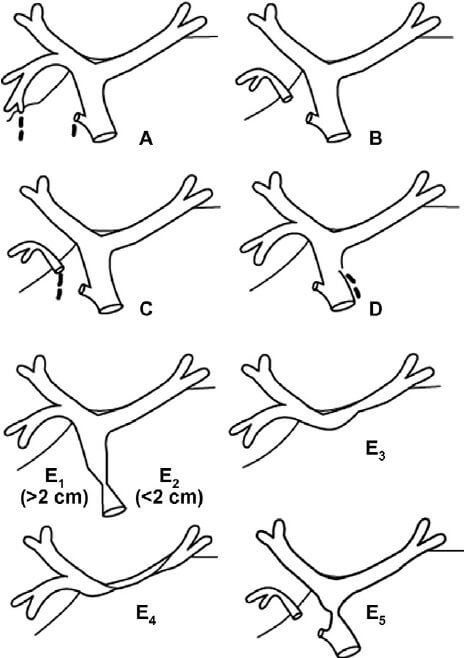
Strasberg and Bismuth classification

A – bile leak from part ATTACHED to biliary tree (cystic duct or duct of Luschka)

B – BLOCK in part of biliary tree

C – bile leak from CUT-OFF duct (not in communication) with the biliary tree

D – DEFECT (<50%) in common hepatic duct

E – ENTIRE circumference (100%) injury to common hepatic duct (sub-classified using Bismuth classification from E1 to E4 with strictures moving proximally towards confluence; E5 is a separate entity)

  • E1 – >2 cm distal to hepatic duct confluence
  • E2 – <2 cm distal to hepatic duct confluence
  • E3 – hilar stricture with intact confluence
  • E4 – hilar stricture with involvement of confluence
  • E5 – strictures involving right aberrant sectoral duct and common hepatic duct
strasberg bismuth classification
(PDF) Is There a Role for Endoscopic Therapy as a Definitive Treatment for Post-Laparoscopic Bile Duct Injuries? (researchgate.net)

Management

Strasberg typeManagement
A
– Without retained stoneERCP + Sphincterotomy + Stent
– With retained stoneERCP + Sphincterotomy + Removal of stone + Stent
B and CHepatico-jejunostomy
D
– Small injuryPrimary repair around stent
– Extensive injuryHepatico-jejunostomy
EHepatico-jejunostomy
  • Facebook
  • Twitter
PGMEE, MRCS, USMLE, MBBS, MD/MS Gastrointestinal systemGeneral Surgery

Post navigation

Previous post
Next post

Related Posts

PGMEE, MRCS, USMLE, MBBS, MD/MS breast cancer genes

Breast Cancer Risk Factors with Mnemonics

Jul 16, 2016Aug 18, 2023

EPIDEMIOLOGY OF BREAST CANCER Incidence: In general, less industrialized nations tend to have lower rates of breast cancer, with Japan being an exception to this rule. The highest rates are seen in Europe and North America. Age at onset: Race: incidence is higher among white women than African- American woman, but the mortality is higher…

Read More
PGMEE, MRCS, USMLE, MBBS, MD/MS

Sarcomere Structure : Mnemonic

Feb 2, 2019Feb 27, 2026

Remember the sequence: Zahir Is A Hungry Man Z is the final alphabet: Z lines represents the end of sarcomere M for middle: M line represents the midline of sarcomere I is a thin letter: I band has only thin filaments H is a thick letter: H zone has only…

Read More

Pathology Spotters: Instruments

Nov 14, 2013

Pathology Spotter Series: Instruments Level: Undergraduate (MBBS) A) Spotter 1: Instrument: Paraffin Block Use: Tissue embedding – After adding fixative, biopsies are embedded in paraffin/wax to support the tissue so that thin sections or slices can be cut and placed on a microscope slide. B) Spotter 2: Instrument: Lumbar Puncture…

Read More

Comments (2)

  1. Ajay Shanker verma says:
    Oct 15, 2023 at 11:14 am

    Awesome

    Reply
  2. Koch says:
    May 28, 2024 at 9:01 am

    Thank you!

    Reply

Leave a Reply Cancel reply

Your email address will not be published. Required fields are marked *

This site uses Akismet to reduce spam. Learn how your comment data is processed.

Pre-clinical (Basic Sciences)

Anatomy

Biochemistry

Community medicine (PSM)

Embryology

Microbiology

Pathology

Pharmacology

Physiology

Clinical Sciences

Anesthesia

Dermatology

Emergency medicine

Forensic

Internal medicine

Gynecology & Obstetrics

Oncology

Ophthalmology

Orthopedics

Otorhinolaryngology (ENT)

Pediatrics

Psychiatry

Radiology

Surgery

RSS Ask Epomedicine

  • What to study for Clinical examination in Orthopedics?
  • What is the mechanism of AVNRT?

Epomedicine weekly

  • About Epomedicine
  • Contact Us
  • Author Guidelines
  • Submit Article
  • Editorial Board
  • USMLE
  • MRCS
  • Thesis
©2026 Epomedicine | WordPress Theme by SuperbThemes