Skip to content
Epomedicine

Mnemonics, Simplified Concepts & Thoughts

Epomedicine

Mnemonics, Simplified Concepts & Thoughts

Bile duct injuries – Mnemonic

Epomedicine, Aug 28, 2023Aug 28, 2023

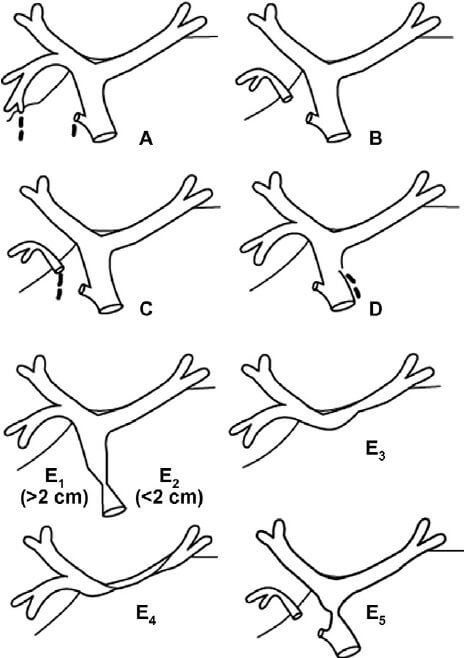
Strasberg and Bismuth classification

A – bile leak from part ATTACHED to biliary tree (cystic duct or duct of Luschka)

B – BLOCK in part of biliary tree

C – bile leak from CUT-OFF duct (not in communication) with the biliary tree

D – DEFECT (<50%) in common hepatic duct

E – ENTIRE circumference (100%) injury to common hepatic duct (sub-classified using Bismuth classification from E1 to E4 with strictures moving proximally towards confluence; E5 is a separate entity)

  • E1 – >2 cm distal to hepatic duct confluence
  • E2 – <2 cm distal to hepatic duct confluence
  • E3 – hilar stricture with intact confluence
  • E4 – hilar stricture with involvement of confluence
  • E5 – strictures involving right aberrant sectoral duct and common hepatic duct
strasberg bismuth classification
(PDF) Is There a Role for Endoscopic Therapy as a Definitive Treatment for Post-Laparoscopic Bile Duct Injuries? (researchgate.net)

Management

Strasberg typeManagement
A
– Without retained stoneERCP + Sphincterotomy + Stent
– With retained stoneERCP + Sphincterotomy + Removal of stone + Stent
B and CHepatico-jejunostomy
D
– Small injuryPrimary repair around stent
– Extensive injuryHepatico-jejunostomy
EHepatico-jejunostomy
  • Facebook
  • Twitter
PGMEE, MRCS, USMLE, MBBS, MD/MS Gastrointestinal systemGeneral Surgery

Post navigation

Previous post
Next post

Related Posts

PGMEE, MRCS, USMLE, MBBS, MD/MS

Acute Stroke Management : Mnemonic Approach

Aug 28, 2019Aug 28, 2019

Mnemonic: BRAIN ATTACK a. Blood pressure: Antihypertensives are recommended only in following conditions: SBP >220 mmHg, DBP >120 mmHg or MAP >130 mmHg (Target SBP reduction by 15% in 1st 24 hours) End organ damage: Acute MI, Aortic dissection, Hypertensive encephalopathy, Severe left ventricular failure Candidates for thrombolysis: SBP >185…

Read More
PGMEE, MRCS, USMLE, MBBS, MD/MS palatogenesis

Face and Palate Development – Embryology made Easy

Aug 7, 2016Aug 7, 2016

4 week embryo 5 mesenchymal prominences (facial primordia) appear in relation to the stomodeum (a depression in the surface ectoderm which marks the future mouth and oral cavity): Cranially: Frontonasal prominence (unpaired) Laterally: Maxillary prominence (paired; 1st pharyngeal arch) Caudally: Mandibular prominence (paired; 1st pharyngeal arch) 5 week embryo Localized…

Read More
PGMEE, MRCS, USMLE, MBBS, MD/MS coombs test

Coomb’s test : Mnemonic

May 23, 2019May 23, 2019

Components of Coomb’s test: Mnemonic: ABCD A: Antibody (to be detected) B: Blood antigen (RBC) C: Coomb’s reagent (Anti-antibody) D: Detect agglutination Direct Coomb’s/Antiglobulin test (DAT or DCT): Mnemonic: In DAT/DCT we take A+B from patient and add C [(A+B) + C] Another Mnemonic: DCBA (Direct Coomb’s detect Blood Bound…

Read More

Comments (2)

  1. Ajay Shanker verma says:
    Oct 15, 2023 at 11:14 am

    Awesome

    Reply
  2. Koch says:
    May 28, 2024 at 9:01 am

    Thank you!

    Reply

Leave a Reply to Ajay Shanker verma Cancel reply

Your email address will not be published. Required fields are marked *

This site uses Akismet to reduce spam. Learn how your comment data is processed.

Epomedicine. Bile duct injuries – Mnemonic [Internet]. Epomedicine; 2023 Aug 28 [cited 2025 Dec 19]. Available from: https://epomedicine.com/medical-students/bile-duct-injuries-mnemonic/.

Pre-clinical (Basic Sciences)

Anatomy

Biochemistry

Community medicine (PSM)

Embryology

Microbiology

Pathology

Pharmacology

Physiology

Clinical Sciences

Anesthesia

Dermatology

Emergency medicine

Forensic

Internal medicine

Gynecology & Obstetrics

Oncology

Ophthalmology

Orthopedics

Otorhinolaryngology (ENT)

Pediatrics

Psychiatry

Radiology

Surgery

RSS Ask Epomedicine

  • What to study for Clinical examination in Orthopedics?
  • What is the mechanism of AVNRT?

Epomedicine weekly

  • About Epomedicine
  • Contact Us
  • Author Guidelines
  • Submit Article
  • Editorial Board
  • USMLE
  • MRCS
  • Thesis
©2025 Epomedicine . All rights reserved.