
Milkmaid’s Grip Milk maids grip is appreciated as an alternating squeezing and releasing of the finger like a milking motion, when asked to maintain a constant, firm grip of examiner’s fingers. This may reflect a combination of Chorea and Motor impersistence. As a result of poor grip, patients often involuntarily…
Tag: Nervous system
PGMEE, MRCS, USMLE, MBBS, MD/MS
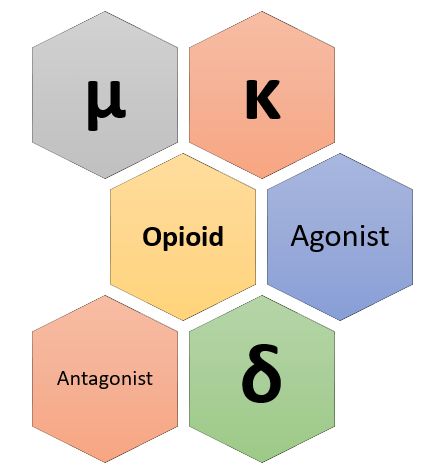
Opioid Receptors Mnemonic
Opioid receptors are a group of inhibitory G protein-coupled receptors with opioids as ligands. Mu (µ) Receptor (MOP) Mnemonic: MU CARDS Miosis eUphoria Constipation Analgesia (Supraspinal + Spinal) Respiratory depression Rigidity (truncal) Dependency Sedation µ1 mediates supraspinal analgesia, and most of other effects including spinal analgesia is mediated by µ2. Kappa…
PGMEE, MRCS, USMLE, MBBS, MD/MS
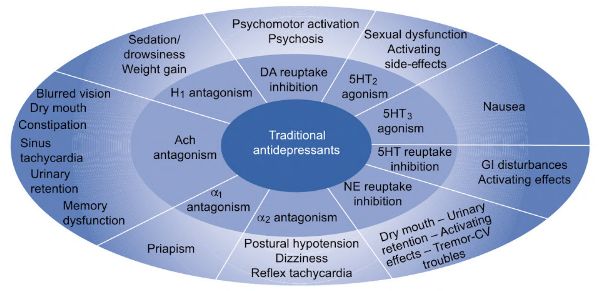
Antidepressants Made Easy
Tricyclic Antidepressants (TCA) Mnemonic: -pramine, -triptyline, -pin Secondary amines: predominantly norepinephrine reuptake inhibitors Nor-triptyline Desi-pramine Tertiary amines: Ami-triptyline Imi-pramine Clomi-pramine Doxe-pin Irreversible MAO Inhibitors Mnemonic: TIPS Non-selective MAO inhibitors: Tranylcypromine Isocarboxazid Phenelzine Selective MAO-B inhibitor: Selegiline (transdermal patch) Reversible Inhibitor of MAO-A (RIMA) Moclobemide Tolaxatone Tetracyclic Antidepressants Nonselective inhibitor of…
PGMEE, MRCS, USMLE, MBBS, MD/MS

Depression Criteria Mnemonic
Mnemonic: DEPRESSION Major symptoms Minor symptoms Alternative mnemonic: SIGECAPS Criteria for Major Depressive Disorder Grading of Depression Unlike in the ICD-10, grading of depression into mild, moderate and severe is not based on the sum of the symptoms, but also takes into account their intensity and the degree of functional…
PGMEE, MRCS, USMLE, MBBS, MD/MS
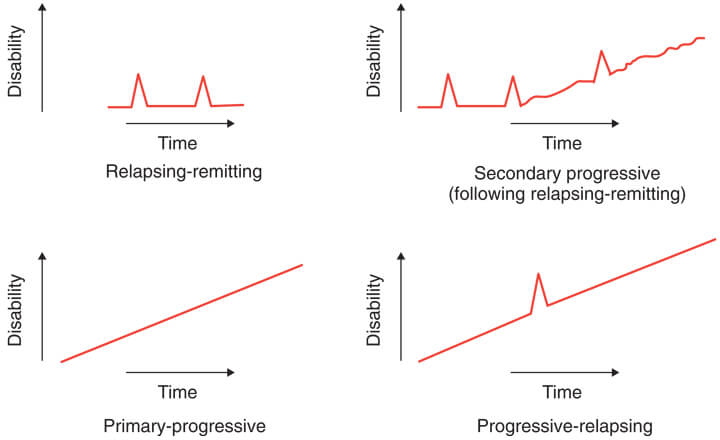
Multiple Sclerosis Mnemonic
Multiple sclerosis is an autoimmune disease of white matter that occurs due to interaction of genetic factors with unknown environmental factors. It is characterized by the pathological triad of inflammation, demyelination and gliosis. It is diagnosed using McDonald’s criteria. My mnemonic for clinical features and treatment of multiple sclerosis is:…
PGMEE, MRCS, USMLE, MBBS, MD/MS
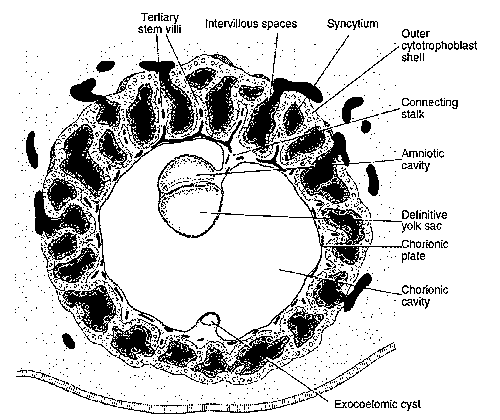
Embryology Week 3: Trimalinar Germ Disc
In the Week 2, we had a bilaminar germ disc with 2 cavities (amniotic cavity and yolk sac) suspended in the chorionic (extraembryonic cavity) by a connecting stalk (future umbilical cord). In the 3rd week, the embryo will have 3 germ layers (ectoderm, mesoderm and endoderm) following a process called…
PGMEE, MRCS, USMLE, MBBS, MD/MS
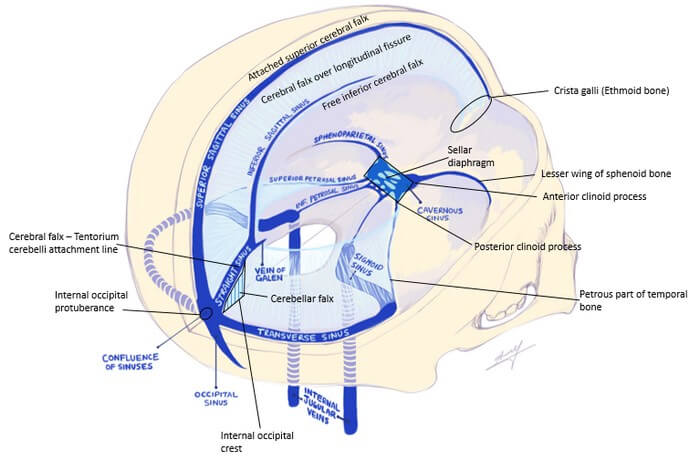
Dural Reflections and Venous Sinuses
Dura mater (pachymenix) is the outer meningeal layer consisting of: Dural Reflections These are the infoldings formed by the inner meningeal layer reflecting away from the fixed periosteral dural layer. Two vertical reflections – Separate the right and left hemisphere Two horizontal reflections Dural Venous Sinuses 1. Superior sagittal sinus:…
PGMEE, MRCS, USMLE, MBBS, MD/MS
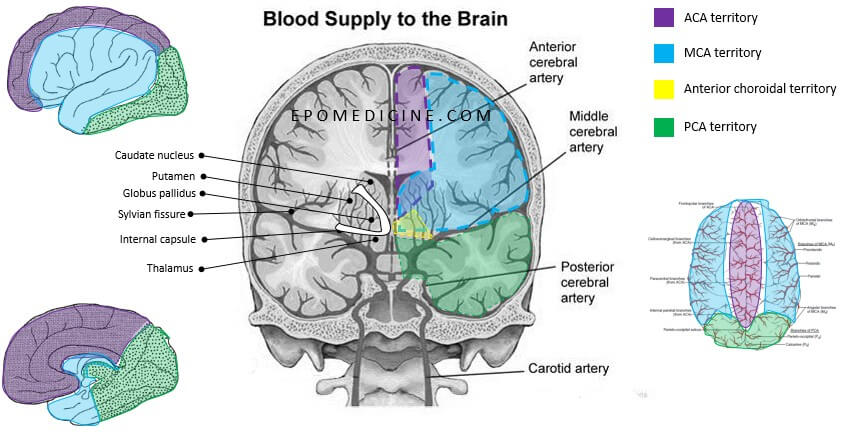
Circle of Willis and Forebrain Blood Supply
We have already discussed earlier on the intracranial course of Internal Carotid Artery (ICA) and Circle of Willis formation with the help of a simple mnemonic. General Concepts of Blood Supply of Brain and Spinal Cord 1. Spinal cord, Hind-brain and Mid-brain: Veterbro-basilar system 2. Forebrain: Circle of willis which…